BULANDSHAHR, INDIA — As fuel supply disruptions ripple through parts of India, rural households are increasingly turning to biogas systems that convert farm waste into cooking fuel, offering a locally produced alternative at a time when liquefied petroleum gas (LPG) access has become unpredictable.
In Nekpur village, located in Uttar Pradesh’s Bulandshahr district, 25-year-old Gauri Devi cooks daily meals over a steady blue flame powered not by a gas cylinder, but by methane produced from cow dung. While long queues for LPG refills have become common in nearby towns, her kitchen remains largely unaffected.
“It cooks everything — vegetables, tea, lentils,” she said, explaining that if pressure drops, the system simply needs a short rest before resuming. “We only keep an LPG cylinder for emergencies.”
India consumes more than 30 million tonnes of LPG annually, importing over half of its requirement. Although authorities maintain there is no nationwide shortage, delays in distribution, panic buying and black-market resale have led to prolonged waits for refills in several regions, particularly following recent global energy market disruptions linked to conflict in the Middle East.
A decades-old solution gaining new urgency
Biogas is not new to rural India. Since the 1980s, government programmes have subsidised over five million household digesters, designed to convert animal waste into combustible methane and nutrient-rich slurry for fertiliser.
At Gauri Devi’s home, the system consists of an underground tank roughly the size of a small car. Each morning, cow dung is mixed with water and fed into the digester, producing gas that is piped directly to the stove.
Also read: Pakistan’s Population Boom Fuels Climate Crisis, Pollution and Urban Collapse
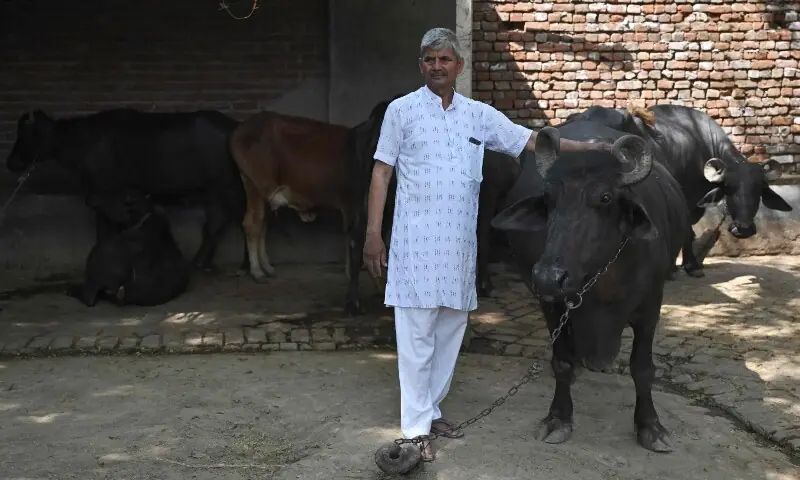
For farmers like Pramod Singh, who installed a larger unit in 2025 capable of serving a six-member household, the benefits go beyond cooking fuel.
“The gas is useful, but the real value is the slurry,” he said, noting that it improves soil quality and reduces dependence on costly chemical fertilisers, whose global supply has been affected by trade disruptions.
Local farmer leader Pritam Singh calls the by-product “black gold,” adding that interest in biogas has surged as LPG queues lengthen. “People who were never interested now come to ask how to install it,” he said. “Once they see food cooking and crops improving, they are convinced.”
Climate goals and practical limits
India, the world’s most populous nation and third-largest emitter of fossil-fuel pollution, has positioned biogas as part of its strategy to reach carbon neutrality by 2070. New rules require biogas blending in domestic and transport fuel, starting at one percent and rising to five percent by 2028. Several large-scale production plants are under development, alongside subsidised household units costing approximately INR25,000–30,000 ($265–$318).
Yet adoption remains uneven. According to A.R. Shukla, president of the Indian Biogas Association, small digesters require regular maintenance and space — resources not all households possess.
Also read: Jet Fuel Supply Crisis May Last Months Despite Ceasefire: IATA
“Biogas plants are mini factories,” he said. “Without organised installation and community-level support, many families will continue to rely on LPG as their primary fuel.”
For landless labourers like Ramesh Kumar Singh, who spent hours waiting for a cylinder refill in a neighbouring village, biogas remains out of reach.
“We work on other people’s farms all day,” he said. “We don’t have land for this.”
Even so, as fuel uncertainty persists, rural biogas systems are emerging as a resilient, locally controlled energy source — quietly reshaping how villages cook, farm and cope with global shocks.
