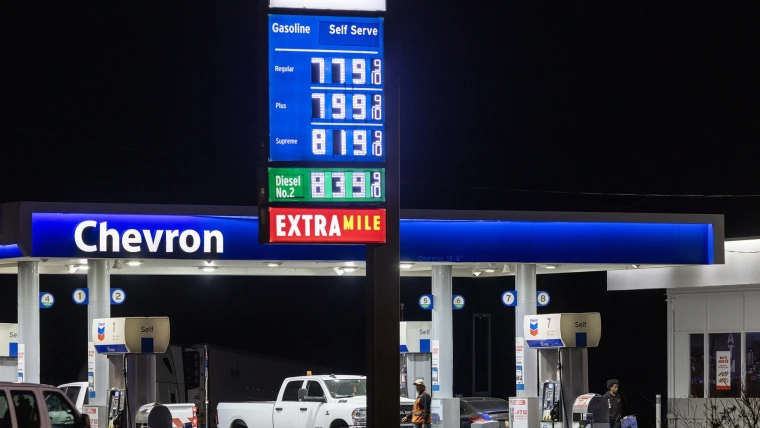
U.S. gasoline prices are climbing at their fastest pace in months as energy markets increasingly signal that the conflict involving Iran may drag on longer than political messaging suggests, keeping pressure on oil supply routes and consumer fuel costs.
The national average price for regular gasoline surged to $4.39 per gallon, marking the sharpest single-day increase since early March and pushing prices to a new wartime high. The jump followed a two-step rise late this week, first adding seven cents and then another nine cents overnight, according to industry tracking data. Since hostilities began, average pump prices are up more than 47 percent.
Oil markets remain on edge
Behind the spike is a sustained rally in crude oil. U.S. benchmark crude closed the week near $102 per barrel, while Brent crude ended around $108, extending year-to-date gains to roughly 80 percent.
Analysts say prices are being driven less by immediate supply shortages and more by growing uncertainty over shipping access in the Middle East.
That uncertainty intensified after Donald Trump said the United States intends to maintain a naval blockade affecting Iranian ports, enforced since April 13. Speaking at the White House, Trump argued that economic pressure would eventually force Tehran to negotiate, though he acknowledged receiving — and rejecting — a recent proposal from Iranian officials.
Also read: Biogas Cooking in India: How Rural Homes Cut LPG Dependence
“Now gasoline is high,” Trump said, adding that prices would fall once the conflict ends. However, many market analysts disagree, warning that oil prices often remain elevated even after active fighting subsides.
Strait of Hormuz risk looms large
Energy traders remain focused on the Strait of Hormuz, a narrow waterway through which roughly a fifth of the world’s oil supply passes. Iran has previously demonstrated its ability to disrupt traffic in the strait, a risk analysts say is now firmly priced into global markets.
Strategists at Citigroup warned that Brent crude could spike as high as $150 per barrel if shipping through the strait remains restricted into late June. Even a partial or delayed reopening, they said, would not immediately ease price pressures.
Political signals diverge from market behavior
While senior administration officials have suggested that hostilities have effectively ended for legal purposes, financial markets have shown little sign of relief. U.S. crude was on track for an 8 percent weekly gain, reflecting continued concern about supply stability rather than near-term diplomatic developments.
Congressional leaders are also divided. Some lawmakers have pushed for a vote under the War Powers Resolution as the conflict crossed the 60-day mark, while House Speaker Mike Johnson said congressional authorization is unnecessary because the United States is “not at war.”
Markets, however, appear unconvinced.
Energy executives warn of prolonged strain
Executives at major oil producers say the global energy system is operating under extreme stress. Chevron CEO Mike Wirth said that without restored supply flows, demand destruction across the economy may become unavoidable. Meanwhile, Exxon Mobil CEO Darren Woods said about 15 percent of the company’s oil output has been affected by the conflict.
Also read: Pak Faces LNG Crisis as Gulf War Disrupts Qatar Gas Supplies
Even if shipping routes reopen, Woods cautioned it could take two months for oil flows to normalize and additional time for fuel to reach end markets.
Consumers feel the impact
As prices rise, frustration is mounting among consumers, particularly in Midwestern states where gas prices have jumped by as much as $2 per gallon since the conflict began. Online forums and local communities are increasingly filled with complaints about affordability and uncertainty, underscoring how quickly geopolitical risk is translating into household costs.
Analysts at ING said markets are entering a critical phase, with traders bracing for renewed volatility if diplomacy stalls. “Hope is fading,” the firm warned, noting that any return to escalation would likely push oil prices even higher.
For now, fuel markets appear to be preparing not for a quick resolution, but for a prolonged period of instability — and drivers are paying the price at the pump.
