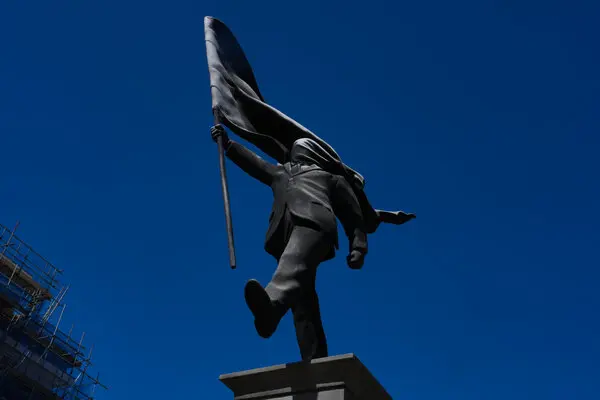
LONDON — Before most of the city woke up, a new sculpture had appeared in one of central London’s most closely watched ceremonial spaces, raising questions about how it was installed, who approved it, and what happens next.
The work, later claimed by Banksy, was placed on a plinth in Waterloo Place, a short distance from Pall Mall and St James’s Park. The sculpture depicts a suited male figure moving forward while a flag drapes across his face, blocking his vision.
Authorship was confirmed several hours after the installation, when Banksy posted a short video montage on Instagram. The footage offered brief glimpses of the overnight operation, showing a large vehicle arriving, traffic cones being positioned and a statue lifted into place using heavy equipment.
According to observers familiar with Banksy’s previous projects, the operation was likely planned well in advance. James Peak, host of The Banksy Story podcast, said installations of this scale typically involve reconnaissance, precise timing and a professional crew capable of working quickly in restricted areas.
Also read: Pakistanis offer Indians ‘Abhinandan tea’ at London protest
The location adds to the significance of the piece. Waterloo Place sits within a cluster of national memorials and historic statues, including monuments to Edward VII and Florence Nightingale. The area is also surrounded by government buildings, embassies and private members’ clubs, making it an unusual site for an unannounced public artwork.
Public reaction has been immediate. Crowds gathered throughout the day, and images of the sculpture circulated widely online. Many viewers praised the work’s symbolism, while others debated its political meaning. As with many of Banksy’s pieces, no official explanation accompanied the release, leaving interpretation open.
The installation was not authorised in advance. Westminster City Council confirmed it had not been notified before the sculpture was placed. Council workers later installed temporary barriers around the plinth while officials assessed safety and legal considerations.
In a statement, the council said it was reviewing the situation and had taken initial steps to protect the artwork while options were being considered. Officials said the sculpture would remain accessible to the public during the assessment period.
Also read: Sword of Tipu Sultan sold for ₹ 140 Crore at London auction
Banksy’s unsanctioned works have had varied outcomes in the past. Some have been removed within hours, others protected behind glass or preserved as cultural landmarks. Sculptural works have occasionally been stolen or relocated, though their size often complicates removal.
Art historians note that Banksy’s recent projects have increasingly moved beyond flat street murals into three-dimensional works placed in politically charged locations. These interventions often test the boundaries between public art, vandalism and civic authority.
For now, the sculpture remains in place, watched by passersby and guarded by temporary barriers. Whether it becomes a permanent fixture, is relocated, or quietly removed will depend on decisions still pending from local authorities. As in many previous cases, the artwork’s impact may outlast its physical presence.
