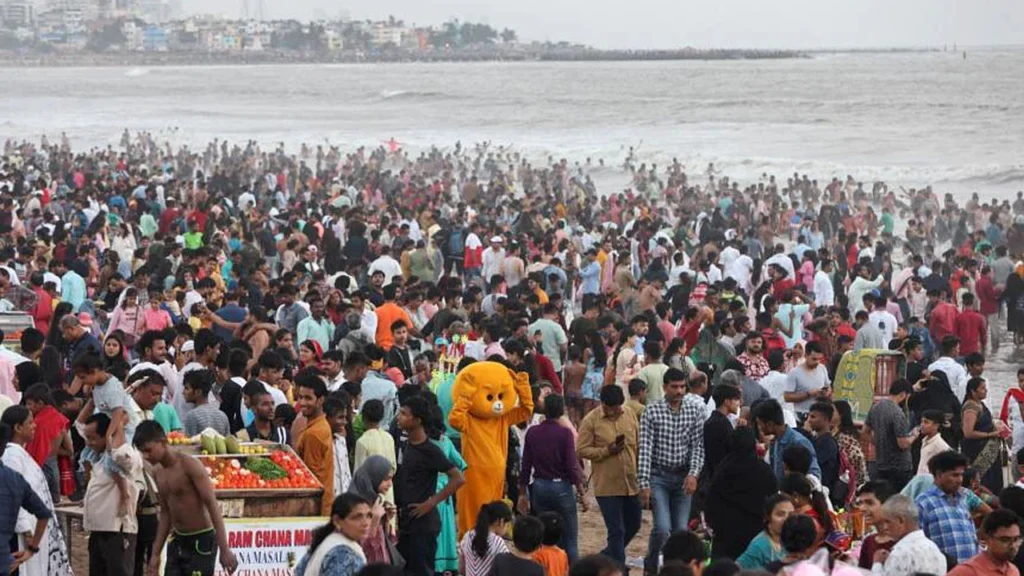
Pakistan’s rapidly expanding population is increasingly being viewed not just as a demographic challenge but as a driving force behind climate stress, environmental degradation, urban overcrowding and a deepening public health crisis, experts warn.
With the country’s population now exceeding 240 million and growing by several million each year, demand for housing, transport, energy, food and infrastructure has surged to levels that are straining already fragile systems. Analysts say this pressure is accelerating pollution, carbon emissions and resource depletion across the country.
Environmental specialists note that population growth is intensifying activity in high-emission sectors. The energy sector alone accounts for roughly 40% of Pakistan’s total greenhouse gas emissions, while agriculture contributes about 25% and transport nearly 20%.
Also read: Will Japan disappear? 5 points on country’s population crisis
As the population grows, emissions from all three sectors continue to climb, compounding the country’s vulnerability to climate change.
Urban expansion fuels heat and deforestation
Rapid urbanisation driven by population growth has triggered widespread housing expansion, often at the expense of green spaces. Trees are being cleared to make way for residential schemes, roads and commercial development, reducing natural cooling and pushing temperatures higher.
Urban planners warn that many Pakistani cities are now experiencing the “urban heat island” effect, where dense construction and limited vegetation cause urban areas to become significantly hotter than surrounding rural regions. This has led to more intense heatwaves, rising electricity demand and mounting pressure on power supplies.
Air pollution emerges as a major health threat
The environmental fallout is increasingly translating into serious health risks. According to the World Health Organization, prolonged exposure to air pollution is linked to heart disease, stroke, lung cancer, asthma and other respiratory illnesses.
Health experts caution that without sustainable population management and urban planning, Pakistan’s healthcare system could face overwhelming demand as pollution-related illnesses rise.
Population could double by mid-century
Minister of State for National Health Mukhtar Ahmed Bharath has warned that Pakistan’s population could approach 500 million by 2050 if current trends continue. Speaking to local media, he described unchecked population growth as the root cause of multiple national challenges.
He noted that Pakistan is already the world’s fifth-most populous country, with around six million children born each year. According to Dr Bharath, inadequate spacing between births is affecting maternal health, child nutrition and overall family wellbeing, contributing to issues such as child stunting.
He cautioned that as the population expands rapidly, available resources will shrink in proportion, making it increasingly difficult to meet basic needs.
Cities under mounting strain
Urban centres have borne the brunt of population pressure over the past two decades. Dr Bharath pointed to Islamabad, where the population has reportedly surged from about 400,000 to nearly four million, creating serious challenges for service delivery and administration.
Also read: What are the 4 reasons for China’s population shrinkage?
Major cities such as Lahore and Karachi have also expanded far beyond planned limits, complicating governance and infrastructure management.
To ease urban congestion, the minister said the Punjab government under Chief Minister Maryam Nawaz is prioritising rural development by improving basic facilities in villages, with the aim of slowing migration to cities. He urged other provinces to adopt similar strategies.
Government action alone not enough
Dr Bharath stressed that slowing population growth is essential for sustainable economic development. He warned that without effective population control, providing food, education and healthcare to a vastly larger population would be nearly impossible.
He added that while government policies are important, public awareness and participation are equally critical in addressing the issue.
Karachi highlights the crisis
Nowhere are the consequences of unchecked population growth more visible than in Karachi. Once celebrated as the “City of Lights,” the metropolis is struggling with water shortages, deteriorating infrastructure and the rapid spread of informal settlements.
Census data shows Karachi’s population grew from about 9.8 million in 1998 to more than 20.3 million by 2023, more than doubling in just over two decades. Experts attribute this rise to both natural population growth and large-scale migration from across the country in search of work and opportunity.
Urban analysts say the city’s growth has been largely unplanned. Chronic water shortages, a housing deficit of nearly one million units and more than 400 informal settlements have created severe social and economic stress. They argue that weak implementation of master plans and insufficient investment by federal, provincial and municipal authorities have left the city ill-prepared for its expanding population.
Without urgent, coordinated planning and population management, experts warn that Karachi — and Pakistan as a whole — could face an increasingly unstable and unsustainable future.
