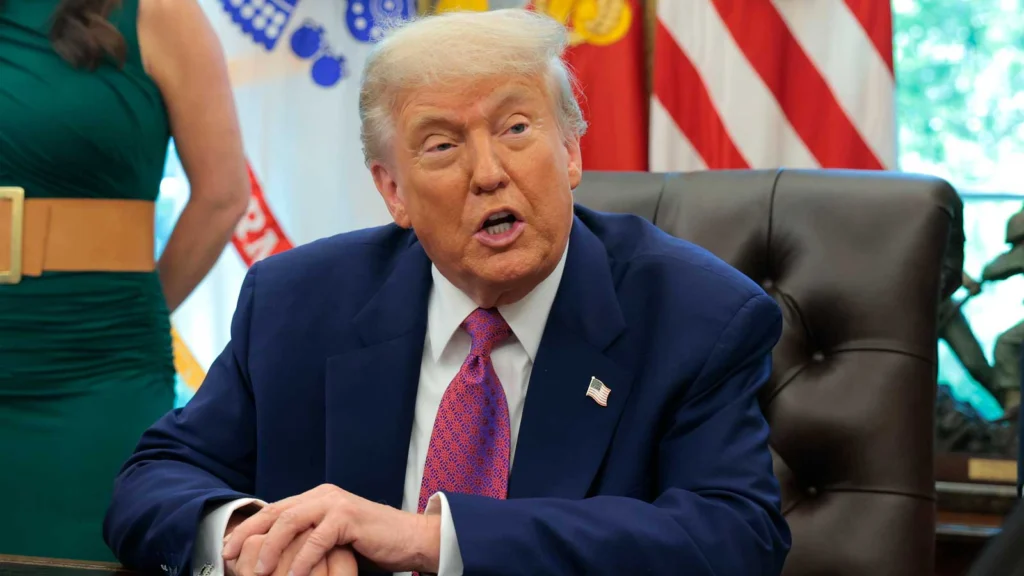
US President Donald Trump is drawing intense international attention after appearing to threaten military action against the Gulf state of Oman in a dispute over control of the Strait of Hormuz, a vital maritime corridor for global energy supplies.
Trump’s remarks came during a White House Cabinet meeting on May 27, when he was asked about an unofficial proposal reportedly under discussion between Iran and Oman to jointly manage shipping through the strait.
Rejecting the idea of any single nation controlling the waterway, Trump insisted that the strait must remain open to all and reaffirmed that the United States would ensure free passage for international shipping.
In a striking statement captured on record, he said Oman “will behave just like everybody else or we’ll have to blow them up,” language that suggests possible military consequences if Oman were to align with Iran on control of the route.
The Strait of Hormuz is a chokepoint through which roughly one-fifth of the world’s crude oil and liquefied natural gas traditionally passed before disruptions began earlier this year amid the US-Iran conflict.
Trump’s comments were later shared by the US State Department with a video clip and transcript, without any immediate clarification or correction suggesting a misstatement.
Oman, despite being a long-standing US ally involved in mediation efforts with Tehran, has not confirmed that it sought to control the strait.
The warning comes as part of a broader pattern of assertive foreign policy rhetoric under Trump’s administration.
Media analyses have noted that Trump’s tenure has included military strikes, threats, and warnings against a number of countries around the world — a posture sometimes linked to what analysts call the “madman theory,” in which heightened displays of resolve and willingness to use force are meant to influence other states’ behaviour.
Critics argue that the escalatory language risks further destabilising an already tense Middle East environment where diplomatic negotiations aimed at a ceasefire with Iran continue alongside sporadic military actions.
Supporters of Trump’s approach say firm statements are aimed at reinforcing US strategic interests in keeping critical sea lanes open for global commerce.
As the situation evolves, global markets and international stakeholders are closely watching developments involving the Strait of Hormuz, where uncertainties over control and security have direct implications for energy prices and regional stability.
