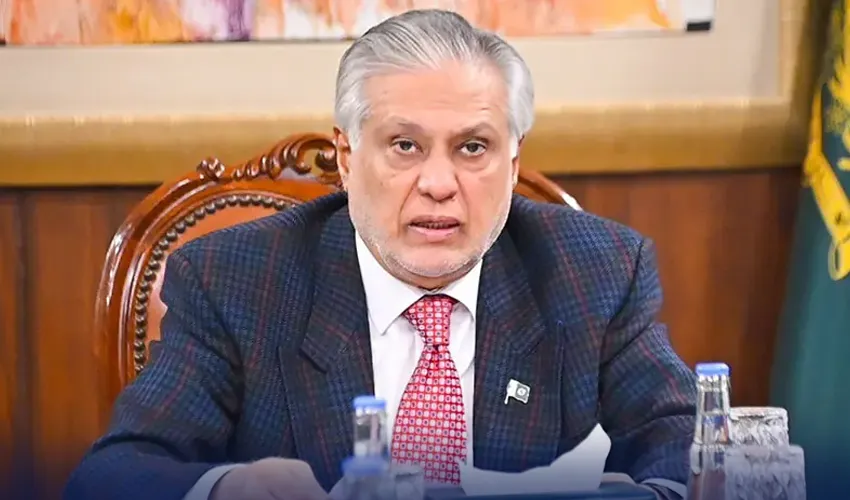
Deputy Prime Minister and Foreign Minister Ishaq Dar has said that economic sanctions on Iran will not be lifted immediately, despite progress in negotiations between Iran and the United States following the Islamabad agreement.
Speaking in an interview with Al Arabiya, Dar said that while Iran has shown willingness to reduce its nuclear stockpile to a low level, decisions regarding sanctions will be made solely by Washington and Tehran through mutual consultation.
Next phase of talks focuses on sanctions nuclear programme and Lebanon
Dar said the negotiations have now entered a structured second phase focusing on three core areas, including economic sanctions, Iran’s nuclear programme, and the situation in Lebanon.
To manage these issues, three technical working groups have been formed with defined mandates covering nuclear compliance, sanctions mechanisms, and regional security matters linked to Lebanon.
He said negotiators have been given 30 days to complete the remaining technical process, while a broader final agreement must show substantial progress within 60 days. He added that the timeline could be extended if all parties agree.
Dar dismissed speculation about secret arrangements, stating that every commitment is clearly documented in the written Islamabad agreement and that Pakistan has no hidden interests in the outcome.
Regional conflict nearly derailed diplomatic progress
The foreign minister said Israeli military actions in Lebanon almost derailed the US-Iran diplomatic track. He noted that sustained diplomatic efforts by Pakistan and other partners helped restore dialogue and prevent the collapse of negotiations.
Dar urged observers not to question the intentions of the negotiating parties, saying the memorandum of understanding between the US and Iran was drafted with precision and caution to avoid ambiguity.
Memorandum of understanding forms basis for final deal
According to Dar, the US Iran MoU has been formally accepted by both sides and now serves as a framework for converting initial commitments into a comprehensive and enforceable agreement.
He said Pakistan condemned Israel’s attack on Iran on February 28 and subsequently took diplomatic initiative to de-escalate tensions. These efforts resulted in a ceasefire and the resumption of talks aimed at regional stability.
Dar revealed that six rounds of intensive negotiations, lasting up to 21 hours each, were held in Islamabad. He said this marked the first time in 47 years that direct US-Iran talks took place in the Pakistani capital.
Pakistan served as mediator and witness
Dar said senior leadership from both sides participated in the negotiations, including the US vice president and Iran’s parliamentary speaker and foreign minister. Pakistan was represented by Dar himself, the chief of defence forces, and the national security adviser, who acted as mediators and official witnesses.
He added that Pakistan maintained transparency throughout the process by keeping key regional countries informed of developments.
R4 Forum launched as regional coordination platform
Dar also announced the formation of the R4 Forum involving Pakistan, Saudi Arabia, Egypt, and Turkey. He clarified that the initiative is not a political bloc but a cooperative platform representing nearly half a billion people across key regions.
He said the forum connects strategic zones, including the Red Sea, the Mediterranean, and parts of Africa, strengthening coordination on peace and economic stability.
Dar said Qatar, Bahrain, Kuwait, Jordan, and China supported Pakistan’s mediation role, while the European Union, Canada, Australia, and Japan also backed the peace initiative. Copies of the Islamabad agreement were shared with Egypt, Saudi Arabia, and Turkey.
Strait of Hormuz shipping fees suspended for trial period
Dar said that ships passing through the Strait of Hormuz will not face transit or service fees for a 60-day trial period. The measure aims to restore confidence in one of the world’s most critical maritime corridors.
He said the recent conflict severely disrupted global energy markets, pushing oil prices sharply higher and triggering inflation across multiple economies. According to Dar, the crisis affected an estimated 20 to 25 percent of global GDP.
Pakistan shielded consumers from fuel price shock
Dar said Pakistan absorbed the impact of rising oil prices by providing petroleum subsidies worth billions of rupees for three weeks instead of transferring the burden to consumers. He added that when international prices declined, the relief was immediately passed on to the public.
He said Pakistan’s mediation efforts were driven by the need to reduce regional tensions, secure maritime trade routes, and protect global and domestic economies from the fallout of conflict.
About Tamoor Ahmed

Tamoor Ahmad has been covering politics since 2022.
