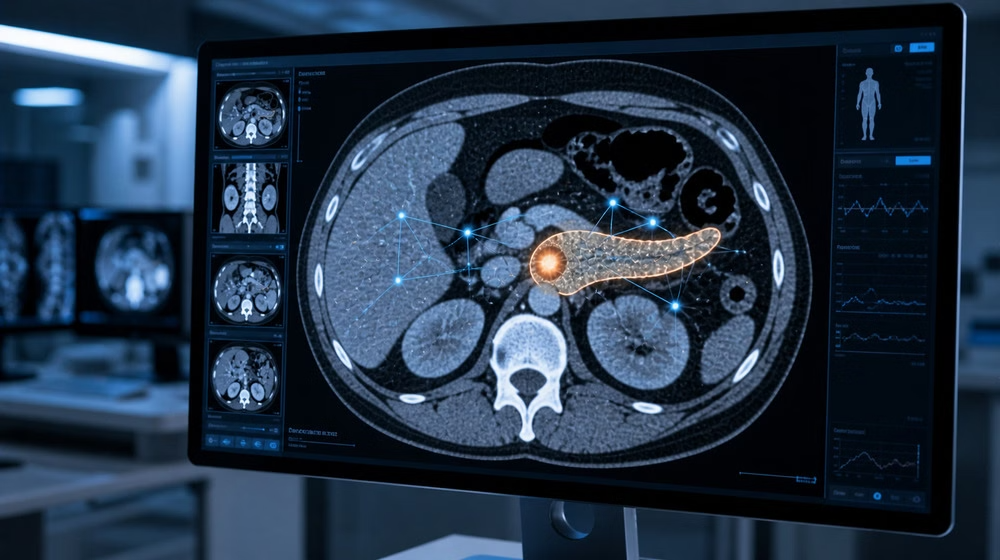
A new artificial intelligence system known as REDMOD could transform the early detection of pancreatic cancer by identifying warning signs long before they become visible through standard diagnostic methods, according to research published in Gut.
The model focuses on detecting pancreatic ductal adenocarcinoma, the most common and aggressive form of pancreatic cancer. The disease is often diagnosed late because early-stage cases rarely produce symptoms or visible abnormalities on routine imaging scans. This delay remains one of the biggest challenges in oncology, leading to low survival rates worldwide.
Researchers developed REDMOD, short for Radiomics-based Early Detection Model, to address this gap. The system uses advanced radiomics, a method that analyses subtle patterns in medical images that are not detectable to the human eye. It examines tissue texture and structure in CT scans to identify early cancer signatures.
The model also includes automated pancreatic segmentation, which allows it to precisely outline the pancreas and separate it from surrounding organs. This reduces the need for manual input from radiologists and improves consistency in image analysis.
In testing, REDMOD was applied to CT scans from 219 patients across multiple hospitals. All of these individuals were initially considered healthy but were later diagnosed with pancreatic cancer.
Also read: KP to Restart Free Cancer Medicines Program
Among them, 87 had scans taken 3 to 12 months before diagnosis, 76 had scans from 12 to 24 months earlier, and 56 had imaging data collected more than two years before diagnosis, in some cases up to three years earlier.
The researchers also compared these results with scans from 1,243 individuals who did not develop pancreatic cancer within a three-year period. The average age of patients later diagnosed with cancer was 69, while the comparison group averaged 64.
One of the most significant findings was that REDMOD could detect early cancer signals an average of 475 days before clinical diagnosis.
“475 days is transformative,” said a senior oncologist, speaking on condition of anonymity. “That’s over a year of lead time. For cancers like pancreatic or ovarian, where late diagnosis is common, this window means the difference between stage 1 and stage 4. It shifts us from treatment to prevention.”
The system also outperformed human radiologists in controlled testing. It correctly identified 73 percent of true cancer cases, compared to 39 percent detected by specialists reviewing the same scans.
For cases diagnosed more than two years later, accuracy remained significantly higher than conventional interpretation methods.
In further validation, REDMOD correctly classified more than 81 percent of scans from an independent group of 539 patients as cancer-free. It also achieved 87.5 percent accuracy in a dataset from the National Institutes of Health, which included 80 patients.
Overall performance remained stable, with consistent results across 90 to 92 percent of repeated analyses.
Also read: Only 30% of Children With Cancer Survive in Pakistan Due to Late Diagnosis, Say Experts
Researchers acknowledged limitations, particularly the lack of ethnic diversity in the dataset, which may affect how widely the results can be applied in global populations.
Medical experts say the findings highlight the growing role of artificial intelligence in cancer diagnostics. They note that while early results are promising, further validation in high-risk groups is essential before clinical adoption.
If confirmed through additional trials, REDMOD could help shift pancreatic cancer diagnosis from late-stage detection to early identification, when treatment options are more effective.
The study suggests that combining AI tools with radiology could significantly improve survival prospects in one of the deadliest cancers.
