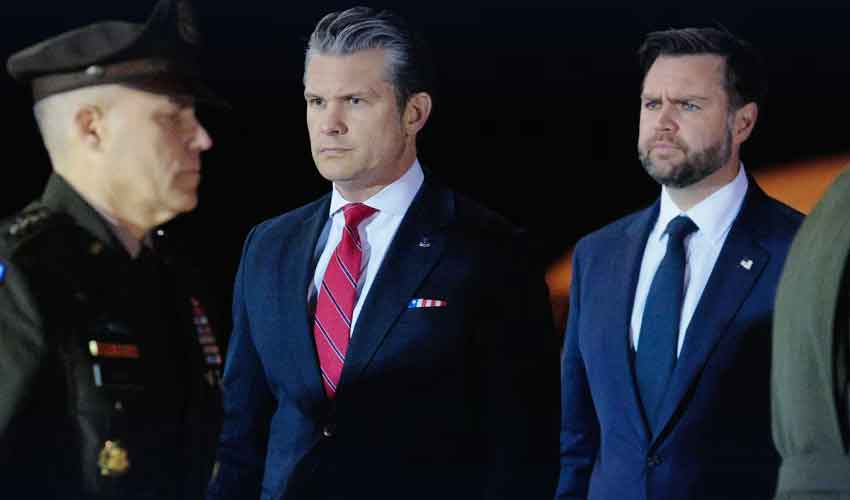
US Vice President JD Vance has reportedly raised repeated questions in private discussions about the Pentagon’s assessment of the ongoing Iran conflict, specifically challenging whether military officials are fully disclosing the extent of pressure placed on American missile stockpiles.
According to a report by The Atlantic, Vance has privately expressed concern that senior defense leaders may be presenting an overly optimistic picture of both US weapons reserves and the effectiveness of strikes carried out during the eight-week Iran war. The discussions have taken place behind closed doors within President Donald Trump’s national security circle.
Dispute Over Military Readiness and Stockpiles
Defense Secretary Pete Hegseth and General Dan Caine, Chairman of the Joint Chiefs of Staff, have publicly maintained that US military readiness remains strong despite sustained operations. They have also described significant damage inflicted on Iran’s air defense systems, naval capabilities, and broader military infrastructure.
However, individuals familiar with internal discussions say Vance has questioned whether these assessments fully reflect the depletion of advanced missile systems used during the campaign. His concerns reportedly center on the pace at which key munitions—particularly air defense interceptors—have been consumed.
The vice president is said to have raised the issue of whether reduced stockpiles could affect US readiness in the event of future high-intensity conflicts involving China, North Korea, or Russia.
Concerns Over Long-Term Military Balance
Officials and analysts note that systems such as Patriot interceptors, THAAD missiles, and SM-3 defenses are among the most expensive and strategically important assets in the US arsenal. A report from the Center for Strategic and International Studies (CSIS) suggested that large quantities of these weapons may have been used during the Iran operation, potentially accelerating depletion rates.
The same analysis warned that US stockpiles were already considered below optimal levels for a potential peer-level conflict prior to the current war, raising questions about how quickly inventories can be rebuilt.
Pentagon Maintains Positive Assessment
Despite internal debate, Pentagon leadership continues to publicly emphasize operational success. Secretary Hegseth has described Iranian military capabilities as severely degraded, arguing that US operations achieved decisive strategic objectives.
Following the announcement of a ceasefire earlier this month, Hegseth characterized the campaign as a “major military success”, claiming it significantly weakened Iran’s defense posture.
The White House has defended Vice President Vance’s role in internal discussions, stating that he routinely asks detailed and probing questions as part of broader national security planning rather than expressing opposition to policy direction.
Ceasefire and Strategic Uncertainty
President Trump has extended the ceasefire agreement, although tensions remain high. The United States has also imposed restrictions affecting maritime activity in the Strait of Hormuz, a critical global energy corridor responsible for a significant share of oil and gas shipments.
While active combat has slowed, officials acknowledge that a durable peace agreement has yet to be reached, leaving the broader regional situation unresolved.
Strategic Implications for Future Conflicts
Security analysts warn that sustained use of high-end missile systems in the Iran conflict could have long-term consequences for US deterrence strategy. If stockpiles are significantly reduced, it may limit the Pentagon’s ability to respond rapidly to simultaneous global crises.
As discussions continue within the Trump administration, the central question remains whether current military reporting accurately reflects the true state of US strategic readiness—or whether deeper vulnerabilities are being masked by operational success claims.
