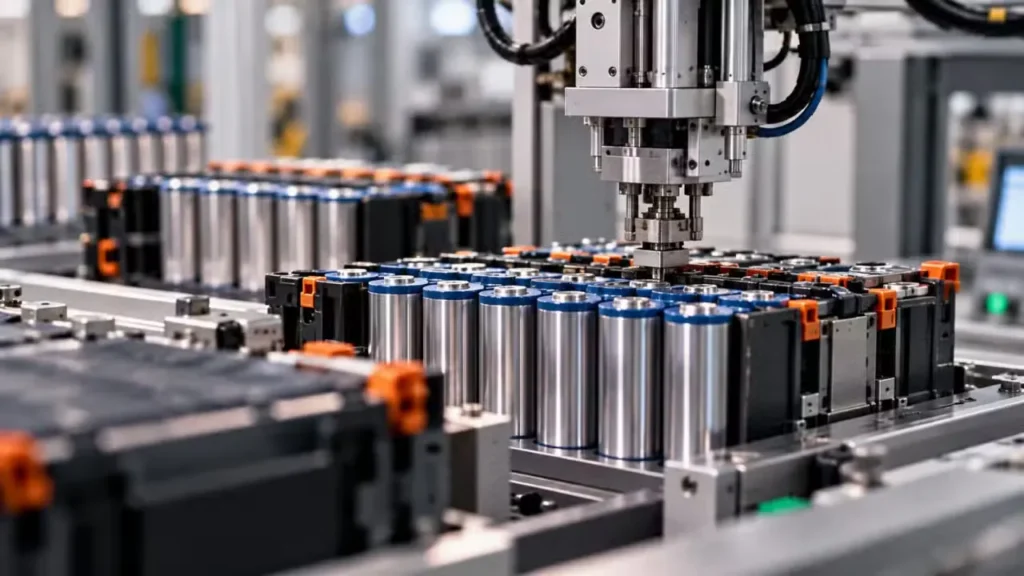
Pakistan is preparing to launch a $2.25 billion lithium-ion battery manufacturing project in Rawalpindi, with production expected to begin within six to eight months after the government approves a policy for the sector.
The proposed facility is being developed by military-owned Margalla Heavy Industries Limited (MHIL) with Chinese partners and a local private-sector investor.
Hamad Ali Mansoor, chief executive of the Engineering Development Board (EDB), told Arab News on October 26 that construction and machinery installation had been completed, but the factory was awaiting government approval before operations could begin.
The project is expected to manufacture lithium-ion battery cells for energy storage systems and electric vehicles. If implemented as planned, it could mark a significant step towards developing Pakistan’s domestic battery manufacturing industry and reducing reliance on imported components.
The investors have not been publicly identified in the report, and MHIL had not provided a comment at the time of publication.
Factory Targets Annual Capacity of More Than 1,000 MW
According to Mansoor, the facility will initially produce batteries with a capacity of around 200 to 300 megawatts before gradually expanding to a planned annual capacity exceeding 1,000 megawatts.
The factory is located at Heavy Industries Taxila in the Rawalpindi district. MHIL’s existing activities include defence equipment, unmanned drones, electric buses, two-wheelers and battery energy storage systems.
The proposed investment is part of Pakistan’s broader effort to attract foreign industrial partners and develop local manufacturing capabilities. Domestic production could eventually support battery demand from households, businesses, factories and electric vehicles.
However, the production timeline remains conditional on government approval of the proposed lithium battery manufacturing policy. The reported investment and capacity targets should therefore be treated as project plans rather than evidence that commercial production has started.
Pakistan’s Battery Storage Demand Could Reach 100,000 MW
The EDB estimates that demand for battery energy storage systems could reach 100,000 megawatts by June 2030, depending on economic growth and the adoption of electric vehicles.
Mansoor said demand could approach that level if Pakistan’s gross domestic product grows by 5% or more annually. If economic growth remains below 3%, he estimated that demand could be closer to 80,000 megawatts.
These are projections provided by the EDB chief executive, not confirmed future orders or installed capacity. Actual demand will depend on economic conditions, electricity-sector requirements, investment in energy storage and the pace of electric vehicle adoption.
The EDB also estimates that grid stabilisation alone could require between 3,000 and 5,000 megawatts of battery storage capacity. Meeting the wider projected requirement could involve four to five gigafactories, each costing approximately $1 billion to $1.25 billion, according to Mansoor.
The figures indicate the scale of investment officials believe may be needed to establish a domestic battery industry. Whether the projected demand translates into commercially viable manufacturing will depend on financing, technology, supply chains and market growth.
Battery Manufacturing Policy Awaits Government Approval
The government’s proposed lithium battery manufacturing policy was submitted to the Ministry of Industries and Production in March, according to Mansoor.
The plan envisages four major manufacturing facilities, with three proposed for Punjab’s Lahore, Faisalabad and Rawalpindi divisions and another for Karachi. The framework would also require manufacturers to export a specified share of their production, although the target has not been disclosed.
Mansoor said the proposed policy incorporates international safety and performance standards. These provisions will be important as Pakistan seeks to manufacture battery cells for domestic use and overseas markets.
The Ministry of Industries and Production publishes approved industrial policies on its official policy portal. The lithium battery manufacturing framework’s approval status should be checked against official government announcements before any final policy provisions are presented as binding requirements.
Electric Vehicle Policy Could Support Battery Demand
The battery project comes as Pakistan pursues wider changes in its automotive industry. Prime Minister Shehbaz Sharif has approved the Automotive and Auto Parts Manufacturing Policy 2026-2031, although the proposed tax incentives were reported to be awaiting International Monetary Fund approval.
The EDB expects the development of the electric vehicle sector to support demand for battery storage and related components. Lithium-ion batteries are used in electric vehicles and can store electricity generated by solar and wind installations for later use.
Pakistan currently assembles batteries and related components, including motors, controllers and chargers, according to Mansoor. He said the government wants to expand domestic manufacturing to reduce dependence on imported parts and create opportunities for exports.
Local battery-cell production could strengthen the country’s engineering sector and support the supply chains needed for electric mobility and energy storage. The scale of those benefits, however, will depend on whether the proposed factories move into production, achieve their planned capacity and compete effectively with imported products.
For now, the Rawalpindi project remains dependent on approval of the battery manufacturing policy. Its progress will be an important indicator of whether Pakistan can turn investment commitments and industrial plans into operational manufacturing capacity.
