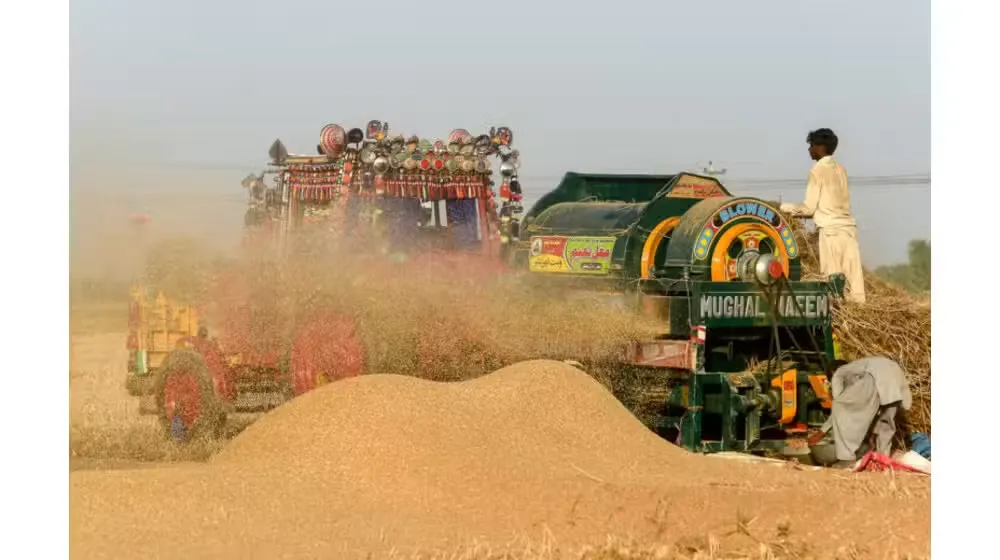
Pakistan plans to maintain strategic wheat reserves of up to six million tonnes as the federal government seeks to secure domestic supplies, contain market disruptions and reduce dependence on imports.
Federal Minister for National Food Security and Research Rana Tanveer Hussain announced the plan at a press conference in Islamabad on Monday. He said the country had sufficient wheat stocks to meet national demand this year and that the government was monitoring prices and supplies.
According to the Press Information Department (PID), the government has also formulated a National Wheat Policy aimed at strengthening food security, supporting farmers and improving stability in the wheat market.
The six-million-tonne figure represents the government’s stated reserve target. It should not be interpreted as confirmation that this volume is already held in storage.
Wheat Price Set at Rs4,500 per 40kg for 2027
Prime Minister Shehbaz Sharif has set the indicative wheat price for 2027 at Rs4,500 per 40 kilograms, up from Rs3,500 in the previous year. The minister said the price was finalised after consultations with provincial governments and relevant stakeholders.
The government says the higher indicative price is intended to give farmers greater certainty before the next sowing season, help them recover production costs and encourage domestic cultivation.
Hussain said imported wheat would cost approximately Rs4,500 per 40kg, making domestic procurement a more suitable option at a comparable price. He said the government would prioritise local farmers rather than rely unnecessarily on imported supplies.
However, the impact of the indicative price will depend on how procurement arrangements are implemented, production costs evolve and market conditions develop across the provinces.
More Than 1.3 Million Tonnes Supplied to Provinces
The minister said more than 1.3 million tonnes of wheat had been supplied to provincial governments from stocks held by the Pakistan Agricultural Storage and Services Corporation (PASSCO).
He added that the government could arrange imports of up to 550,000 tonnes, depending on provincial requirements and market demand. The statement indicates that imports remain a contingency option rather than a confirmed purchase of the full quantity.
The government has also pledged to act against hoarding, speculative activity and artificial shortages. Hussain described the recent rise in wheat prices as artificial and said he expected prices to return to normal within days.
That assessment reflects the minister’s position. Actual price movements will need to be assessed through market data and retail prices in different parts of the country.
The Ministry of National Food Security and Research is the relevant federal department for official updates on wheat policy and food-security measures. Its previous statements have also highlighted the need for coordination between federal and provincial authorities to monitor stocks and market conditions.
Farmers Welcome Indicative Price but Seek Better Returns
Khalid Mahmood Khokhar, president of Pakistan Kissan Ittehad, welcomed the Rs4,500 indicative price. The farmers’ association had previously called for a rate of Rs5,000 per 40kg and warned that uncertainty over crop policy could discourage wheat cultivation.
Farmers have also raised concerns about the cost of fertilisers and other agricultural inputs. A higher indicative price may improve their planning, but its benefit will depend on whether the price farmers actually receive covers their production expenses.
The government has linked its wheat strategy to broader agricultural reforms, including policies concerning seeds, biotechnology and olives. Hussain said access to quality seeds, modern technology and stronger regulation would help improve yields and reduce production costs.
For consumers, the immediate concern is whether sufficient supplies reach flour mills and markets at affordable prices. For farmers, the test will be whether the announced price and procurement policies provide predictable returns.
The effectiveness of the planned reserves will ultimately depend on stock management, provincial coordination and transparent implementation.
