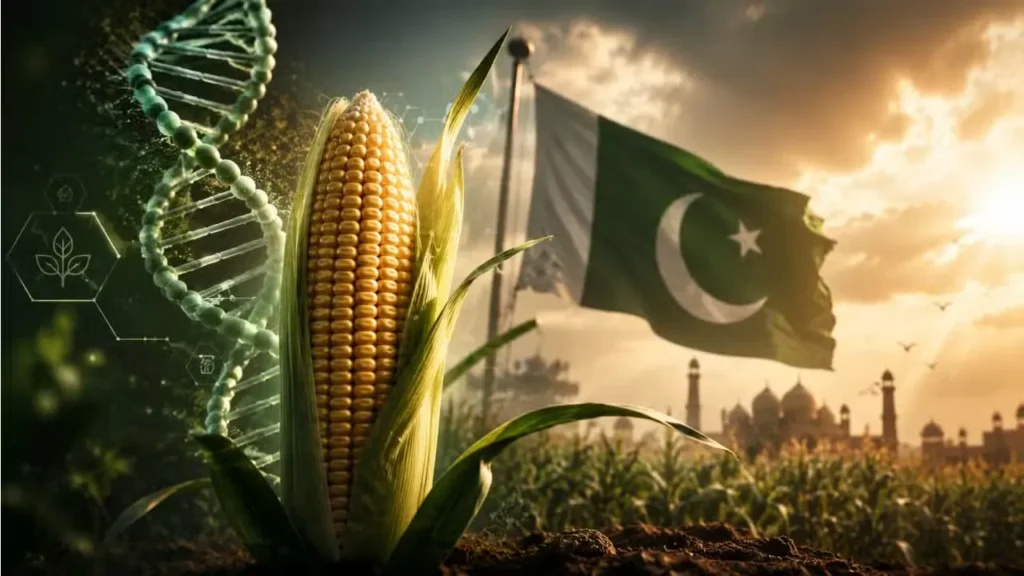
Pakistan’s National Biosafety Committee is scheduled to consider the renewal of commercial licences for genetically modified maize varieties on October 23, 2026, amid concerns that the decision could precede a broader government review of the country’s genetically modified crop policy.
According to the reported meeting agenda, applications involving insect-resistant and herbicide-tolerant maize varieties developed by multinational companies Corteva and Bayer are among the items under consideration.
Environmental organisations and agricultural policy specialists have urged the government to complete its review of the economic and environmental implications of genetically modified maize before extending commercial approvals. However, the committee’s final decision and the status of the policy review could not be independently confirmed.
GMO Maize Licence Renewals Face Scrutiny
The National Biosafety Committee operates within Pakistan’s federal biosafety regulatory framework, overseen by the Pakistan Environmental Protection Agency under the Ministry of Climate Change and Environmental Coordination.
The official Pakistan Biosafety Clearing House explains that the country’s biosafety framework covers genetically modified organisms, including their research, field trials, import and commercial use.
Opponents of the proposed renewals argue that extending commercial licences before the government completes its policy review could limit the opportunity to address questions about crop performance, environmental risks and economic benefits.
They have called for greater transparency around the scientific assessments supporting any decision, including information about potential effects on non-GMO maize cultivation and the wider agricultural sector.
The concerns remain part of a policy debate and should not be interpreted as evidence that the proposed renewals are unsafe or that the committee has disregarded its regulatory obligations.
Pakistan’s Earlier Restrictions on GMO Maize
Pakistan previously suspended activities involving genetically modified maize in 2019, amid concerns about possible cross-pollination, unintended crop contamination and implications for the country’s non-GMO maize sector.
The earlier restrictions form part of the background to the current debate over commercial cultivation and the conditions under which genetically modified crops should be permitted.
The applicable regulatory framework includes the Pakistan Biosafety Rules, 2005, which establish licensing requirements and provide for scientific risk assessment and risk management. Pakistan’s biosafety rules and guidelines were amended in 2024, according to the official Biosafety Clearing House.
The rules require risk assessments to be conducted on a case-by-case basis for activities requiring a licence. They also provide for decisions to be based on application information, scientific risk assessments and prior field experience.
Critics argue that publishing the relevant assessments and explaining the reasons for regulatory decisions would help the public understand how environmental and agricultural concerns are being addressed.
GMO Soybean Imports Also on the Agenda
The reported agenda also includes a request from Zubair Feeds (Pvt.) Ltd. to import 47 authorised genetically modified soybean varieties for animal-feed processing through the Centre of Excellence in Molecular Biology.
The proposal comes amid continuing efforts to establish clearer regulatory arrangements for genetically modified commodities intended for food, feed and processing.
Pakistan’s official biosafety portal published information in July 2026 about approvals for specified genetically modified soybean events following decisions taken at the National Biosafety Committee’s 37th meeting in May. Those approvals relate to the events listed in the official notice and should not be treated as automatic approval for every soybean variety or import application.
The reported 38th meeting agenda also includes a field-testing application for UAM 2026, a multi-gene cotton variety submitted by MNS University of Agriculture, Multan. The proposed variety is intended to address challenges including pink bollworm damage and invasive weeds.
Field testing and commercial release are distinct regulatory stages, and approval for one purpose does not automatically authorise the other.
Transparency Remains Central to Biosafety Decisions
The outcome of the maize licence review could have implications for seed companies, farmers, agricultural researchers and policymakers involved in Pakistan’s crop-development strategy.
Clear disclosure of the committee’s decision, the relevant risk assessments and any conditions attached to approvals would help stakeholders evaluate the scientific and policy basis for the outcome.
Climate Change Minister Musadik Malik was reportedly unavailable for comment when contacted by the original source. No official response addressing the specific concerns was independently verified for this report.
The committee’s decision and any subsequent government policy announcement remain unconfirmed. Readers can consult the Pakistan Biosafety Clearing House for official regulatory notices and published information about GMO approvals in Pakistan.
