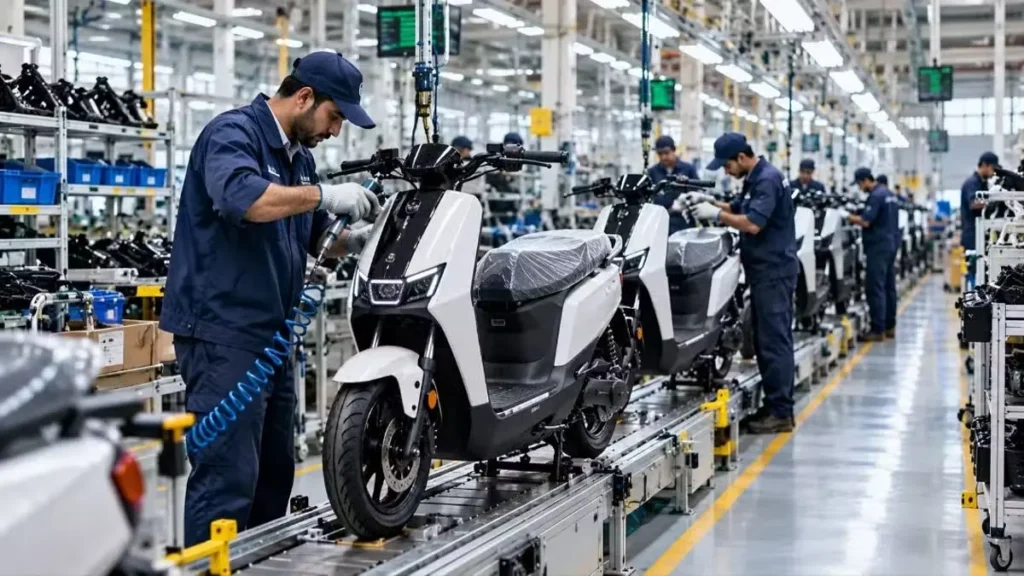
China’s G-Force Group has signed a joint venture agreement with a Pakistani electric vehicle (EV) company to manufacture and trade electric mobility products in Punjab, including electric bikes, batteries and charging stations.
Under the agreement, the local company will establish an electric bike manufacturing plant at Quaid-e-Azam Business Park in Sheikhupura. G-Force Group will separately set up a facility in Punjab to manufacture batteries and EV charging stations.
The agreement was signed at PISC House on Davis Road in Lahore, with Punjab Minister for Industries and Commerce Chaudhry Shafay Hussain attending the ceremony as chief guest.
G-Force Group China Director Zhang Rui and local company Chairman Dr Muhammad Amjad signed the agreement on behalf of their respective companies.
Electric Bike Manufacturing Plant Planned in Sheikhupura
The proposed manufacturing facilities are intended to expand Punjab’s electric vehicle supply chain, covering two-wheelers as well as supporting infrastructure.
The local company will lead the establishment of the electric bike plant at Quaid-e-Azam Business Park, while G-Force Group plans to manufacture batteries and EV charging stations in the province.
The agreement marks a planned expansion of cooperation between Chinese and Pakistani businesses in the electric mobility sector. However, the companies have not disclosed the project’s investment value, production capacity or expected completion dates in the reported announcement.
Punjab Government Seeks More EV Investment
Speaking at the signing ceremony, Chaudhry Shafay Hussain said the Punjab government was working to expand the electric vehicle sector under the chief minister’s leadership.
He noted that several electric two-wheeler factories were already operating in the province, while other domestic and foreign companies were establishing manufacturing facilities.
The minister said electric bikes could gradually replace petrol-powered motorcycles in the coming years, potentially helping reduce noise and air pollution.
He also highlighted investment opportunities in Punjab’s special economic zones and encouraged Chinese investors to establish EV charging station manufacturing facilities in the province.
Joint Venture Expected to Create Jobs
Hussain said the joint venture would bring additional investment to Punjab and create employment opportunities. He added that growing investment by Chinese companies was strengthening economic cooperation between Pakistan and China.
Local manufacturing of electric bikes, batteries and charging stations could support the development of a broader EV industry in the province. However, the scale of these benefits will depend on the implementation of the project, production levels, consumer demand and the availability of charging infrastructure.
The proposed facilities could also contribute to local supply chains if production generates demand for domestic components, technical services and skilled workers.
EV Market Growth Depends on Affordability and Infrastructure
Electric motorcycles are one potential route for expanding electric mobility in Pakistan, where two-wheelers are widely used for daily commuting.
The wider adoption of electric bikes will depend on factors such as purchase prices, battery performance, charging access, maintenance costs and consumer confidence.
Local production may help develop the supply base, although its effect on retail prices will depend on manufacturing costs and the extent of locally sourced components.
For now, the agreement establishes a framework for cooperation between G-Force Group and its Pakistani partner. Further details on investment, construction schedules and commercial production will be needed to assess the project’s eventual contribution to Punjab’s EV industry.
