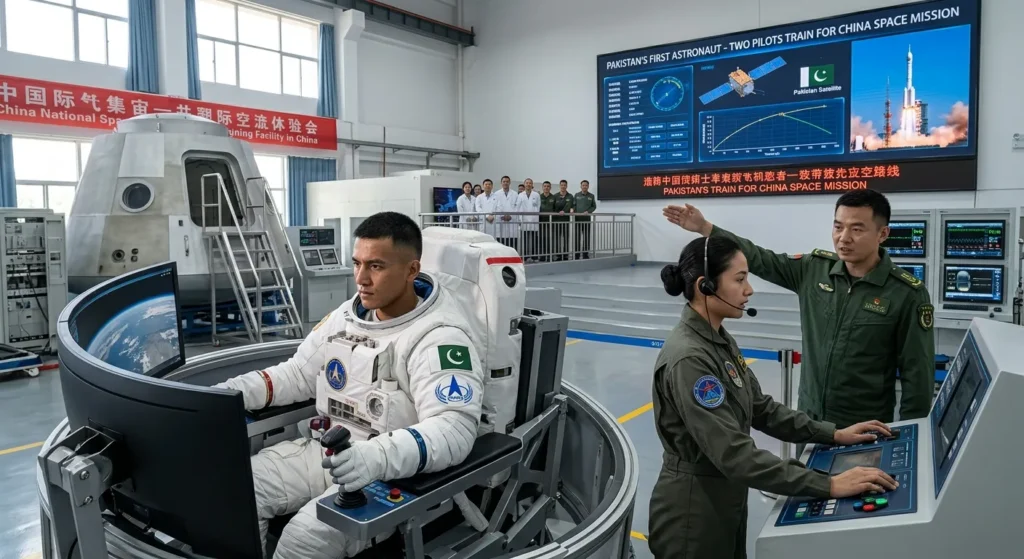
Pakistan is preparing to select its first astronaut for a mission to China’s Tiangong space station, with two Pakistani pilots currently undergoing intensive training as the final decision approaches.
Pilots Zeeshan Ali and Khurram Daud have spent months training at the China Astronaut Research and Training Center in Beijing. Their preparation includes learning Mandarin, spacecraft systems and emergency procedures, as well as centrifuge exercises designed to prepare them for the intense forces experienced during launch.
The mission would mark the first time a Pakistani citizen travels into space and represent another major step in the growing space cooperation between Pakistan and China.
Final Astronaut Selection Expected in October
Amer Gilani, who oversees human spaceflight cooperation at Pakistan’s space agency SUPARCO, said the final decision on which pilot will fly is expected in mid-to-late October.
China has not yet announced which Pakistani pilot will be selected or provided a launch date.
The astronaut chosen for the mission will remain in China until the launch rather than returning to Pakistan beforehand. After completing the mission, the astronaut will return home following the required recovery period.
Training includes intensive Mandarin lessons, spacecraft operations and exercises designed to help the pilots adapt to microgravity and the physical forces of launch.
The two pilots emerged from a group of around 20 finalists selected from an initial pool of Pakistani pilots and scientists. Candidates were assessed for medical fitness, psychological resilience and their ability to withstand high g-forces.
SUPARCO Director of Artificial Intelligence Uzair Ansari said the requirement for experience with high-speed flying was an important factor in selecting the two pilots.
Pakistani Astronaut to Conduct Science Experiments
The selected pilot will travel to Tiangong as a payload specialist, meaning the astronaut’s primary role will be to conduct Pakistan’s scientific experiments rather than operate the spacecraft.
SUPARCO received more than 300 research proposals from universities in Karachi, Lahore and Islamabad following a year-long campaign.
Chinese institutes eventually selected four experiments for the mission. The research will focus on biotechnology applications linked to challenges including food security and climate change.
According to Ansari, the experiments are being developed and tested in SUPARCO laboratories before receiving approval from Chinese engineers.
The Pakistani research payload will be relatively small compared with Tiangong’s broader scientific program. The Chinese space station has already hosted more than 180 experiments and generated hundreds of research papers and patents.
Tiangong consists of three main modules, Tianhe, Wentian and Mengtian, with a combined mass of about 77 metric tons. The station contains numerous experimental facilities covering areas such as life sciences, materials science, fluid physics, combustion and radiation exposure.
Mission Highlights Pakistan-China Space Cooperation
The mission will rely heavily on China’s existing space infrastructure. The Pakistani astronaut will travel aboard a Chinese spacecraft, launch from a Chinese facility and train under Chinese instructors.
Pakistan currently does not have its own crewed spacecraft or independent launch vehicle capable of sending astronauts into orbit.
The planned stay in space will last around one week, considerably shorter than the approximately six-month missions typically undertaken by Chinese astronauts.
The Pakistani astronaut is expected to return to Earth alongside two members of a Chinese crew currently aboard Tiangong.
Since Yuri Gagarin became the first human to travel into space in 1961, citizens of roughly 50 countries have flown into orbit. However, only Russia, the United States and China have independently launched crewed spacecraft.
China’s planned mission with Pakistan would therefore represent the first time Beijing transports a foreign astronaut to its space station.
No Commitment Yet for Pakistani Moon Mission
Pakistan has not secured an official commitment for a future astronaut to travel to the Moon through its cooperation with China.
Gilani said there was currently no official agreement or discussion on sending a Pakistani astronaut to the Moon, adding that future cooperation would depend partly on the outcome of the country’s first crewed space mission.
Separately, Pakistan is also developing a lunar rover for China’s Chang’e 8 mission, currently expected around 2028.
The Pakistani-built rover is designed to use AI-based stereo imaging to identify obstacles, estimate depth and plan its route across the lunar surface. Such autonomous capabilities are important because Earth-based controllers cannot continuously guide a rover in real time due to communication delays.
For Pakistani scientists and engineers, the upcoming Tiangong mission could provide practical experience in human spaceflight and international scientific cooperation.
Ansari described the mission as a “once-in-a-lifetime opportunity” for Pakistan’s scientific community.
