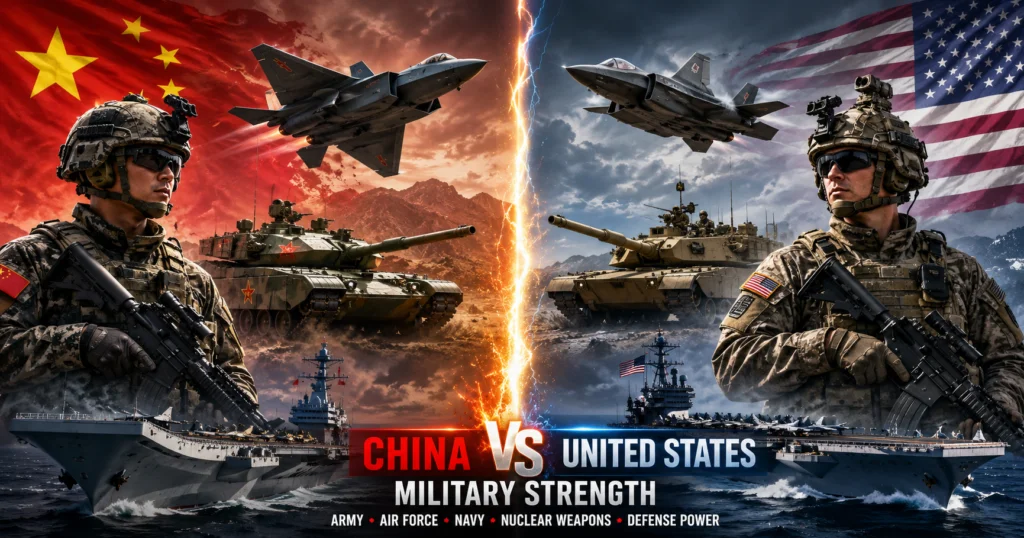
The China vs United States military strength comparison in 2026 goes far beyond counting soldiers, tanks, aircraft or warships. The two countries have built military systems around very different strategic priorities.
According to the supplied 2026 Global Firepower assessment, the United States ranks first among 145 countries, with a PowerIndex score of 0.0741. China ranks third with a score of 0.0919.
The figures put both countries among the world’s most powerful conventional militaries, but their strengths are distributed differently.
The United States has spent decades developing a force capable of operating across multiple continents and oceans. Its military power includes a huge aircraft fleet, 11 aircraft carriers, nuclear-powered submarines, aerial refueling aircraft, strategic transport, satellites, overseas bases, precision weapons and a broad network of allies.
China’s People’s Liberation Army (PLA) has taken a different approach. It maintains more active-duty personnel, more tanks, more self-propelled artillery and more mobile rocket systems in the supplied comparison. China also has a larger naval fleet by total vessel count and has invested heavily in missiles, naval modernization, air power, nuclear weapons and domestic defense production.
The biggest factor is geography.
China can concentrate aircraft, missiles, ships, air defenses, surveillance systems and logistics close to its mainland, particularly in the Western Pacific. The United States has a much greater global reach, but projecting military power into the region requires long-distance logistics, forward bases, allied access and large support fleets.
That distinction between global military power and regional force concentration is central to understanding the China vs USA military balance in 2026.
China vs USA Military Strength 2026 at a Glance
The headline figures show how differently the two countries have structured their armed forces.
| Military Category | China | United States |
|---|---|---|
| Global Military Rank | #3 | #1 |
| PowerIndex | 0.0919 | 0.0741 |
| Active Personnel | 2,035,000 | 1,333,030 |
| Reserve Personnel | 510,000 | 799,500 |
| Defense Budget | $303 billion | $831.5 billion |
| Total Aircraft | 3,529 | 13,032 |
| Fighter Aircraft | 1,443 | 1,791 |
| Transport Aircraft | 287 | 917 |
| Special-Mission Aircraft | 105 | 611 |
| Aerial Tankers | 9 | 610 |
| Helicopters | 1,007 | 5,913 |
| Tanks | 5,870 | 4,666 |
| Armored Vehicles | 152,040 | 409,660 |
| Self-Propelled Artillery | 2,940 | 1,521 |
| Mobile Rocket Projectors | 2,770 | 1,731 |
| Naval Assets | 841 | 465 |
| Aircraft Carriers | 3 | 11 |
| Submarines | 61 | 66 |
| Destroyers | 53 | 83 |
The figures show that there is no single category that defines military power.
China’s advantages include manpower, land-based fires, missile forces, naval numbers, industrial capacity and regional geography.
The United States has major advantages in air power, aerial refueling, strategic transport, carrier aviation, global logistics, submarine forces and worldwide military access.
China vs USA Military Ranking in 2026
The United States holds the #1 position in the 2026 Global Firepower ranking, while China is ranked #3.
The reported PowerIndex scores are:
- United States: 0.0741
- China: 0.0919
Global Firepower’s ranking combines multiple factors, including manpower, equipment, finances, resources and geography.
Such an index provides a broad comparison but cannot fully capture factors such as operational readiness, training, ammunition stocks, intelligence, electronic warfare, cyber capabilities, command systems, alliance support or wartime industrial production.
That limitation is particularly important when comparing China and the United States.
A U.S. military operation in Europe would involve very different requirements from a potential operation in the Taiwan Strait or South China Sea. Likewise, China’s ability to concentrate forces near its mainland does not automatically translate into the same level of global military reach.
China vs USA Military Personnel
China has the larger active-duty military in the supplied 2026 comparison.
The figures list approximately 2.035 million active Chinese personnel, compared with around 1.333 million active U.S. personnel.
The reserve picture is different. The United States is listed with approximately 799,500 reserve personnel, compared with 510,000 for China.
| Manpower Category | China | United States |
|---|---|---|
| Active Personnel | 2,035,000 | 1,333,030 |
| Reserve Personnel | 510,000 | 799,500 |
| Paramilitary Personnel | 625,000 | 0 |
| Available Manpower | 764,123,366 | 150,463,900 |
| Fit for Service | 626,864,169 | 124,816,644 |
| Reaching Military Age Annually | 19,810,606 | 4,445,524 |
China’s larger manpower pool provides considerable depth, but modern warfare cannot be measured by population alone.
Advanced fighter aircraft, submarines, missile systems, cyber units, air-defense networks and intelligence platforms require highly trained personnel and sophisticated support infrastructure.
For that reason, the size of an active-duty force is only one part of the China vs USA military strength comparison.
How China and the United States Structure Their Militaries
China’s military modernization has focused heavily on transforming the PLA into a technologically advanced force capable of joint operations.
The PLA emphasizes:
- Precision strike
- Long-range missiles
- Integrated air defense
- Naval power
- Space systems
- Cyber operations
- Electronic warfare
- Surveillance
- Information networks
- Joint operations
The U.S. military has developed around global power projection.
Its force structure places particular emphasis on:
- Aircraft carriers
- Long-range aviation
- Aerial refueling
- Strategic airlift
- Nuclear submarines
- Overseas bases
- Satellite systems
- Expeditionary forces
- Joint command networks
- Allied interoperability
This explains why inventory comparisons can sometimes appear contradictory.
China can have more tanks or ships by count while the United States possesses substantially greater capacity to move and sustain forces far from its homeland.
China vs USA Army and Land Power
China has one of the world’s largest land forces and has invested heavily in modern tanks, armored vehicles, artillery, rockets, drones and air-defense systems.
The United States operates a smaller active Army but supports it with extensive aviation, logistics, surveillance, precision weapons and long-distance transport capabilities.
| Land Category | China | United States |
|---|---|---|
| Tanks | 5,870 | 4,666 |
| Armored Vehicles | 152,040 | 409,660 |
| Self-Propelled Artillery | 2,940 | 1,521 |
| Towed Artillery | 1,400 | 1,878 |
| Mobile Rocket Projectors | 2,770 | 1,731 |
China has more tanks, self-propelled artillery and mobile rocket systems in the supplied figures.
The United States has considerably more listed armored vehicles and more towed artillery.
But equipment numbers alone do not determine battlefield effectiveness. Sensors, ammunition, maintenance, crew training, air defense, reconnaissance, drones, engineering and logistics all affect how military hardware performs.
China Has More Tanks
China is listed with approximately 5,870 tanks, compared with 4,666 U.S. tanks.
China’s armored force includes modern systems such as the Type 99 and Type 96 families, while the United States relies heavily on the M1 Abrams family.
Tank numbers are useful for measuring inventory depth, but they do not show the full combat capability of an armored force.
Modern armored warfare increasingly depends on sensors, drones, precision weapons, communications, electronic warfare and protection against anti-tank systems.
China Leads in Artillery and Mobile Rocket Systems
China’s numerical advantage becomes more visible in land-based fires.
The supplied comparison lists approximately:
- 2,940 Chinese self-propelled artillery systems
- 2,770 Chinese mobile rocket projectors
- 1,521 U.S. self-propelled artillery systems
- 1,731 U.S. mobile rocket projectors
These figures fit China’s broader emphasis on long-range precision fires.
The PLA Rocket Force also provides China with a large family of ballistic and cruise missiles capable of threatening targets well beyond the immediate battlefield.
This capability is particularly significant in the Western Pacific because China’s mainland-based missile forces can operate alongside aircraft, naval forces, radar and surveillance systems.
China vs USA Air Force 2026
Air power is one of the clearest areas of numerical U.S. advantage.
The supplied figures list approximately 13,032 U.S. military aircraft, compared with 3,529 Chinese aircraft.
The fighter comparison is considerably closer, with 1,791 U.S. fighters and 1,443 Chinese fighters.
| Air Category | China | United States |
|---|---|---|
| Total Aircraft | 3,529 | 13,032 |
| Fighter Aircraft | 1,443 | 1,791 |
| Dedicated Attack Aircraft | 371 | 926 |
| Transport Aircraft | 287 | 917 |
| Trainer Aircraft | 401 | 2,610 |
| Special-Mission Aircraft | 105 | 611 |
| Aerial Tankers | 9 | 610 |
| Helicopters | 1,007 | 5,913 |
| Attack Helicopters | 281 | 1,024 |
The American advantage is not simply the number of fighters.
The United States has a much larger supporting aviation ecosystem that includes tankers, transport aircraft, surveillance platforms, electronic warfare aircraft and other special-mission systems.
Those capabilities allow combat aircraft to operate farther from home and remain in the air longer.
China Fighter Jets and the J-20
China has rapidly modernized its fighter fleet.
Important Chinese combat aircraft include the:
- J-20
- J-16
- J-10
- Various older fighter variants
The J-20 is particularly important because it represents China’s development of an operational stealth fighter.
The J-16 provides a heavy multirole platform, while the J-10 family forms another major component of China’s modern fighter fleet.
China is also expanding carrier-based aviation as the PLA Navy develops its aircraft-carrier capabilities.
This means China’s air force can no longer be characterized simply by older-generation aircraft. Its modernization increasingly includes advanced sensors, long-range weapons, electronic warfare and networked operations.
U.S. Fighter Fleet
The United States operates a large and diverse combat-aircraft fleet centered on platforms such as:
- F-35 Lightning II
- F-22 Raptor
- F-15
- F-16
- Carrier-based fighters
The F-35 has become particularly important because it combines stealth, sensors and networked operations and is also operated by multiple U.S. allies.
The F-22 remains a specialized air-superiority platform, while modern F-15 variants provide significant weapons payload and range.
The U.S. advantage also extends beyond the fighters themselves.
Its aircraft operate within a larger system of tankers, airborne warning platforms, intelligence aircraft, satellites, bases and allied infrastructure.
U.S. Tanker Advantage Is One of the Biggest Differences
One of the most striking statistics in the China vs USA military comparison is aerial refueling.
The supplied figures list:
- United States: 610 aerial tankers
- China: 9 aerial tankers
Aerial tankers allow fighters and other aircraft to remain airborne longer and operate farther from their home bases.
This capability is particularly important for the United States because its forces routinely operate thousands of kilometers from the American mainland.
China has less need for a comparable tanker fleet when operating close to its own territory because aircraft can use mainland bases.
However, China’s need for aerial refueling capacity increases as it seeks greater operational reach across the Pacific.
Strategic Airlift Gives the U.S. Greater Global Reach
The United States is listed with 917 transport aircraft, compared with 287 for China.
Transport aircraft are essential for moving troops, ammunition, equipment, spare parts and supplies.
The American military has spent decades developing global air mobility supported by large transport fleets, logistics facilities and overseas bases.
China has expanded its strategic airlift capabilities, but its fleet remains considerably smaller.
Near China, the difference is partly offset by China’s extensive domestic transport infrastructure. Farther from the mainland, strategic airlift becomes increasingly important.
China vs USA Navy 2026
The naval comparison is more complicated than simply counting ships.
China is listed with approximately 841 naval assets, compared with 465 for the United States.
However, a patrol vessel and a nuclear-powered submarine are not equivalent military platforms.
| Naval Category | China | United States |
|---|---|---|
| Total Naval Assets | 841 | 465 |
| Aircraft Carriers | 3 | 11 |
| Helicopter Carriers | 4 | 9 |
| Submarines | 61 | 66 |
| Destroyers | 53 | 83 |
| Frigates | 46 | 0 |
| Corvettes | 50 | 27 |
| Patrol Vessels | 150 | 0 |
| Mine-Warfare Vessels | 36 | 4 |
China has the larger fleet by total hull count.
The United States has substantially more aircraft carriers and destroyers and a slightly larger submarine fleet according to the supplied data.
The more meaningful question is therefore not simply who has more ships, but what types of ships each country operates and where those forces are designed to operate.
China’s Rapid Naval Expansion
The People’s Liberation Army Navy (PLAN) has expanded rapidly over the past two decades.
Its modernization includes:
- Destroyers
- Frigates
- Corvettes
- Submarines
- Amphibious ships
- Support vessels
- Aircraft carriers
- Patrol vessels
China’s enormous commercial shipbuilding industry provides an important industrial foundation for naval expansion.
The geographic position of the Chinese fleet is also significant. Many Chinese naval forces can operate with support from mainland aircraft, missiles, air-defense systems, ports and surveillance infrastructure.
U.S. Navy and Global Power Projection
The U.S. Navy is structured around blue-water operations.
American naval forces regularly operate across the Pacific, Atlantic, Mediterranean, Indian Ocean and other strategically important waters.
Its fleet emphasizes:
- Nuclear-powered aircraft carriers
- Nuclear submarines
- Large destroyers
- Carrier aviation
- Long-range weapons
- Replenishment ships
- Overseas bases
- Allied ports
This is why raw vessel counts do not fully capture the difference between the two naval systems.
China has a larger number of vessels, while the United States has a fleet structured heavily around global power projection.
China vs USA Aircraft Carriers
China has three aircraft carriers, while the United States has 11 in the supplied 2026 comparison.
China’s carrier program has progressed from initial operational experience toward increasingly sophisticated naval aviation.
Its carrier fleet provides experience in:
- Flight-deck operations
- Carrier aviation
- Fleet coordination
- Naval logistics
- Long-distance deployment
- Carrier strike-group operations
The United States, however, has decades of institutional experience operating large carrier strike groups.
U.S. carriers also operate alongside destroyers, submarines, support ships, aircraft and extensive intelligence and logistics networks.
The carrier numbers therefore represent more than a simple 3-to-11 comparison. They also reflect the maturity and global operating structure of each country’s carrier fleet.
China vs USA Submarine Strength
The submarine numbers are relatively close.
China is listed with 61 submarines, compared with 66 for the United States.
The composition of those fleets is important.
The U.S. submarine force is entirely nuclear-powered and includes attack submarines and ballistic-missile submarines.
China operates both diesel-electric and nuclear-powered submarines, including ballistic-missile submarines.
China has been modernizing its undersea fleet as it seeks stronger sea-denial capabilities, nuclear deterrence and greater reach.
However, submarine performance is difficult to measure from public inventory data.
Acoustic signature, sensors, crew training, weapons, maintenance and anti-submarine warfare capabilities can be more important than raw submarine numbers.
China vs USA Destroyers
The United States is listed with 83 destroyers, compared with 53 for China.
China’s modern surface fleet nevertheless includes increasingly capable vessels such as the Type 052D and Type 055.
These ships can contribute to air defense, anti-ship warfare, anti-submarine operations and long-range missile missions.
The rapid growth of China’s modern destroyer fleet has become an important part of the PLAN’s transition from a predominantly coastal force toward broader blue-water operations.
China’s Missile Forces
Missile capability is central to any serious China vs United States military comparison.
China’s PLA Rocket Force operates a broad range of systems, including:
- Short-range ballistic missiles
- Medium-range ballistic missiles
- Intermediate-range systems
- Anti-ship ballistic missiles
- Cruise missiles
- Strategic nuclear missiles
These weapons can threaten military targets across a large part of the Western Pacific.
Potential targets include airbases, ports, command facilities, logistics hubs, radar installations and ships.
This creates an anti-access and area-denial challenge for forces operating near China’s coastline.
However, missile range alone does not guarantee successful targeting.
A long-range strike also requires surveillance, communications, target identification, tracking and a functioning sensor-to-shooter network.
China’s Anti-Ship Missile Capability
Systems such as the DF-21D and DF-26 have received particular attention because of their potential anti-ship roles.
Their strategic significance lies in the possibility of threatening high-value naval platforms from considerable distances.
But hitting a moving ship at long range requires more than the missile itself.
China needs:
- Satellites
- Radar
- Aircraft
- Surveillance systems
- Data links
- Target identification
- Real-time tracking
The effectiveness of the broader targeting network is therefore just as important as missile specifications.
U.S. Long-Range Strike Capability
The United States distributes long-range strike capability across several platforms rather than relying primarily on one mainland-based missile force.
These include:
- Strategic bombers
- Submarines
- Surface ships
- Tactical aircraft
- Long-range precision weapons
- Emerging ground-launched systems
This distributed structure allows the United States to maintain strike options across multiple geographic locations.
China’s approach is more heavily centered on mainland-based missile forces, particularly for operations around the Western Pacific.
China vs USA Nuclear Weapons
China and the United States are both nuclear-armed states with survivable nuclear capabilities.
The United States maintains a nuclear triad based on:
- Land-based ICBMs
- Ballistic-missile submarines
- Strategic bombers
China has historically maintained a smaller nuclear arsenal but has expanded and diversified its nuclear forces.
Its modernization includes land-based ballistic missiles, ballistic-missile submarines, nuclear-capable aviation and mobile launch systems.
Exact warhead numbers should be treated cautiously because nuclear-force information is largely classified and public figures are estimates.
The more important point is that both countries possess nuclear forces capable of imposing catastrophic costs on an adversary.
That makes a direct U.S.-China conflict fundamentally different from a conventional military comparison.
China vs USA Defense Budget 2026
The supplied comparison lists a nominal defense budget of approximately:
- United States: $831.5 billion
- China: $303 billion
The U.S. figure is therefore roughly 2.7 times the Chinese figure.
However, defense budgets cannot be compared solely by converting each country’s spending into U.S. dollars.
Personnel costs, domestic production, purchasing power, research expenses and the cost of operating overseas all affect what a military can obtain from its budget.
The United States also spends heavily on a global military infrastructure that includes overseas bases, carrier groups, nuclear submarines, strategic aviation, satellites and logistics.
China’s defense spending supports a force operating primarily from its own territory and within a different domestic cost environment.
China’s Defense Industry and Shipbuilding
China’s defense-industrial base is one of its most important long-term military assets.
It can produce large quantities of:
- Warships
- Fighters
- Missiles
- Tanks
- Artillery
- Drones
- Air-defense systems
- Submarines
- Satellites
- Radar systems
Its enormous commercial manufacturing and shipbuilding sectors also provide industrial capacity that can support military production.
This makes production speed an important part of the broader China vs USA military power comparison.
The question is not only how much equipment each country has today, but also how quickly each can replace losses and expand production during a prolonged strategic competition.
U.S. Defense-Industrial Strength
The United States retains major capabilities in areas including:
- Stealth aircraft
- Nuclear submarines
- Aircraft carriers
- Precision weapons
- Sensors
- Satellites
- Advanced engines
- Electronic systems
- Long-range aviation
- Military networking
The United States also works closely with defense industries in allied countries.
At the same time, modern conflicts have highlighted the importance of producing large quantities of ammunition, missiles, drones and replacement equipment.
Industrial capacity is therefore becoming increasingly important alongside technological sophistication.
China vs USA Space Power
Space systems are now deeply integrated into modern military operations.
Military satellites support:
- Navigation
- Communications
- Missile warning
- Intelligence
- Weather information
- Surveillance
- Targeting
The United States operates an extensive military space infrastructure and has established the U.S. Space Force.
China has also developed a substantial military and dual-use space architecture.
Space capabilities are particularly important for China’s long-range missile and naval operations because surveillance, navigation and communications help connect distant sensors with military platforms.
Both countries also possess capabilities that could threaten or disrupt an opponent’s space systems.
Public information is insufficient to provide a reliable numerical ranking of their classified counter-space capabilities.
Cyber and Electronic Warfare
Cyber and electronic warfare are among the most difficult areas to compare using public data.
Both countries have sophisticated organizations working on:
- Cyber defense
- Cyber operations
- Electronic attack
- Electronic protection
- Signals intelligence
- Communications security
- Information operations
Unlike tanks or aircraft, cyber capabilities cannot be counted reliably.
Their effects may also remain hidden until a conflict or major exercise reveals them.
Cyber and electronic warfare could affect command networks, communications, logistics, radar, satellites and intelligence systems, making them an important but difficult-to-measure part of military power.
Logistics Is a Major U.S. Advantage
Logistics is one of the least visible but most important elements of military strength.
The United States has built a system capable of moving and sustaining forces across the world.
Its advantages include:
- 917 transport aircraft
- 610 aerial tankers
- Overseas bases
- Logistics ships
- Pre-positioned equipment
- Allied ports
- Global transportation networks
These capabilities allow American forces to sustain operations thousands of kilometers from the U.S. mainland.
China is expanding its overseas logistics and long-range military capabilities, but its system remains less globally distributed.
Near China, however, geography changes the equation because Chinese aircraft, ships and missile forces can operate much closer to their domestic bases.
Geography Shapes the China vs USA Military Balance
China and the United States are similar in overall territorial size, but their strategic geography is very different.
China borders or lies close to:
- Russia
- India
- Central Asia
- Korea
- Japan
- Southeast Asia
- The East China Sea
- The South China Sea
- Taiwan
The United States has Canada and Mexico as its land neighbors and is separated from major Eurasian powers by two oceans.
That geographic separation provides the United States with substantial homeland protection.
But it also means U.S. forces must travel enormous distances to operate near China.
Taiwan and the Western Pacific
Taiwan is one of the most important geographic factors in any discussion of the China vs USA military balance.
A hypothetical conflict in the Taiwan Strait would not resemble a generic global military comparison.
China could potentially operate close to:
- Mainland airbases
- Missile units
- Ports
- Air-defense systems
- Radar networks
- Industrial infrastructure
The United States would place greater emphasis on:
- Forward bases
- Aircraft carriers
- Submarines
- Long-range bombers
- Tankers
- Regional logistics
- Allied access
This creates a central distinction in the comparison.
The United States has greater global military reach, while China can concentrate substantial military resources close to its own territory.
First Island Chain and Regional Geography
The Western Pacific’s island geography affects air and naval operations.
The first island chain is broadly associated with locations extending from Japan through Taiwan and the Philippines toward Southeast Asia.
The geography affects:
- Airbase access
- Radar coverage
- Missile deployment
- Naval movement
- Submarine operations
- Surveillance
- Logistics
For China, moving beyond nearby waters is an important strategic objective.
For the United States and its regional partners, access to bases and infrastructure can help distribute aircraft, ships, sensors and logistics.
Geography therefore functions as a major component of the military balance.
U.S. Alliances and Regional Access
The United States also benefits from a broad network of alliances and security partnerships.
Important Indo-Pacific relationships include Japan, South Korea, Australia and the Philippines.
These relationships can provide access to:
- Airbases
- Ports
- Intelligence
- Maintenance facilities
- Training areas
- Logistics networks
Allied forces should not simply be added to U.S. military inventory figures because each country retains its own military and makes independent political decisions.
However, access to regional infrastructure can significantly affect how military forces operate.
China’s Regional Force Concentration
China’s most important military advantage in its immediate region is the ability to combine multiple capabilities.
These can include:
Navy + Air Force + Rocket Force + Air Defense + Satellites + Mainland Logistics + Coastal Infrastructure
A Chinese naval formation operating near the mainland can potentially receive support from land-based aircraft, missiles, radar, surveillance systems, air defenses and nearby ports.
That layered structure helps explain why China’s regional military position cannot be assessed simply by comparing total national inventories.
America’s Global Power Projection
The U.S. military’s structure reflects almost the opposite strategic requirement.
Its major power-projection tools include:
- Aircraft carriers
- Nuclear submarines
- Tankers
- Transport aircraft
- Strategic bombers
- Overseas bases
- Satellites
- Logistics networks
- Allied access
The difference between 610 U.S. aerial tankers and nine Chinese tankers, for example, says a great deal about the different missions each military has historically prioritized.
The United States has built the infrastructure required to sustain air and naval operations far from its homeland.
Where China Leads in the 2026 Comparison
Based on the supplied figures, China has numerical advantages in several categories:
- Active personnel
- Tank inventory
- Self-propelled artillery
- Mobile rocket systems
- Total naval hull count
- Frigates
- Corvettes
- Patrol vessels
- Mine-warfare vessels
- Merchant vessels
- Regional land-based missile concentration
China also benefits from geographic proximity to likely operating areas in the Western Pacific and a large domestic defense-industrial base.
Where the United States Leads
The supplied figures show major U.S. advantages in:
- Overall Global Firepower ranking
- Defense spending
- Total aircraft
- Fighter aircraft
- Attack aircraft
- Transport aircraft
- Special-mission aircraft
- Aerial tankers
- Helicopters
- Armored vehicles
- Aircraft carriers
- Destroyers
- Submarine numbers
- Global logistics
- Overseas military access
These capabilities are particularly relevant to the United States’ ability to project and sustain military power far from North America.
China vs USA Military Strength 2026: Overall Assessment
The supplied 2026 figures show two highly capable but differently structured military systems.
The United States has the broader global military infrastructure, including a much larger aircraft fleet, extensive aerial-refueling capacity, strategic airlift, 11 aircraft carriers, a large nuclear-submarine force, global logistics and a wide network of overseas access.
China has greater active manpower, more tanks and land-based fires, a larger naval fleet by hull count, a substantial missile force, growing naval and air capabilities, a large defense-industrial base and a major geographic advantage near its own territory.
For that reason, a simple comparison based on the number of soldiers, ships or aircraft can be misleading.
The United States’ global reach does not automatically translate into the same advantage in every regional scenario. Likewise, China’s ability to concentrate forces near its mainland does not give it equivalent global military reach.
Any hypothetical conflict between the two countries would depend on geography, political objectives, alliances, warning time, mobilization, intelligence, missile operations, air and naval bases, logistics, industrial production, cyber and electronic warfare and the duration of hostilities.
Most importantly, China and the United States are nuclear-armed powers.
That makes any simple prediction about who would win a hypothetical war highly uncertain and fundamentally different from a conventional comparison of military inventories.
