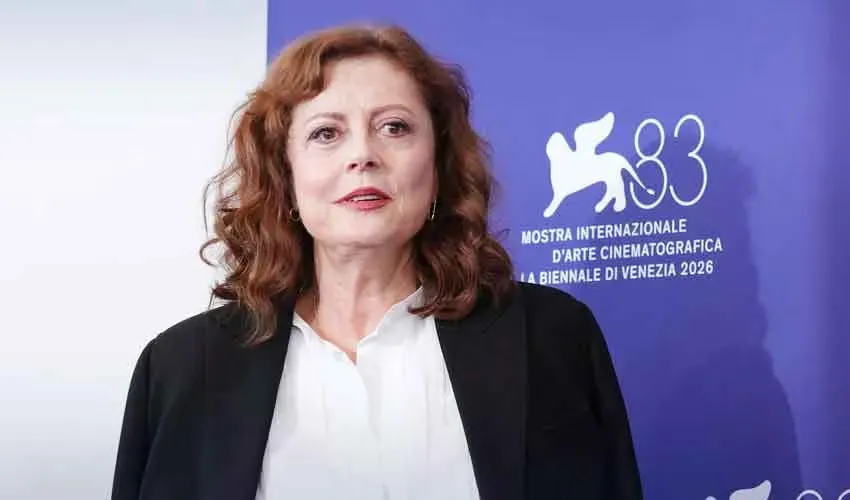
Oscar-winning actor Susan Sarandon said she continues to lose acting opportunities because of her outspoken support for Palestinians, telling reporters at the Venice Film Festival that parts of Hollywood remain unwilling to work with her.
The 79-year-old actor made the comments on Sunday while promoting her latest film, “The Echo Chamber,” at the festival. She said public attitudes toward the Israel-Palestine conflict had shifted but argued that the entertainment industry’s major power structures had been slower to change.
“I’ve still had movies taken away recently because there are agencies that are telling people not to hire me still,” Sarandon said.
She added that she felt welcomed internationally despite what she described as continued resistance within parts of the US film industry.
Sarandon Says Views on Palestine Have Changed
Sarandon said she believes the public conversation surrounding Palestine and US support for Israel has changed significantly since the start of the Gaza war in 2023.
“I think that the narrative has completely changed in terms of the historical relevance of Palestine,” she said, pointing to greater public awareness of US financial support for Israel.
Public opinion in the United States has shifted on some aspects of the conflict since the war began, with polling in recent years showing changing views on Israel and growing sympathy for Palestinians among some groups.
Sarandon said those changes had not necessarily translated into greater professional opportunities for actors and filmmakers who publicly criticize Israel.
Susan Sarandon’s Hollywood Career and Activism
Sarandon, who won an Academy Award for “Dead Man Walking,” has had a career spanning several decades. Her other notable films include “The Rocky Horror Picture Show,” “Bull Durham” and “Thelma & Louise.”
Her political activism has occasionally affected her professional relationships.
In 2023, United Talent Agency dropped Sarandon after comments she made while attending pro-Palestinian rallies following the Hamas attack on Israel that triggered the subsequent Gaza war.
Sarandon has continued to publicly support Palestinians and criticize aspects of US policy toward Israel.
At the Venice Film Festival, she said resistance to hiring outspoken critics of Israel remained particularly strong at major studios.
“If it is a major studio, I think it’s not just with me but with other people who have been told that that is impossible,” she said.
She also thanked Andrea Pallaoro, the director of “The Echo Chamber,” for giving her a role in the film.
“I found my family, I found my people and I’m OK,” Sarandon said, drawing extended applause from those attending the news conference.
Palestine Debate Reaches Venice Film Festival
The Israel-Palestine conflict has also become part of the wider discussion surrounding this year’s Venice Film Festival.
Activists have called on festival organisers to display the Palestinian flag in recognition of Palestinian directors whose films are being screened at the event.
Venice artistic director Alberto Barbera has said the festival cannot formally raise the Palestinian flag because Italy does not recognise Palestine as a state.
Barbera has nevertheless highlighted films at the festival that portray the experiences and struggles of ordinary Palestinians.
The debate has added a political dimension to an event that brings together filmmakers, actors and industry figures from around the world.
What Is Susan Sarandon’s New Film?
Sarandon is appearing in “The Echo Chamber,” one of the 21 films competing for the Golden Lion, Venice’s top prize.
The film is based on the final screenplay by Italian filmmaker Bernardo Bertolucci. Sarandon plays an ageing singer who hires a music producer recovering from drug addiction to help produce a comeback album.
The Golden Lion winner is scheduled to be announced on September 12.
For Sarandon, the Venice appearance provides an opportunity to promote a new film while also highlighting what she describes as the continuing professional consequences of her political activism.
Her comments underline the ongoing tension between political expression and professional relationships in Hollywood, particularly as debates over the Gaza war continue to influence cultural institutions and the entertainment industry.
