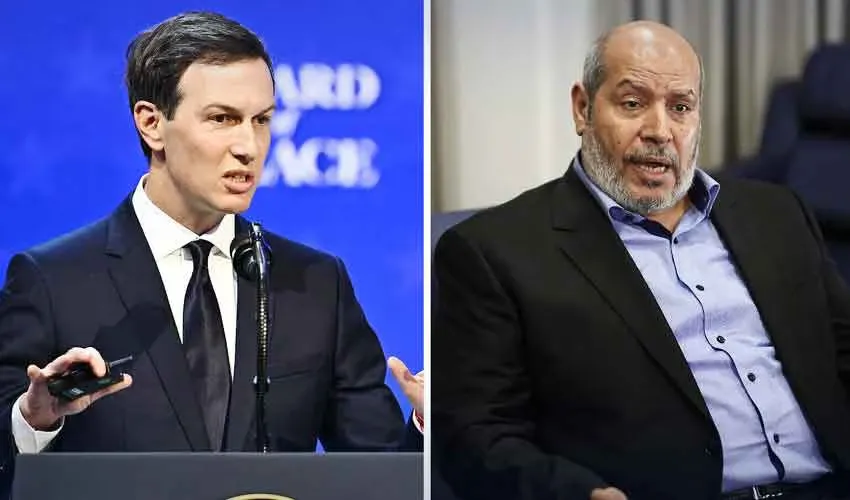
US President Donald Trump’s son-in-law and Middle East envoy Jared Kushner held a rare meeting with Hamas leaders in Egypt on Sunday, as Washington works to revive a stalled Gaza peace roadmap that Israel has rejected.
The talks, held in the coastal town of El-Alamein, focused on translating the US-backed plan into concrete steps — including Hamas’s disarmament, the transfer of governance in Gaza, and corresponding Israeli measures.
Kushner’s First Hamas Meeting Since the Ceasefire
Kushner met Hamas political leader Khalil al-Hayya and other members of the group’s leadership, marking his first direct meeting with Hamas officials since October 2025, when he took part in talks that helped finalize the ceasefire and hostage-release agreement. A source with direct knowledge of Sunday’s meeting described it as productive, with reports placing its length at somewhere between 90 minutes and more than two hours.
Kushner was joined by Board of Peace high representative and Gaza director-general Nickolay Mladenov, along with board member and former British Prime Minister Tony Blair. Egyptian intelligence chief Hassan Rashad, Qatari diplomat Ali al-Thawadi, and a senior Turkish official also attended, alongside Board of Peace senior advisers Aryeh Lightstone and Liran Tancman, according to reports. The goal was to turn the Board of Peace’s 15-point Gaza roadmap into concrete, verifiable steps to sustain the ceasefire and advance toward the plan’s second phase.
US Pushes Hamas on Disarmament
Disarmament dominated the discussions. A source familiar with the meeting said Kushner told Hamas that the US wants tangible action rather than assurances, given Israel’s distrust that the group will follow through.
The source said Gaza “can never again be a source of terror for Israel”, and that Hamas must give up its governing authority along with all weapons and military infrastructure.
Kushner reportedly told Hamas there was no room to negotiate on disarmament itself but indicated that genuine progress from the group would prompt the US to push Israel toward reciprocal steps.
In response, Hamas leaders asked Kushner to relay to Trump that they remained committed to disarming and demilitarizing Gaza and said they were prepared to hand governing authority to a Palestinian technocratic government without interference once it began operating.
Hamas Ties Disarmament to Israeli Commitments
Hamas leaders also voiced frustration over continued Israeli military operations in Gaza. According to sources familiar with the talks, al-Hayya told Kushner that Hamas would only begin implementing disarmament once Israel publicly committed to its own obligations under the roadmap — including halting strikes and withdrawing to the so-called “yellow line.”
That line has never been precisely defined, and Israeli forces have moved beyond it. Reports indicate Israel currently controls roughly 60 percent of Gaza, with Prime Minister Benjamin Netanyahu saying in May that Israel intended to expand control to 70 percent. Netanyahu has maintained that Israeli forces will not withdraw from any position in Gaza until Hamas is fully disarmed.
Hamas Reaffirms Acceptance of Roadmap’s Second Phase
Following the meeting, Hamas said it had reaffirmed acceptance of the roadmap for the plan’s second phase, which the group said should include a permanent ceasefire, a full Israeli withdrawal from Gaza, sustained humanitarian assistance, and the start of reconstruction.
Hamas said it had fully complied with the first phase of the ceasefire agreement while accusing Israel of failing to meet its own obligations, escalating military operations, and worsening humanitarian conditions. The group called on mediators and the Board of Peace to press Israel to fulfill its first-phase commitments, halt violations, and agree to a timetable for the second phase. Hamas also credited Trump’s role in reaching the ceasefire, though its statement notably did not explicitly address disarmament, despite the issue being central to the Kushner talks.
What the US-Backed Roadmap Envisions
Under the roadmap, Hamas would gradually surrender its weapons and military infrastructure while transferring governing authority to the National Committee for the Administration of Gaza (NCAG), a Palestinian technocratic body meant to oversee daily administration under the Board of Peace’s broader framework. The committee has not yet entered Gaza.
The plan also calls for deploying an International Stabilization Force, advancing reconstruction, and increasing humanitarian assistance. If Hamas begins handing over weapons, corresponding Israeli steps could include allowing the stabilization force to deploy, enabling reconstruction in the Rafah area, and discussing initial troop withdrawals — alongside accelerated humanitarian relief, which the Board of Peace has also pushed Israel to expand.
A regional diplomat said the first weapons handover to the NCAG is unlikely before the end of 2026, since the International Stabilization Force remains in early training stages. The diplomat also expressed doubt that Netanyahu would allow significant disarmament progress before Israel’s October 27 Knesset election, with a further one- to two-month delay possible while a new government forms.
Israel Has Rejected the Roadmap
The Kushner-Hamas meeting came just days after Netanyahu publicly rejected Trump’s latest Gaza roadmap — an unusual point of friction between the Israeli government and the Trump administration. The plan has been described in various reports as both a 15-point roadmap and part of a broader 20-point US peace framework.
Netanyahu has called the proposal unacceptable to Israel and insists Hamas must be fully disarmed before any Israeli withdrawal. The roadmap itself envisions Hamas gradually surrendering weapons while Israel simultaneously halts attacks and begins withdrawing—making sequencing the central point of disagreement: Hamas wants Israeli commitments and withdrawal alongside its own disarmament, while Israel insists disarmament must come first.
Kushner Also Addressed Displacement Concerns
A Palestinian source told Al Jazeera that Hamas briefed Kushner on alleged Israeli ceasefire violations during the meeting, and that Kushner told Hamas the US rejects any plans to displace Gaza’s residents. The talks took place against the backdrop of an ongoing and serious humanitarian situation in the enclave.
Kushner reportedly thanked Hamas leaders for their cooperation in recovering the remains of deceased Israeli hostages, while Hamas representatives thanked the Trump administration and the Board of Peace for efforts to improve humanitarian conditions in Gaza.
Kushner Meets Egypt’s President, Prepares for Israel Trip
After the Hamas meeting, Kushner held talks with Egyptian President Abdel Fattah el-Sisi, with Egypt’s presidency saying the two discussed the Gaza situation along with broader Egypt-US relations. El-Sisi highlighted the strategic partnership between the two countries, while Kushner praised Egypt’s coordination with Washington and el-Sisi’s role in advancing regional stability. Separately, Hamas’s al-Hayya met with Egyptian intelligence chief Hassan Rashad.
Kushner is scheduled to travel to Israel on Monday for talks with Netanyahu, accompanied by Mladenov and Blair, as the US and the Board of Peace seek to understand Israel’s concerns and find a path forward. A senior Israeli official said the talks are expected to address Washington’s demand for reciprocal Israeli steps, including concerns over targeted killings of Hamas fighters in Gaza. The Board of Peace has said its goal is for both sides to agree on a desired outcome and accelerate the roadmap’s implementation.
Regional Countries Back the Roadmap
Several regional governments have criticized Israel’s rejection of the US-backed plan. Saudi Arabia, the United Arab Emirates, Jordan, Pakistan, Indonesia, and the Gaza ceasefire mediators issued a joint statement condemning the rejection, saying Israel bears responsibility for obstructing peace efforts in Gaza. The foreign ministers called on the Board of Peace and the United States to take immediate, concrete steps to prevent any party from blocking implementation.
A Rare Direct Engagement With Hamas
For years, the US avoided direct contact with Hamas, which Washington designates as a terrorist organization. The Trump administration has increasingly broken from that pattern as part of its push to end the conflict and advance the ceasefire, with officials defending the contacts as necessary while critics argue such meetings risk legitimizing the group.
Sunday’s meeting was Kushner’s first with al-Hayya and other Hamas leaders since the October 2025 ceasefire and hostage-release negotiations — talks that, alongside fellow US envoy Steve Witkoff, helped secure the original ceasefire. Progress since then has largely stalled over the disarmament question.
What Happens Next
Attention now shifts to Kushner’s meeting with Netanyahu and whether Washington can persuade both sides to accept reciprocal steps. For Hamas, the roadmap requires disarmament, demilitarization, and an end to its governing role in Gaza. For Israel, the central demand remains the complete removal of Hamas’s military capabilities before any full withdrawal.
The Board of Peace wants Hamas to begin decommissioning weapons and infrastructure while Israel takes corresponding steps — including facilitating humanitarian relief, allowing the International Stabilization Force into Gaza, and considering troop withdrawals. Whether these parallel steps can overcome deep mistrust between the two sides will determine whether the roadmap moves from diplomatic discussion to actual implementation.
About Tamoor Ahmed

Tamoor Ahmad has been covering politics since 2022.
