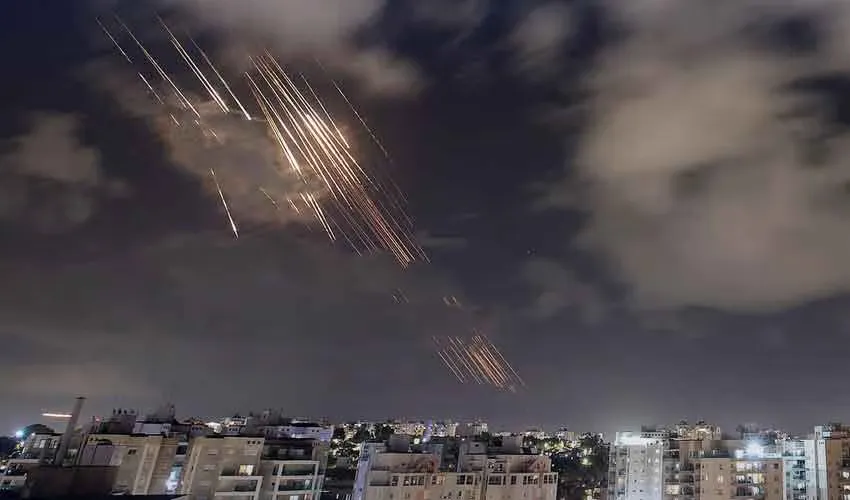
The United States launched a ninth consecutive night of military strikes on Iran on Monday, escalating the conflict following recent American troop casualties in Jordan and Iraq and increasing tensions across the Middle East.
The latest exchange of attacks has also heightened concerns over the security of the Strait of Hormuz, a vital global shipping route, after reports of damaged oil tankers and renewed warnings about threats to commercial maritime traffic.
US expands military campaign
The US military carried out fresh strikes across several parts of Iran, with explosions reported in Hormozgan and Bushehr provinces.
According to Iran’s semi-official Tasnim News Agency, attacks were also reported in Sirik, Chabahar, Konarak, Tabriz, Khuzestan, Bandar Mahshahr and Bandar Imam Khomeini.
US Central Command said it had launched a new wave of operations targeting Iranian military command centers, air defense systems, and coastal surveillance sites that it said posed a threat to commercial shipping passing through the Strait of Hormuz.
President Donald Trump said the latest operation delivered another severe blow to Iran’s military capabilities, repeating his claim that Tehran had been left with “almost nothing.”
US troop casualties fuel escalation
The latest military action followed recent casualties among US forces in Iraq and Jordan.
The US military said one service member was killed in northern Iraq while handling unexploded ordnance recovered from a downed Iranian drone. Secretary of State Marco Rubio later clarified that the death was accidental.
Earlier, two American service members were killed in Jordan, while another remains missing. US Central Command said unidentified remains recovered from the site of Friday’s attack are undergoing forensic examination.
According to US officials, the conflict has now claimed the lives of 17 American military personnel, while more than 420 others have been injured.
Iran launches new missile attacks
Iran responded by launching another wave of missiles from Lorestan province, according to Iranian media.
The Islamic Revolutionary Guard Corps claimed responsibility for attacks on what it described as enemy military positions in Syria’s Al-Tanf region and said it had targeted US aircraft stationed at Jordan’s Aqaba Airport.
Iranian officials also claimed ballistic missiles penetrated Jordan’s air defense system and struck multiple US military warehouses.
The Revolutionary Guards further announced that an American MQ-9 drone had been shot down in Kermanshah province, while Iranian media reported the destruction of another enemy drone in southern Iran.
Gulf tensions continue to rise
Iran also claimed responsibility for drone attacks targeting US military facilities in Kuwait, including Al-Adiri Camp and Ali Al Salem Air Base.
Kuwaiti authorities confirmed that a desalination plant had been damaged for the second consecutive day, prompting emergency measures to protect critical infrastructure and the national electricity grid.
An air defense alert remained in effect across Kuwait as regional tensions continued to escalate.
Strait of Hormuz remains under pressure
The Strait of Hormuz remains at the center of the conflict as concerns grow over the safety of international shipping.
The United Kingdom Maritime Trade Operations reported that a vessel caught fire near the coast of Oman, although the cause has not been confirmed.
Iran’s Revolutionary Guards later claimed that two oil tankers became disabled after explosions while navigating what it described as an unsafe southern route through the Strait of Hormuz.
The group also warned that the waterway would remain unsafe for oil, gas and petrochemical shipments as long as US military operations continued.
Shipping activity through the strategic passage has already slowed, while international benchmark oil prices climbed about 2 percent to above 90 dollars per barrel amid fears of supply disruptions.
Washington says operations will continue
Secretary of State Marco Rubio defended the ongoing military campaign, saying the United States would continue targeting Iranian military assets while commercial shipping remained under threat.
He described the Strait of Hormuz as an international waterway and said Washington remained committed to protecting freedom of navigation while continuing to pursue diplomatic options.
The US Embassy in Bahrain also issued a security advisory warning of possible threats as tensions continue to rise across the Gulf.
Conflict shows no sign of easing
The latest escalation comes after an interim ceasefire agreement between Washington and Tehran collapsed, with both sides accusing each other of repeated violations.
The broader conflict began on February 28, when the United States and Israel launched military operations against Iran, saying the objective was to weaken Tehran’s nuclear and missile capabilities and reduce the influence of its regional allies.
Since then, the conflict has claimed thousands of lives, primarily in Iran and Lebanon, while raising concerns about regional stability, global energy markets, and international security.
