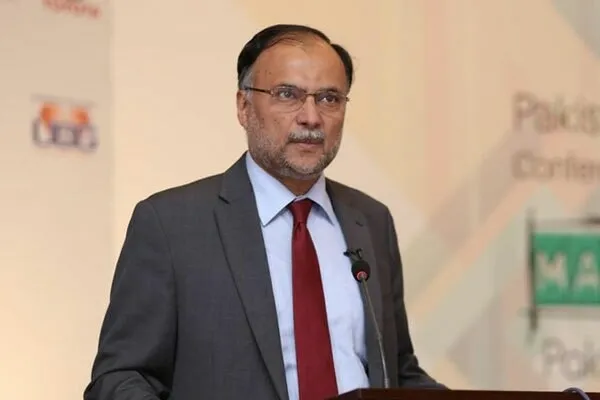
The federal government is unlikely to have meaningful fiscal space for launching new development projects in the upcoming fiscal year, as existing commitments are expected to absorb most of the Public Sector Development Programme (PSDP) for FY2026-27, Planning Minister Ahsan Iqbal said on Tuesday.
Speaking at a meeting of the Annual Plan Coordination Committee (APCC), the minister said federal ministries and divisions had submitted development demands totaling nearly Rs. 3 trillion for the next fiscal year.
However, he warned that severe resource constraints would force the government to prioritize only a limited number of ongoing and critical projects.
Ahsan Iqbal said Pakistan’s development spending has steadily eroded over the past several years. He noted that public development expenditure has declined from around 2.6 percent of gross domestic product to just 0.6 percent, reflecting shrinking fiscal space since FY2018.
As a result, hundreds of projects have been delayed or stalled, creating a cumulative throw-forward liability estimated at nearly Rs. 10 trillion.
The planning minister pointed out that the federal PSDP has remained stuck at around Rs. 1 trillion, roughly the same level seen in 2018, despite rising construction costs and expanding development needs.
In contrast, provincial development budgets have grown significantly, largely due to higher transfers under the National Finance Commission framework.
He disclosed that a substantial portion of the available PSDP has already been committed. On the directives of Prime Minister Shehbaz Sharif, Rs. 125 billion has been earmarked for the N-25 highway project in Balochistan.
Additional allocations include around Rs. 100 billion for Balochistan and another Rs. 150 billion for Azad Jammu and Kashmir, Gilgit-Baltistan, and the merged districts of Khyber Pakhtunkhwa.
According to the minister, foreign-funded projects alone initially required a rupee cover of Rs. 832 billion. After extensive rationalization, this requirement was reduced to Rs. 426 billion.
Even after these adjustments, only about Rs. 165 billion remains available within the PSDP envelope. Once the impact of development spending cuts in the current fiscal year is factored in, the remaining fiscal gap effectively leaves no room for initiating new projects.
Ahsan Iqbal said the PSDP portfolio currently consists of 786 projects, including 197 large-scale schemes. Nearly 81 percent of total development allocations are tied up in mega projects, while another 15 percent is committed to medium-sized initiatives, leaving minimal flexibility for new interventions.
He urged provincial governments to take on a greater role in financing and executing development projects, noting that in several sectors, provinces now command larger financial resources than the federal government. Without stronger provincial participation, he warned, Pakistan’s development momentum could remain constrained despite growing infrastructure and social sector needs.
The remarks highlight the difficult choices facing policymakers ahead of the FY2026-27 budget, as debt servicing pressures, limited revenues, and legacy commitments continue to crowd out space for fresh development spending.
