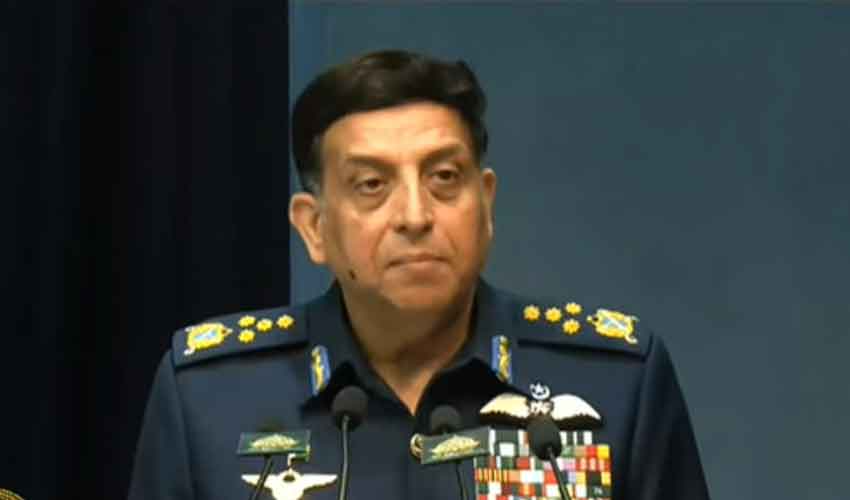
A ceremony was held at Air Headquarters Islamabad to mark the completion of one year of Marka-e-Haq, where senior military officials highlighted the operational performance of the Pakistan Air Force and its role in national defence readiness.
The event brought together serving officers, defence analysts, and senior representatives from the armed forces.
The Pakistan Air Force leadership described the period under review as significant in terms of operational preparedness and modern warfare adaptation.
The ceremony focused on air defence capabilities, electronic warfare development, and evolving security challenges in the region.
Ceremony marks operational review of Marka-e-Haq
The central focus of the event was a review of Marka-e-Haq, a term used by the military leadership to describe recent operational engagements and defence preparedness efforts.
Chief of Air Staff Zaheer Ahmad Babar Sidhu addressed the ceremony in Islamabad on May 7, 2026. He congratulated Pakistan Air Force personnel and praised what he called their operational readiness and swift response capability.
“Pakistan Air Force demonstrated its ability to respond with precision and speed in complex operational conditions,” he said during his address. He added that the force remained fully prepared to defend national airspace under all circumstances.
And he stressed that modern warfare required integration across air, cyber, and electronic domains, which the Pakistan Air Force has been actively developing in recent years.
Claims of operational success and regional tensions
During his speech, the Air Chief referred to tensions following the Pahalgam incident, stating that Pakistan had offered an impartial investigation, which he said was not accepted.
He further claimed that subsequent developments led to military escalation, where Pakistan responded with coordinated operational measures.
These claims were part of the broader narrative presented during Marka-e-Haq, though independent verification of specific operational outcomes remains limited.
According to ISPR Director General Ahmed Sharif Chaudhry, speaking to local media in Islamabad on May 6, 2026, the armed forces maintained a “high level of operational readiness across all domains during recent periods of heightened regional tension.”
He stated, “Pakistan’s defence posture is based on deterrence, readiness, and rapid response capability across multiple theatres.”
So, both civilian and military communications have emphasised preparedness and deterrence as central themes in recent defence messaging.
Local context and public engagement in Islamabad
The ceremony also drew attention from defence enthusiasts and analysts in Islamabad and Rawalpindi. Outside the Air Headquarters vicinity, small groups gathered near the Pakistan Secretariat Road and nearby sectors where security movement briefly affected traffic flow.
In Rawalpindi’s Saddar Market, discussions around Marka-e-Haq and defence developments were visible among shopkeepers and commuters. Some traders noted that national security events often influence public sentiment, particularly in areas close to military installations.
A local transport operator in Rawalpindi said he observed increased movement around the Air Headquarters area during the ceremony, which briefly affected travel timings on Murree Road.
Defence modernization and economic context
Officials highlighted ongoing modernization efforts within the Pakistan Air Force, particularly in cyber and drone warfare capabilities. These developments were described as part of a long-term strategy to align with modern defence requirements.
And while military officials focused on operational themes, broader economic indicators also reflect national priorities.
According to State Bank of Pakistan (SBP) data from March 2026, defence-related allocations remain a significant component of public expenditure, although overall fiscal pressure continues to be managed through structural reforms.
The data shows that Pakistan’s economic policy has been balancing defence spending with external financing requirements, particularly under IMF-linked fiscal frameworks.
Marka-e-Haq narrative and strategic messaging
The Marka-e-Haq framework was repeatedly referenced during the ceremony as a symbol of operational discipline and institutional coordination.
Military leadership emphasised that future conflict scenarios would require faster response times and stronger integration between conventional and digital warfare systems.
And the Air Chief concluded that training, technology, and adaptability remain the core pillars of Pakistan Air Force doctrine moving forward.
The ceremony ended with recognition awards for selected personnel and operational units. Officials reiterated that Marka-e-Haq reflects an ongoing process of capability enhancement rather than a single operational event.
About Tamoor Ahmed

Tamoor Ahmad has been covering politics since 2022.
