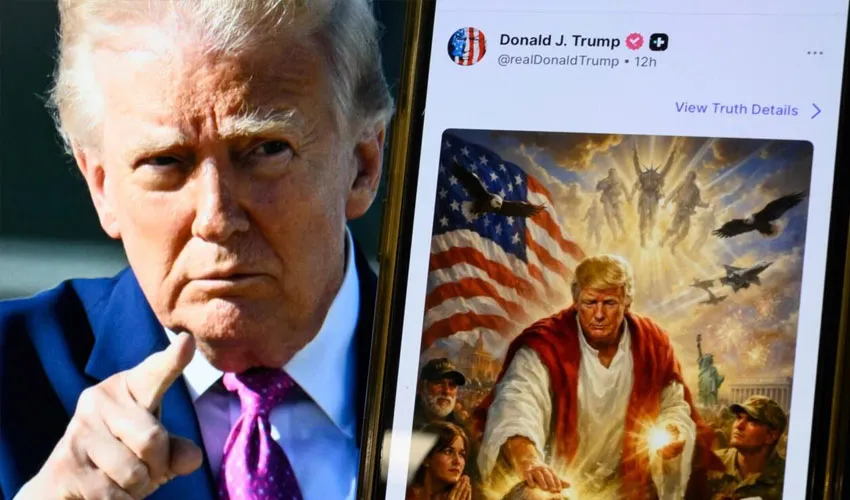
US President Donald Trump has triggered widespread backlash after posting — and later deleting — an AI-generated image that depicted him in a Jesus-like pose, intensifying tensions with Pope Leo XIV and drawing criticism from political, religious, and international figures.
The image, shared on Trump’s Truth Social platform on Sunday, showed the former president dressed in a white robe, placing his hand on another man’s head in a scene resembling a faith-based healing. The post was removed on Monday following strong criticism, with opponents calling it offensive, inappropriate, and blasphemous.
Responding to the controversy, Trump told reporters that the image was meant to portray him “as a doctor” or a Red Cross worker, dismissing criticism as “fake news.”
Escalation with Pope Leo XIV
Trump also used the moment to attack Pope Leo XIV, describing him as “weak on crime” and “terrible for foreign policy,” and adding that he does not want a pope who criticises the US president.
The remarks further strained already fragile relations between the Vatican and the White House, which have been under pressure in recent months over immigration, military actions, and international conflicts.
Pope calls for peace, avoids direct clash
Pope Leo XIV responded indirectly, saying he did not wish to engage in a public dispute with Trump. Speaking during a visit to Algeria, the pontiff emphasised the importance of peace, dialogue, and multilateral cooperation, highlighting the suffering of innocent civilians in global conflicts.
Senior Catholic leaders in the United States strongly condemned Trump’s remarks.
Archbishop Paul S. Coakley said the pope “is not his rival,” stressing that the pontiff’s role is spiritual, not political. Archbishop George Leo Thomas praised Pope Leo for “speaking truth to power” and advocating dialogue over division.
Political and international backlash
The controversy sparked international reaction, with Giorgia Meloni calling Trump’s comments “unacceptable” and defending the pope’s role in promoting peace.
US Senator Bernie Sanders also criticised Trump, describing the post as “egomaniacal” and deeply offensive to religious communities.
Criticism extended into conservative circles, with figures such as Brilyn Hollyhand, Riley Gaines, and Megan Basham calling the image blasphemous and demanding its removal and an apology.
Conservative commentator Isabel Brown labelled the post “disgusting,” stressing the importance of respecting religious beliefs.
Faith, politics, and ongoing tensions
Despite the backlash, Trump continues to command strong support among Christian voters. In the 2024 election, a majority of Catholic voters backed him, reflecting his enduring influence within religious communities.
Following a failed assassination attempt in July 2024, some supporters even described Trump’s survival as a sign of divine protection — a narrative that has further blended religion and politics around his public image.
The latest controversy has deepened divisions between Trump and the Vatican, underscoring the growing strain between political power and religious authority in an increasingly polarized global climate.
