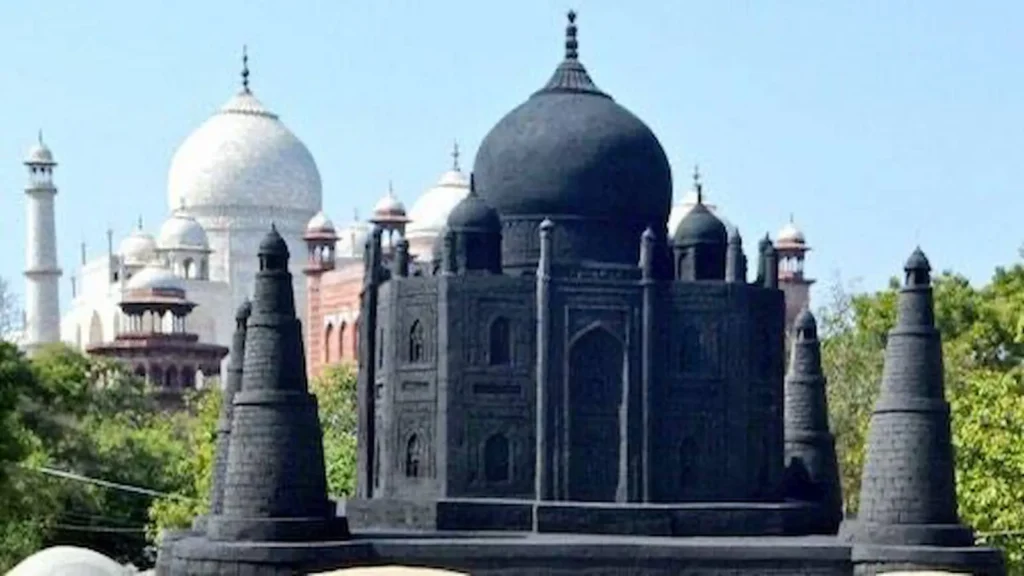
The black Taj Mahal legend suggests that Mughal Emperor Shah Jahan intended to build a second mausoleum in black marble on the opposite bank of the Yamuna River, directly facing the Taj Mahal in Agra, and connect both structures with a bridge.
The story was partly popularised by early traveller accounts, including Jean-Baptiste Tavernier, who mentioned that Shah Jahan may have begun planning his own tomb across the river. Some later guidebooks and gazetteers repeated this claim, adding to its popularity over time.
According to the legend, the proposed structure would have mirrored the Taj Mahal but in black marble, symbolising the emperor’s own resting place opposite that of his wife Mumtaz Mahal. Some writers even pointed to the Mehtab Bagh area and nearby structures such as the Mehtab Burj as possible remains of this unfinished plan.
However, most modern historians reject this interpretation.
Contemporary Mughal sources, including court historians, make no reference to any plan for a “black Taj Mahal.” There is also no archaeological evidence confirming that a second mausoleum was ever formally designed or begun.
Also read: BJP to ‘claim’ Taj Mahal considering it as Hindu Monument
Scholars argue that Tavernier’s account is unreliable, as his travel notes appear to mix separate events and interpretations. He visited India at different times, including while the Taj Mahal was still under construction and again after its completion, but there is no clear evidence linking his observations to an actual second tomb project.
The structures often cited as “foundations” of the black Taj are now understood to be part of the Mehtab Bagh garden complex, originally laid out during earlier Mughal landscaping efforts. Archaeological findings show water channels, garden layouts, and pavilion remains that align with char-bagh design traditions rather than a mausoleum foundation.
Architectural comparisons also weaken the legend. The Mehtab Burj, for example, differs significantly in size, structure, and elevation from the Taj Mahal’s river-facing towers, making it unlikely to be part of a mirrored construction plan.
Another argument sometimes cited is the slightly off-centre placement of Shah Jahan’s cenotaph inside the Taj Mahal. However, similar arrangements exist in other Mughal tombs, such as the Itmad-ud-Daulah complex, where asymmetry in burial placement follows established funerary traditions rather than indicating unfinished architectural plans.
In Islamic burial practice, positioning also follows specific rules, including orientation toward Mecca and the traditional placement of the husband relative to the wife, which further explains the internal layout of the Taj Mahal tomb chamber.
Overall, historians describe the idea of a black Taj Mahal as more romantic myth than historical fact. While it remains a popular story in travel literature and folklore, the evidence strongly suggests that no second mausoleum was ever planned or started by Shah Jahan.
