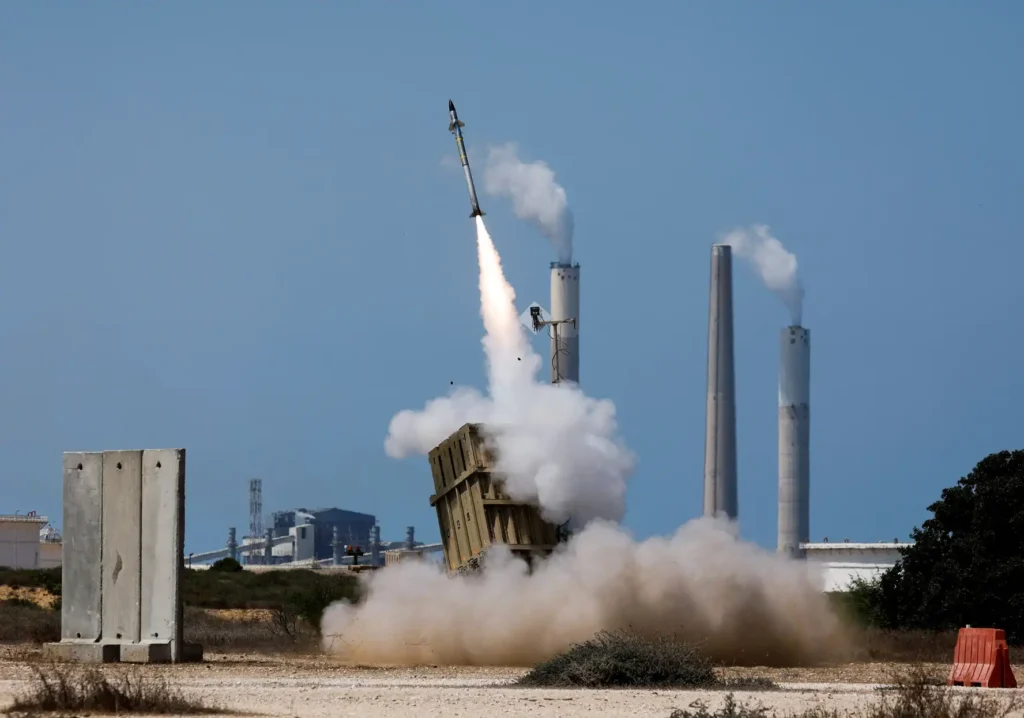
Israel quietly deployed one of its Iron Dome air-defense batteries to the United Arab Emirates during the opening phase of its recent conflict with Iran, according to foreign media reports cited by Axios.
Israeli and American officials said the deployment took place during Operation Roaring Lion, the brief but intense U.S.–Israel confrontation with Iran. It marked the first known operational use of the Iron Dome system outside Israel and the United States.
The battery was reportedly manned by several dozen Israeli troops and successfully intercepted dozens of Iranian missiles aimed at Emirati territory.
According to the reports, the decision was personally approved by Israeli Prime Minister Benjamin Netanyahu following a phone conversation with UAE President Sheikh Mohammed bin Zayed Al Nahyan.
UAE among the most heavily targeted states
During the conflict, Iran launched what Emirati defense officials described as an unprecedented barrage toward the UAE, firing an estimated 550–560 ballistic and cruise missiles along with more than 2,200 drones.
Analysts at the UK-based International Institute for Strategic Studies said the scale of the attacks appeared to be a direct warning from Tehran over Abu Dhabi’s close ties with Israel.
Although the majority of incoming threats were intercepted, some missiles and drones reportedly breached the UAE’s air defenses.
Foreign reports said strikes affected both military and civilian-linked sites, with parts of Dubai—including the International Financial Centre, airfields, and areas near the U.S. consulate—among the locations hit.
The intensity of the attacks prompted Abu Dhabi to request additional assistance. Alongside Israel, the United States and several Western partners reportedly helped reinforce the UAE’s defensive posture during the fighting.
Joint strikes and deepening coordination
Israeli and Emirati officials said coordination between their militaries remained close throughout the war.
The Israeli Air Force reportedly conducted strikes in southern Iran aimed at neutralizing short-range missile threats to Gulf states, while the United States led broader operations against Iranian ballistic missile units to reduce the volume of fire directed at the UAE.
The cooperation builds on ties formalized under the Abraham Accords, which normalized relations between Israel and the UAE in 2020.
Since then, security and intelligence collaboration has steadily expanded, with officials on both sides describing the wartime coordination as unprecedented.
A senior Emirati official quoted by Axios said Abu Dhabi would “not forget” Israel’s assistance, while another praised the United States, France, the United Kingdom, Italy and Australia for helping defend the country, calling the experience a defining test of alliances.
Regional and political sensitivities
The reported deployment could prove controversial inside Israel, where critics may question the decision to station an Iron Dome battery abroad while Israel itself faced sustained Iranian fire.
The presence of Israeli troops on Emirati soil could also carry political sensitivities for Abu Dhabi, despite the rapidly strengthening defense relationship.
Notably, Saudi Arabia did not receive an Iron Dome system during the conflict. While Israel and Saudi Arabia reportedly cooperated through a U.S.-led regional air-defense framework, there were no indications of direct Israeli deployments to the kingdom.
Riyadh has linked any future normalization with Israel to progress toward a two-state solution for Palestinians.
Broader interest in Iron Dome
Other countries have also sought access to Israel’s missile-defense technology. Ukrainian President Volodymyr Zelensky has repeatedly asked Israel to provide Iron Dome systems to counter Russian attacks, requests Israel has so far declined. Meanwhile, Singapore has reportedly acquired Iron Dome systems, and Romania is expected to follow.
The reports also come as U.S. President Donald Trump promotes the idea of a “Golden Dome” missile shield, inspired by Israel’s system but envisioned as a space-based network using hundreds of satellites to detect and track incoming missile threats.
