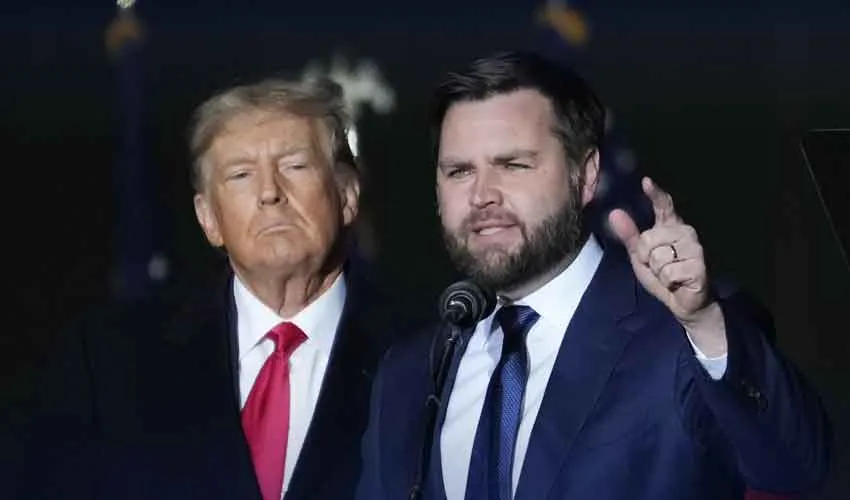
US Vice President JD Vance has said that ongoing US–Iran nuclear negotiations in 2026 are continuing despite deep-rooted mistrust, adding that diplomatic efforts remain active under President Donald Trump’s Iran policy framework.
Speaking at a Turning Point USA event, Vance reiterated Washington’s central position that Iran must not be allowed to acquire nuclear weapons, a key pillar shaping the current Iran nuclear deal negotiations 2026.
He emphasized that the Trump administration is not pursuing a limited agreement, but instead aims for a comprehensive Iran nuclear agreement, covering long-term nuclear restrictions, verification mechanisms, and broader geopolitical stability. According to Vance, the lack of a breakthrough reflects Washington’s refusal to accept a partial or temporary arrangement.
A major component of the ongoing talks is the inclusion of US economic incentives for Iran, with Vance stating that Washington is prepared to help Iran achieve economic reintegration and global financial normalization if it agrees to abandon nuclear weapons development.
He described the offer as historically significant, highlighting that such a proposal represents one of the most substantial US diplomatic incentives for Iran in decades, tied directly to nuclear compliance and regional de-escalation.
Vance also pointed out that the current engagement marks one of the most direct diplomatic interactions between the two nations in nearly 50 years, reinforcing the importance of the ongoing US–Iran diplomatic dialogue 2026 and high-level communication channels.
Despite limited progress, he acknowledged that US–Iran relations remain strained due to decades of mistrust, making any quick resolution difficult even as both sides continue negotiations in good faith.
He added that Iranian negotiators appear willing to continue discussions, while confirming that US policy remains firmly aligned with Trump’s directive to prevent Iran from developing nuclear weapons under any future agreement.
Vance expressed cautious optimism, saying he feels “very good about where we are,” although he stressed that significant differences still exist over the structure and scope of a potential deal.
Reports also indicate that a fragile US–Iran ceasefire framework is currently holding, while diplomatic discussions may potentially shift toward Pakistan as a possible venue for renewed nuclear talks, following earlier rounds of negotiations held in Islamabad.
President Trump has suggested that US–Iran peace talks could resume within days, although no official confirmation has been made regarding timing, format, or location.
The broader geopolitical context remains tense, with ongoing instability across the Middle East continuing to influence the Iran nuclear crisis 2026 outlook, as well as global concerns over regional security and nuclear non-proliferation.
While both Washington and Tehran remain engaged in dialogue, the future of the US–Iran nuclear deal negotiations 2026 remains uncertain, shaped by mistrust, competing strategic interests, and the challenge of reaching a fully comprehensive agreement.
