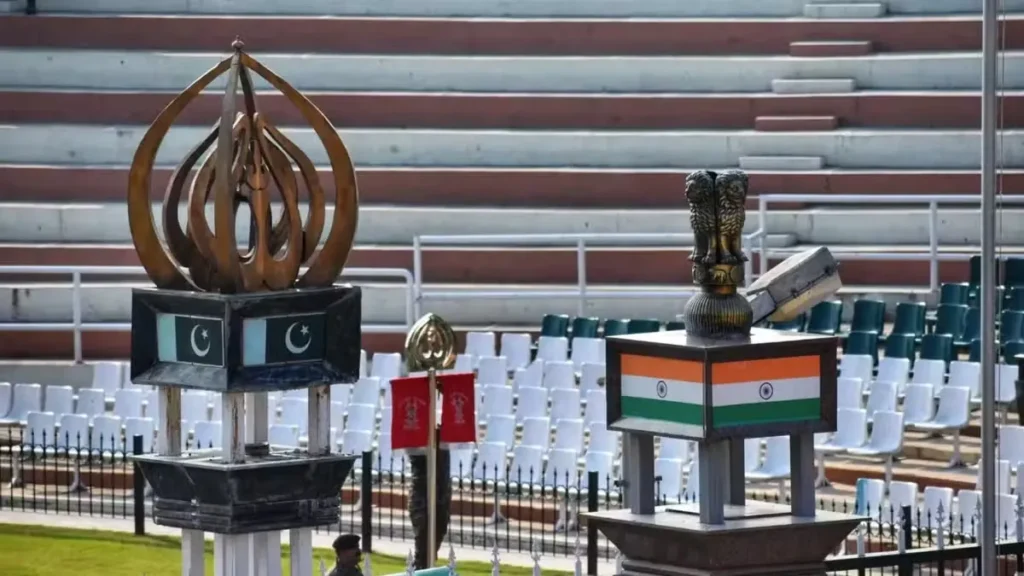
Bollywood actors Ayushmann Khurrana and Sara Ali Khan became the subject of online jokes after a promotional appearance for their upcoming film Udta Teer at the Wagah–Attari border was overshadowed by the sound of Pakistani music playing through loudspeakers.
Videos circulating on social media showed the actors attempting to promote the film as Atif Aslam’s rendition of Taj-e-Dar-e-Haram played nearby. The moment quickly attracted attention online, with users sharing clips and joking about the music drowning out the promotional event.
The incident has added to the attention surrounding Udta Teer, which has drawn criticism over its portrayal of Pakistan. The film is scheduled to release in Indian cinemas on October 23, 2026, but its planned screening in Nepal has already been blocked by the country’s film authorities.
Atif Aslam’s Coke Studio Performance Steals the Show
The border incident became a talking point after the actors’ promotional appearance coincided with the playback of popular Pakistani music.
Atif Aslam’s performance of Taj-e-Dar-e-Haram was particularly prominent in the viral clips. Social media users reacted with jokes and comments, turning the brief encounter into a wider online discussion about the film’s promotion.
The episode has circulated amid heightened sensitivity surrounding Bollywood productions that explore India–Pakistan tensions. However, reactions to the viral footage should not be taken as evidence of a broader public consensus.
What Is ‘Udta Teer’ About?
Directed by Aakash Kaushik, Udta Teer is a spy comedy starring Ayushmann Khurrana and Sara Ali Khan.
The story follows a Pakistani intelligence operative who travels to India and loses his memory after an accident. He subsequently begins to believe that he is an Indian counterterrorism officer, setting up the film’s central conflict.
The storyline has attracted criticism from some viewers who object to its portrayal of Pakistan. Describing the film as anti-Pakistan propaganda, however, reflects a critical interpretation of its narrative rather than an established finding.
The film is scheduled for release in India on October 23, with its promotional campaign generating discussion ahead of its theatrical debut.
Nepal Denies Screening Permission
The film has also encountered a significant obstacle outside India. Nepal’s Central Film Censor Board denied permission for its public screening ahead of the planned release.
According to reporting by India Today, Nepal’s Ministry of Communications and Information Technology informed the local distributor that the film could not be publicly exhibited under the country’s cinema law.
The authorities cited the relevant legal provisions but did not publicly identify the specific scenes or content that prompted the decision.
The restriction applies to public screening in Nepal. It does not, by itself, establish that the film has been banned worldwide or that its scheduled Indian release has been cancelled.
Film Faces Scrutiny Ahead of Release
With the Wagah–Attari video circulating online and the Nepal screening decision attracting media attention, Udta Teer has become a subject of debate before reaching Indian cinemas.
The controversy highlights the sensitivities surrounding entertainment productions that draw on espionage, national identity and regional political tensions.
Whether the online backlash will affect audience interest remains to be seen. For now, the film’s scheduled Indian release and the denial of screening permission in Nepal remain separate developments, while the border incident continues to generate reactions on social media.
