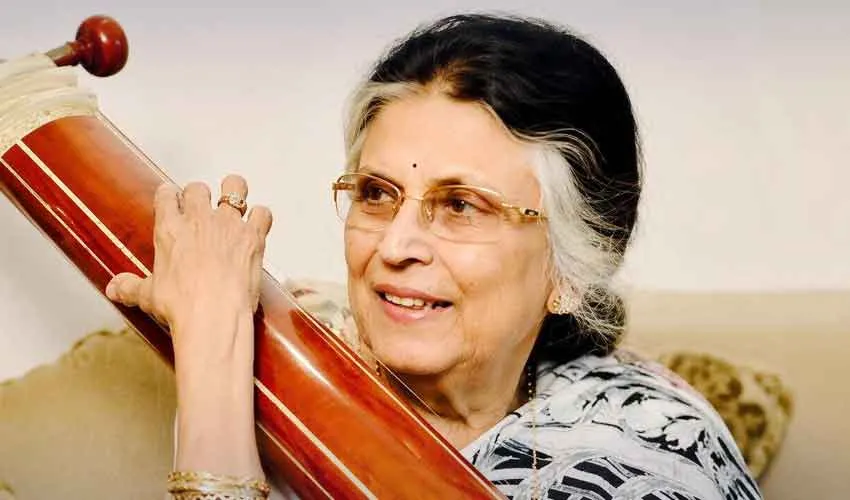
Veteran Indian playback singer Suman Kalyanpur, one of the most graceful voices of Hindi cinema’s golden era, passed away in Mumbai on May 31. She was 89.
Her death marks the end of a musical journey that spanned more than six decades and left an indelible imprint on Indian film and classical music.
According to author and close associate Mangala Khadilkar, Kalyanpur breathed her last around 8pm at her residence in Lokhandwala, Mumbai, following age-related health complications.
Khadilkar, who wrote the acclaimed Marathi biography Suman Sugandh, said the legendary singer spent her final days listening to her own recordings, reconnecting with the music that defined her life and legacy.
Her last rites are scheduled for Monday at 2pm at the Pawan Hans crematorium in Santa Cruz. She is survived by her daughter, Charu.
Kalyanpur’s career unfolded during one of the most prolific and artistically rich periods in Indian film music. Known for her soft timbre, classical control and emotional restraint, she lent her voice to some of Hindi cinema’s most cherished melodies. Her singing style was marked by clarity, elegance and a natural warmth that resonated across generations.
Among her most iconic songs was Aajkal Tere Mere Pyar Ke Charche from Brahmachari, picturised on Shammi Kapoor and Mumtaz.
Other evergreen numbers included Na Na Karte Pyar Tumhin Se from Jab Jab Phool Khile, Tumne Pukara Aur Hum Chale Aaye from Rajkumar, Ajhun Na Aaye Baalma from Saanjh Aur Savera, and Na Tum Humein Jaano from Baat Ek Raat Ki. Each of these songs showcased her ability to convey deep emotion with subtlety rather than force.
Also read: Singer Hasan Raheem is officially married?
Her versatility extended well beyond Hindi cinema. Kalyanpur recorded extensively in Marathi, Bengali, Kannada, Assamese, Odia and several other regional languages.
She was equally revered for her devotional compositions, ghazals and thumris, reflecting a rare command over both classical and light music traditions.
In Marathi music, songs such as Ketakichya Bani Tithe, Sang Kadhi Kalnar Tula and Nimbonyachya Jhadamaghe remain timeless favourites.
Born in Dhaka before the partition of the subcontinent, Kalyanpur later moved with her family to Mumbai. Music entered her life early in a conservative household where singing became a natural outlet.
Her first break came in the early 1950s, and by the age of 16 she was already recording for Hindi films after being introduced to HMV through noted singer Talat Mehmood.
Her rise coincided with an era dominated by the towering presence of Lata Mangeshkar and Asha Bhosle. Kalyanpur’s naturally delicate voice often led to confusion among listeners, with many mistaking her songs for Lata Mangeshkar’s.
While this brought admiration, it also limited her recognition, earning her the unintended label of “the other Lata.” Despite this, composers frequently turned to her when they sought refinement and emotional balance.
In later years, she gradually stepped away from the film industry, with her last widely recognised hit being Behna Ne Bhai Ki Kalai Pe from Resham Ki Dori in 1974. She officially retired from film playback singing in the mid-1980s after contributing to nearly 100 films.
Tributes poured in following news of her passing. Maharashtra Chief Minister Devendra Fadnavis described her voice as divine and timeless, while senior political leaders remembered her as a defining presence of India’s musical heritage.
With Suman Kalyanpur’s death, Indian music has lost one of its most gentle and refined voices. Yet her songs, rich with grace and emotional honesty, continue to live on, ensuring that her legacy endures well beyond her lifetime.
