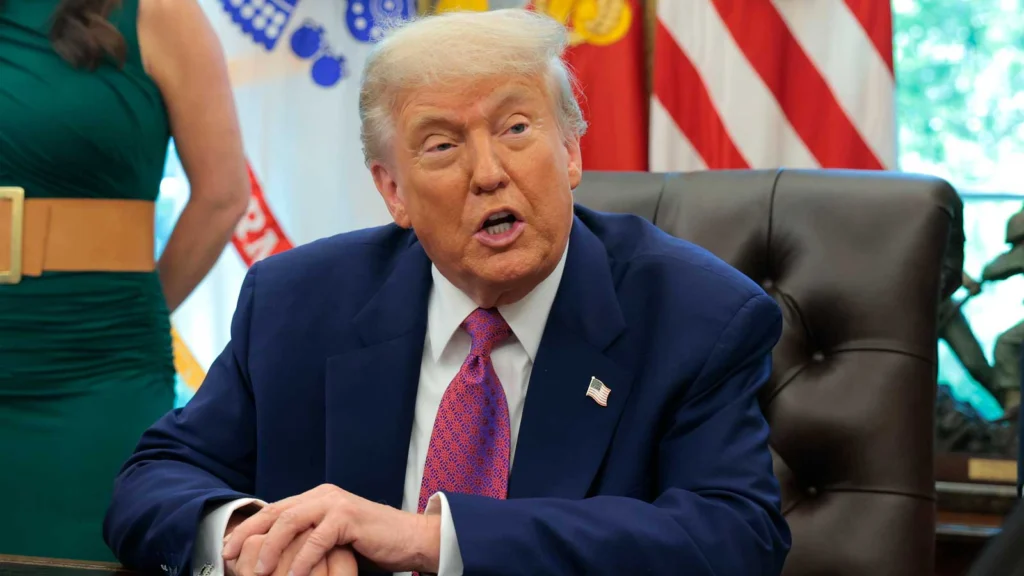
US President Donald Trump has predicted a steep decline in oil and gasoline prices if the United States ends its war with Iran, saying fuel prices could eventually fall below $2 per gallon.
Trump made the comments on Truth Social on Monday as oil prices climbed to their highest level in about six weeks amid continued disruptions to global energy markets and heightened tensions surrounding the Strait of Hormuz.
In his post, Trump said oil prices would drop “precipitously” once the conflict with Iran comes to an end and energy markets begin to stabilise.
“Three Dollars a gallon, but ultimately, below Two Dollars a gallon,” Trump wrote, referring to gasoline prices.
He linked the current increase in energy costs to the ongoing military conflict in the Middle East and suggested that prices would decline rapidly after the United States achieves what he described as victory.
“It will all happen quickly, and Iran will never have a Nuclear Weapon. MAGA!” Trump added.
The president again stressed that Washington would not allow Iran to acquire a nuclear weapon.
Crude prices have moved sharply higher
Trump’s prediction comes as crude prices have moved sharply higher during the conflict.
Brent crude prices climbed above $97 a barrel, reaching a six-week high on Monday, while concerns over disruptions to shipping through the Strait of Hormuz continued to weigh on energy markets.
At the time of the report, November Brent crude futures were up about 0.08% at $97.08 per barrel.
October West Texas Intermediate (WTI) crude futures were trading at $92.37 per barrel, representing an increase of nearly 1%.
Oil prices continued rising over the Labor Day weekend as fighting between the United States and Iran intensified.
Strikes on oil tankers continue
The United States and Iran have been at war since February 28, with tensions increasingly centred on the Strait of Hormuz, a critical route for global energy supplies.
The US struck three Iranian oil tankers on Saturday, according to the report. Iran’s Islamic Revolutionary Guard Corps (IRGC) subsequently responded by striking three tankers and three US-linked vessels in other areas.
The exchanges have heightened concerns about further disruption to energy shipments and added pressure to already elevated oil prices.
Ghalibaf warns America against hitting Iran’s energy facilities
Earlier on Monday, Iranian Parliament Speaker Mohammad Bagher Ghalibaf sent a strong warning to Washington against targeting Iran’s energy infrastructure.
In a post on X, Ghalibaf said Iran’s oil and gas production chain is “sprawling, accessible, and exposed.”
It’s simple: the oil and gas production chain here is sprawling, accessible, and exposed. American oil and gas companies across these waters and facilities share that exposure. Strike our assets and you get struck. We’ve already proven it. Ask the bases that are no longer viable. https://t.co/XiHAf6KzqV pic.twitter.com/0wBf40K4D3
— محمدباقر قالیباف | MB Ghalibaf (@mb_ghalibaf) September 7, 2026
He warned that American oil and gas companies operating across the region and their facilities share that vulnerability.
“Strike our assets, and you get struck. We’ve already proven it. Ask the bases that are no longer viable,” Ghalibaf said.
The warning came as tensions continued to rise over Iran’s energy sector and the broader military confrontation.
US Claims Over Iranian Oil Fleet
Iranian Parliament Speaker Mohammad Bagher Ghalibaf has warned of serious economic consequences for the United States while responding to Washington’s claims about Iran’s oil tanker fleet and military capabilities.
Ghalibaf made the remarks while resharing a post by US Secretary of War Pete Hegseth, who described Iran’s oil tanker fleet as “defenceless.”
Hegseth has also repeated US claims that American military operations have inflicted major damage on Iran’s navy and air force.
In an image shared alongside his post, Ghalibaf warned that the United States could face a “lost decade” for its economy. He attributed the potential consequences to decisions made by officials at the US Department of War.
The Iranian official’s remarks reflected Tehran’s repeated warnings that attacks against its energy infrastructure could prompt retaliation against US interests in the region.
Strait of Hormuz Keeps Oil Markets on Edge
The confrontation around the Strait of Hormuz continues to weigh heavily on global energy markets. The strategic waterway is a key route for international oil and gas shipments, meaning prolonged disruption could keep energy prices elevated and add pressure on countries that depend heavily on imports.
Trump, meanwhile, has continued to argue that oil and gasoline prices will fall sharply once the conflict ends and the United States achieves its objectives.
