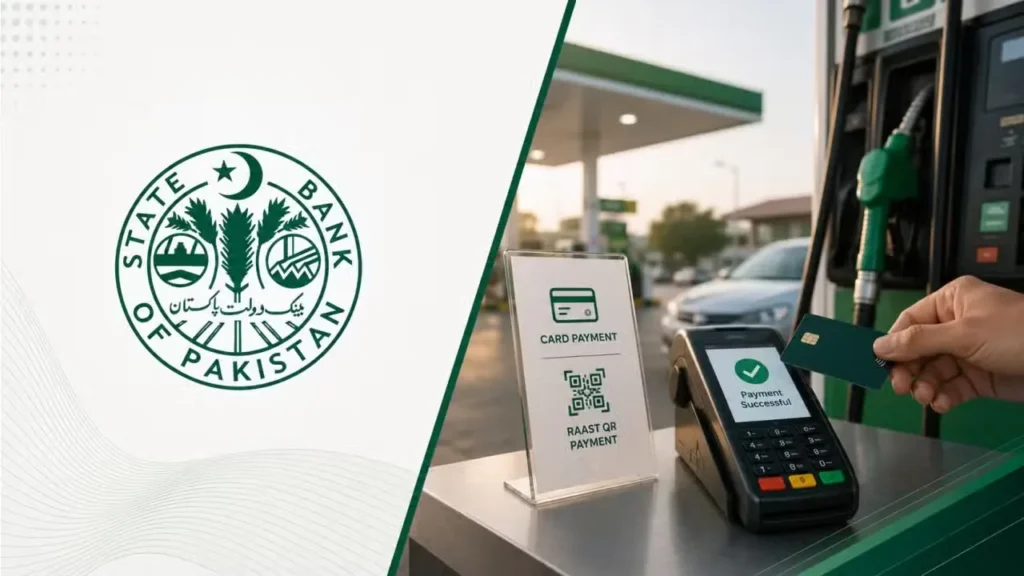
The State Bank of Pakistan (SBP) has unveiled a new framework to accelerate digital payments at petrol pumps, capping bank transaction charges on card payments and directing banks to expand Raast QR payment acceptance across fuel stations nationwide.
The move is expected to make digital transactions cheaper for fuel retailers, encourage wider adoption of cashless payments, and support Pakistan’s broader push toward a digital economy.
The initiative is particularly significant because Pakistan has more than 15,000 fuel stations, many of which still rely heavily on cash due to limited point-of-sale (POS) infrastructure and high banking charges.
Key Details
- Merchant Discount Rate (MDR) capped at Rs. 1 per litre for debit and credit card transactions.
- Interchange Reimbursement Fee (IRF) limited to Rs. 0.20 per litre.
- Banks directed to deploy Raast QR payment systems at petrol pumps.
- New pricing framework will remain effective until January 31, 2027.
- Policy applies to all payment cards issued in Pakistan.
SBP Targets Cash-Heavy Fuel Sector
Under the new framework, commercial banks have been instructed to actively collaborate with fuel station operators to introduce Raast QR-based payment acceptance, enabling customers to pay instantly using Pakistan’s digital payment platform.
The central bank said the reduced transaction charges are designed to encourage more fuel stations to accept digital payments while making electronic transactions more affordable for dealers.
Officials believe the initiative will help reduce dependence on cash, improve payment convenience, and strengthen financial inclusion across the country.
Dealers Welcome Lower Bank Charges
The Pakistan Petroleum Dealers Association (PPDA) welcomed the State Bank’s decision, describing it as a major step toward expanding digital payments in the petroleum retail sector.
According to the association, petrol pumps currently pay around 0.8% in banking charges on card transactions—equivalent to approximately Rs. 2.40 per litre—which has discouraged many dealers from installing card payment facilities.
PPDA Chairman Malik Khuda Baksh said:
“Although our demand was for zero percent charges, we appreciate this initiative and believe that, in consultation with the PPDA, the charges will be reduced further in the future.”
He noted that the issue had been raised during a meeting with the Oil and Gas Regulatory Authority (OGRA) and government officials in late July, where Federal Petroleum Minister Bilal Azhar Kayani assured dealers that their concerns would be addressed.
Background
Pakistan has been steadily expanding digital financial services through initiatives such as Raast, the country’s instant payment system developed by the State Bank.
Despite rapid growth in digital banking, fuel stations remain among the country’s most cash-dependent businesses because of limited POS availability and relatively high transaction costs.
According to the latest SBP data, 68.3 million payment cards are currently in circulation across Pakistan, with electronic payments continuing to grow, particularly in the retail sector.
What This Means
Lower transaction costs could encourage more fuel stations to install card machines and QR payment facilities, making digital payments more accessible for millions of motorists.
Greater adoption of electronic payments may also reduce cash handling risks, improve transaction transparency, and support the government’s efforts to document the economy and promote financial inclusion.
Industry experts believe the success of the initiative will depend on how quickly banks expand POS terminals and Raast QR acceptance beyond major urban centers.
What’s Next?
Commercial banks are expected to begin working with petrol pump operators to expand digital payment infrastructure nationwide.
The special pricing framework will remain in force until January 31, 2027, during which regulators will likely monitor adoption rates before deciding whether to extend or revise the policy.
Frequently Asked Questions (FAQs)
What changes has the SBP announced for fuel station payments?
The SBP has capped card transaction charges and instructed banks to expand Raast QR payment acceptance at petrol pumps across Pakistan.
How much is the new card payment charge?
The Merchant Discount Rate (MDR) has been capped at Rs. 1 per litre, while the Interchange Reimbursement Fee (IRF) is limited to Rs. 0.20 per litre.
Why is the policy important?
The move aims to reduce reliance on cash, increase digital payment acceptance at fuel stations, and improve financial inclusion throughout Pakistan.
