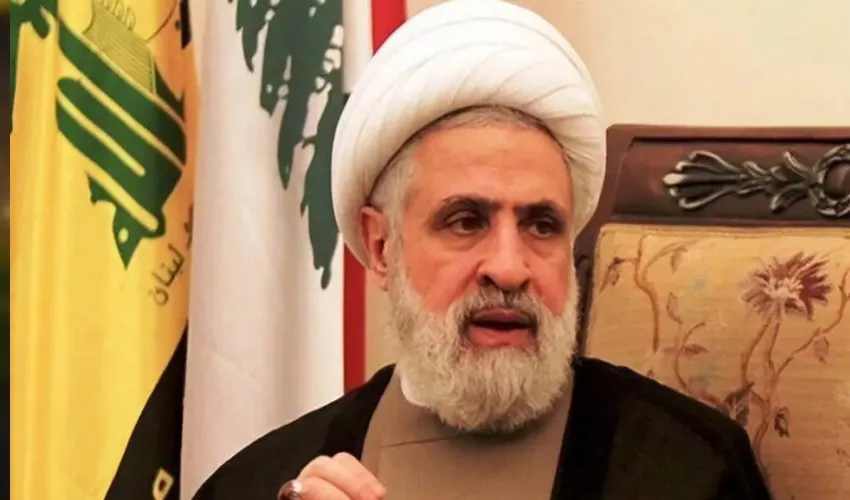
Hezbollah leader Naim Qassem has urged Lebanon’s government to boycott planned Lebanon–Israel negotiations in Washington, DC, as the Israel–Hezbollah conflict escalation intensifies along the southern border.
In a televised address, Qassem dismissed the proposed Washington-Israel-Lebanon talks as ineffective, arguing that they would not lead to a ceasefire and instead serve political pressure from external powers.
The talks, scheduled for Tuesday, are expected to involve the Lebanese and Israeli ambassadors to the United States, raising questions about US mediation in the Middle East amid worsening regional instability.
Hezbollah disarmament pressure claims
Qassem alleged that the negotiations are designed to advance Hezbollah disarmament pressure, pointing to repeated statements from Israeli officials demanding the group surrender its weapons.
He said Israel’s stance leaves little room for meaningful dialogue, adding that participation would amount to accepting predetermined outcomes rather than genuine diplomacy.
According to Qassem, the Hezbollah stance on negotiations remains firm: talks framed around disarmament undermine Lebanon’s sovereignty and weaken its negotiating position.
Call for Lebanese government boycott
Urging a clear political response, Qassem called on the Lebanon government foreign policy leadership to take what he described as a “historic and heroic” decision by refusing to attend the talks.
He warned that engaging under current conditions would be seen as a concession to Israel and Washington, particularly as Israel–Hezbollah border clashes continue to intensify.
Since early March, renewed cross-border attacks have deepened the Israel Lebanon conflict escalation, triggering sustained Israeli airstrikes and ground activity in southern Lebanon.
Lebanon humanitarian crisis deepens
Israeli military operations have worsened the Lebanon humanitarian crisis displacement, forcing large-scale civilian evacuations and damaging critical infrastructure.
According to available figures, at least 2,055 people have been killed, including civilians, children, and medical workers, while thousands have been injured. An estimated 1.2 million people have been displaced from their homes.
Lebanese officials have repeatedly said their priority remains securing an immediate ceasefire and easing civilian suffering.
However, Israeli officials continue to push for broader Lebanon Israel negotiations that would include Hezbollah’s disarmament and long-term security arrangements, a position strongly rejected by the group.
As diplomatic pressure grows, divisions remain over whether negotiations under current conditions can reduce tensions or risk prolonging the conflict.
