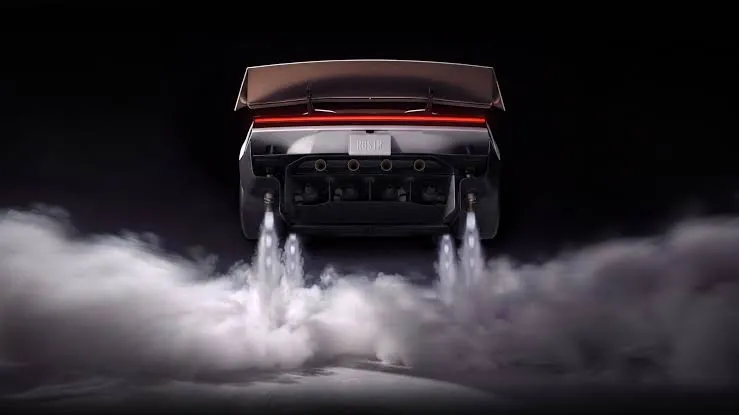
Elon Musk has unveiled a redesigned Tesla Roadster featuring SpaceX-developed thruster technology that allows a specially equipped version of the electric sports car to perform brief airborne manoeuvres.
Musk described it as the world’s first flying car, although its demonstrated capabilities are closer to rocket-assisted stunts than conventional flight.
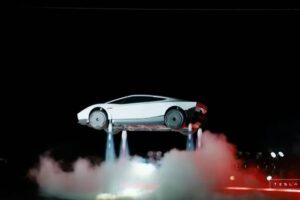
The demonstration took place at a SpaceX testing facility in Texas on October 15, 2026. The vehicle drove up a curved ramp, performed an aerial flip and landed after using thrusters to move through the air.
It also demonstrated a suction-based system that allowed it to travel upside down along a surface, according to reports by Reuters and the Associated Press.
Musk said the technology combines altitude controls with forward and rear thrusters, enabling the vehicle to perform manoeuvres not possible with an ordinary production car.
However, the demonstration does not establish that the Roadster is a practical flying vehicle for everyday transportation. Its flight capabilities are associated with a specialised version, and Tesla says the Rocket configuration is not approved for public road use.
How Tesla Roadster Uses SpaceX Thrusters
The redesigned Roadster combines an electric sports car platform with aerospace technology developed in collaboration with SpaceX.
Tesla describes the specialised Rocket version as using cold-gas thrusters positioned around the vehicle. These can provide forward and upward acceleration as well as rotational movement, allowing the car to perform short aerial manoeuvres.
During the Texas demonstration, the vehicle appeared to lift off, rotate in mid-air and return to the ground. It also performed a stunt involving a jump over other Tesla vehicles.
The car was remotely controlled during the demonstration, according to Musk, who said the arrangement was intended to reduce the risk of injury.
Tesla has also described a multi-mode suction system designed to increase grip and downforce. This system was demonstrated as the vehicle travelled upside down along a curved surface.
The company has not established that these features make the Roadster suitable for sustained flight, routine air travel or use in the same way as a conventional aircraft.
Tesla Claims Acceleration From 0 to 60 mph in Under One Second
One of the headline performance claims is that the thruster-equipped Roadster can accelerate from zero to 60 miles per hour in less than one second.
That figure is a manufacturer claim rather than an independently established real-world performance result. The company has not demonstrated that the vehicle can deliver the same performance consistently under ordinary road conditions.
Tesla’s Roadster plans have been delayed for years. The second-generation model was announced in 2017, but production is now expected to begin in 2028, according to recent reporting.
The latest demonstration therefore represents a preview of a vehicle still under development rather than confirmation of immediate consumer availability.
Roadster Prices, Deposits and Special Versions
Tesla’s reservation information describes different versions of the Roadster, including Performance, Thrust and Rocket configurations.
The Performance and Thrust options are aimed at different levels of performance, while the single-seat Rocket version is listed as invitation-only and includes the specialised flight system.
Reports on the launch said the Thrust version required a substantial reservation deposit, while the Rocket variant was not generally available to all customers.
Prospective buyers should review Tesla’s current reservation terms carefully, as deposits, final pricing and delivery dates do not necessarily guarantee a completed vehicle or a specific delivery schedule.
The Rocket version is particularly distinct from an ordinary road car because Tesla says it is not approved for public road use. Any use of its flight functions would also depend on applicable aviation, safety and local regulations.
Can Tesla’s Flying Roadster Be Used on Public Roads?
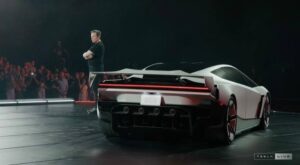
Musk acknowledged during the presentation that the vehicle might not be legal in every jurisdiction. Tesla’s own website explicitly states that the Rocket version is not approved for public road use.
The demonstration also leaves questions about the practical limitations of the technology, including passenger capacity, flight duration, operating conditions, safety certification and the regulatory approvals required for real-world use.
A vehicle capable of performing a brief airborne manoeuvre is not necessarily equivalent to a flying car that can safely transport passengers through populated areas. Practical deployment would require further technical testing and regulatory clearance.
For now, the Roadster is best understood as an ambitious performance vehicle that combines electric propulsion with specialised rocket-style technology.
Its planned production in 2028 remains a future target, and its eventual capabilities will need to be assessed against the specifications, safety standards and approvals of the production model.
