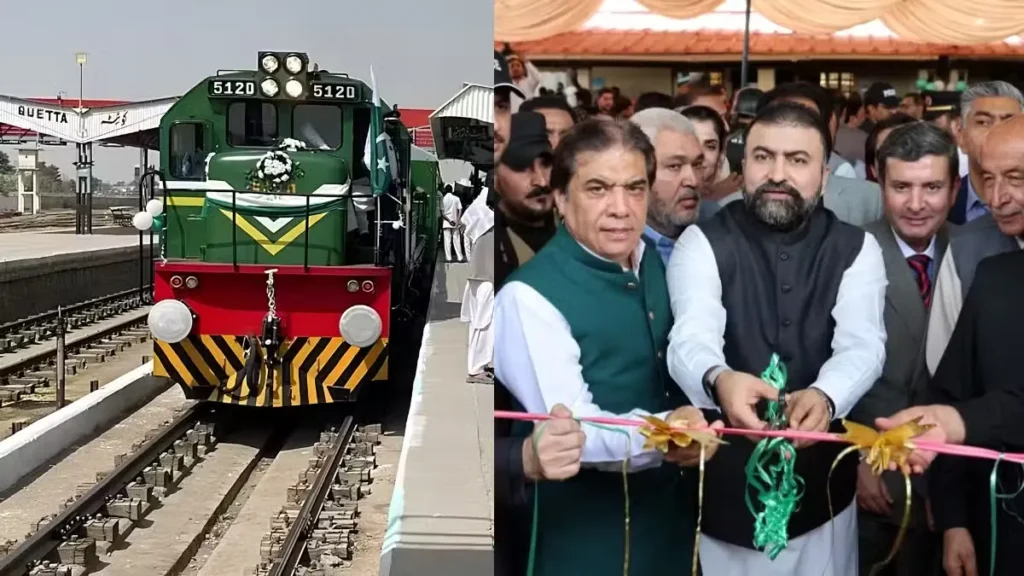
The engine of the newly launched Jinnah People’s Train derailed at Kuchlak near Quetta just a week after the service was inaugurated, with railway officials and police offering different explanations for the incident.
According to railway authorities, the derailment occurred in the yard of Kuchlak Railway Station. No casualties were reported, and the engine was later placed back on the track.
Investigation Underway
Railway officials said an investigation had been launched to determine the cause of the derailment.
The initial account from railway authorities suggested that fishplates, which are used to join sections of railway track, had been stolen from the station yard.
Officials were looking into whether the missing track components contributed to the engine leaving the rails.
Police Give Different Account
Police sources, however, disputed the claim that stolen fishplates caused the incident.
According to the police account, worn-out railway sleepers were responsible for the derailment. Sleepers are placed beneath railway tracks to support the rails and keep them properly aligned.
Police sources said work to replace the damaged or worn sleepers began following the incident.
The conflicting accounts mean that the exact cause of the derailment has not yet been established.
Incident Comes Soon After Train Launch
The derailment occurred only days after the inauguration of the Jinnah People’s Train, a project involving an estimated investment of around Rs. 3 billion.
The incident has raised questions about the condition of railway infrastructure along the route, although no official conclusion has yet been issued on whether maintenance issues or missing track components caused the derailment.
It was not immediately clear whether the incident affected passenger operations or how long the engine remained out of service.
The investigation is expected to determine the actual cause and establish whether any negligence or maintenance issue contributed to the derailment.
About Tamoor Ahmed

Tamoor Ahmad has been covering politics since 2022.
