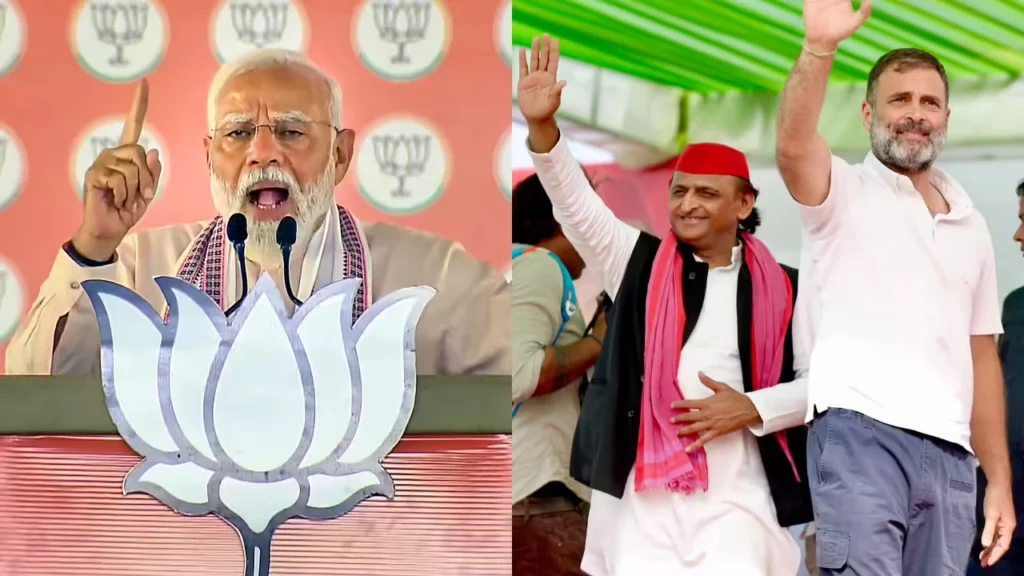
The looming threat over the Strait of Hormuz has heightened concerns across the entire world. A country like India, which represents a vast segment of the global population and naturally, relies heavily on imports to meet its energy requirements, is inevitably impacted by this crisis. At such a juncture, when Prime Minister Narendra Modi appeals to his fellow citizens to conserve fuel, refrain from purchasing unnecessary gold, utilize public transportation and promote local products, what exactly is inappropriate about that?
This appeal was neither a signal of panic nor a declaration of a state of emergency; rather, it was a message of economic discipline and national responsibility. Yet, Congress leader Rahul Gandhi and Samajwadi Party chief Akhilesh Yadav have launched a political offensive, characterizing this appeal as a sign of the government’s failure. The pertinent question is; Is it appropriate to view every national challenge solely through the prism of politics? Is mocking an appeal made in the national interest truly the hallmark of a responsible opposition?
The times the world is currently navigating are far from ordinary. Global supply chains had already been disrupted in the wake of the Russia-Ukraine war. Now, the escalating conflict in West Asia has triggered a severe crisis regarding the supply of crude oil. Approximately 20 percent of the world’s energy supply passes through the Strait of Hormuz. Any disruption along this route leads to an explosive surge in oil prices, a scenario that directly impacts India, which imports nearly 40 percent of its crude oil and about 90 percent of its LPG requirements. In such a situation, if the government appeals to the public to conserve energy, it reflects its foresight, not its failure.
In reality, most nations across the globe expect their citizens to exercise restraint and offer cooperation during such times. During energy crises in countries like Japan, Germany and various other European nations, citizens voluntarily conserved electricity and fuel. In those contexts, such actions were viewed as serving the national interest; however, in India, the opposition has instead set about weaponizing this issue for political gain. Prime Minister Modi urged the public to reduce their consumption of petrol and diesel, opt for the Metro and public transportation, promote electric vehicles, prioritize “work from home” arrangements and virtual meetings, and refrain from unnecessary purchases of gold. What exactly is there in these suggestions that could be termed anti-national or anti-people?
In reality, this appeal holds significance on three distinct levels. First, in terms of conserving foreign exchange: India’s trade deficit is driven primarily by the importation of oil, gold and electronics. Billions of dollars are spent annually on gold imports alone. Second, regarding energy security; A rise in oil prices has a direct impact on inflation. Transportation costs escalate, industrial operational costs increase and ultimately, the general public bears the brunt.
The third and primary objective is to chart a course toward national self-reliance. This is because initiatives such as “Vocal for Local”, electric mobility, public transportation and a digital work culture serve as the very pillars of long-term economic resilience. The Prime Minister’s appeal appears to be aimed not merely at navigating the current crisis but also, and fundamentally, at preparing India for the future in its own best interest.
Rahul Gandhi’s Politics: Negativity in Every Issue
Characterising the Prime Minister’s appeal as a “government failure”, Rahul Gandhi argued that advising the public to practice sacrifice and thrift is proof of failed governance; however, it must be said that this line of reasoning is extremely superficial. This is because no nation functions solely through its government; it requires equal participation from its citizens. In reality, the greatest flaw in Rahul Gandhi’s politics is precisely this: he seeks an opportunity to oppose every national issue. Be it the morale of the armed forces, foreign policy, the vaccination drive, or fiscal discipline, one observes that negativity consistently serves as the bedrock of his politics.
The irony lies in the fact that in the very nations whose economic policies the Congress party frequently lauds, civic discipline is accorded the highest priority. During energy crises in the United States and Europe, governments appealed to citizens to reduce heating, increase their use of public transport and conserve fuel. At the time, such actions were hailed as responsible leadership.
Alongside Rahul Gandhi, SP Chief Akhilesh Yadav also appears to be joining the chorus of criticism against the Modi government. This represents a brand of politics in which even a national crisis is transformed into a political opportunity. Akhilesh Yadav has become so deeply entrenched in his politics of opposition to the BJP that he perceives nothing but flaws in every government initiative. In this context, the question arises: as a former Chief Minister of a vast state like Uttar Pradesh, does he not comprehend the far-reaching impact that oil prices have on farmers, the transport sector and everyday commodities? If the government is proactively raising public awareness and suggesting viable alternatives, what exactly is objectionable about that?
The responsibility of the opposition extends beyond mere criticism; it also entails offering constructive cooperation during times of crisis. Regrettably, the current opposition appears to be focused more on political gains and losses than on the national interest. Furthermore, the narrative the opposition is attempting to construct, suggesting that the country is facing a fuel crisis- is far removed from reality. The Ministry of Petroleum has clarified that the nation possesses adequate reserves of crude oil and LPG. No reports of shortages have been received from any petrol pump or gas agency.
The government has issued directives to refineries to ramp up LPG production. Oil marketing companies are striving to keep prices stable in the domestic market despite rising global rates. These companies are absorbing immense financial pressure on a daily basis to ensure that no additional burden falls upon the general public. In other words, the government is not merely issuing appeals; it is also taking concrete measures to tackle the crisis.
It must be acknowledged that Prime Minister Modi’s message is, fundamentally, a message of “shared responsibility”. Amidst the crisis in West Asia, Prime Minister Modi’s appeal represents a responsible initiative aimed at fostering fiscal discipline, energy security and self-reliance. It is neither an attempt to spread panic nor an effort to impose a burden on the public. Rather, it serves as a cautionary note designed to prepare the nation for future challenges. In contrast, the stance adopted by Rahul Gandhi and Akhilesh Yadav appears to be driven more by political opportunism; they have offered neither alternative solutions nor an acknowledgement of the gravity of the crisis.
It would be highly desirable for political parties to demonstrate maturity, at least when it comes to national economic challenges. If the country’s energy security, foreign exchange reserves and economic stability remain robust, the benefits will accrue to every citizen, regardless of their political ideology. Prime Minister Modi’s appeal ought to be viewed through the lens of national interest, rather than through the prism of politics.
The views expressed in this article are the author’s own and do not necessarily reflect The Asian Mirror’s editorial stance.
