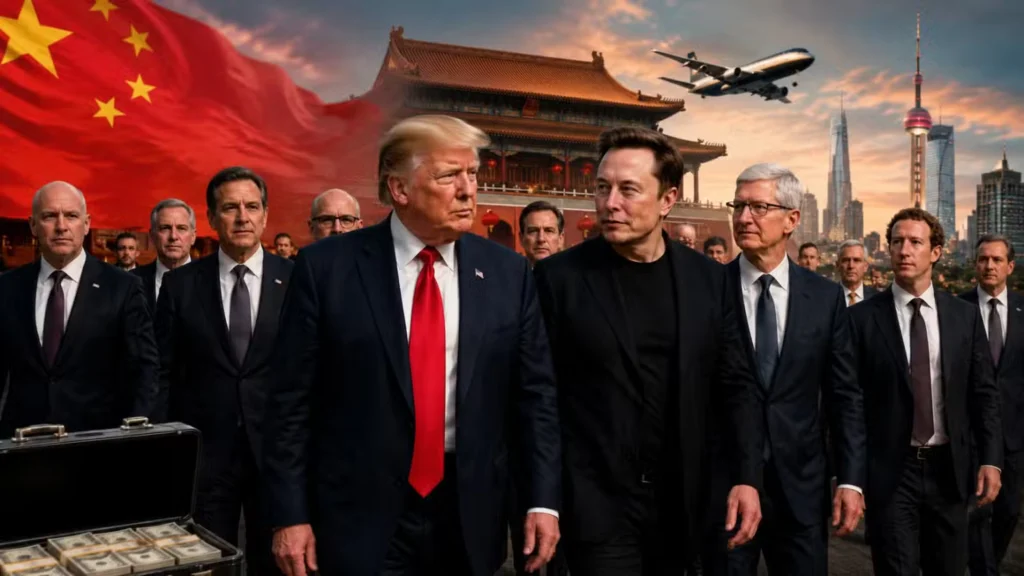
The White House has invited several of the world’s most influential business leaders to join President Donald Trump on an upcoming visit to China, signalling a renewed push to blend high-level diplomacy with corporate engagement.
Among those invited are Tesla and SpaceX chief executive Elon Musk and Apple CEO Tim Cook, according to people familiar with the planning. The delegation is expected to include senior executives from major US financial, technology, and industrial firms.
Companies represented are likely to span sectors central to US–China economic ties. Executives from Boeing, Goldman Sachs, Blackstone, BlackRock, Citigroup, and Meta are expected to participate in parts of the trip, reflecting the administration’s focus on trade, investment, and market access.
Business-first approach to diplomacy
The visit is being framed as an economic mission aimed at exploring potential commercial agreements and reviving stalled trade momentum between Washington and Beijing. White House officials say the goal is to expand economic engagement with China while advancing US business interests in technology, finance, and manufacturing.
Rather than traditional state-to-state diplomacy alone, the administration appears to be emphasizing direct interaction between corporate leaders and Chinese counterparts. Supporters of the approach argue that involving decision-makers who control capital, supply chains, and technology could accelerate deal-making and reduce friction in key industries.
But critics say the strategy risks blurring the line between national policy and corporate priorities. Some analysts warn that allowing large companies such a prominent role in diplomatic engagements could skew negotiations toward private interests rather than broader strategic or security concerns.
Mixed reaction online and among analysts
Reaction on social media and policy forums has been divided. Some users described the move as pragmatic, arguing that economic realities require direct engagement between the world’s largest businesses and China’s leadership.
Others were more skeptical. Concerns have been raised about the influence of corporate executives on sensitive policy discussions, particularly at a time when US–China relations remain strained over technology controls, data security, and geopolitical competition.
“The optics matter,” said one Washington-based analyst, noting that corporate participation on this scale is unusual for a presidential visit to China. “It suggests that economic outcomes are being prioritised very openly.”
What comes next
Details of the itinerary and any potential agreements remain closely guarded. Officials have not confirmed whether formal deals will be announced during the visit or whether discussions will focus on laying groundwork for future negotiations.
What is clear is that the trip represents an ambitious attempt to reshape US–China engagement by placing business leaders at the centre of diplomatic outreach. Whether this approach delivers tangible results or fuels further debate over corporate influence in foreign policy will become clearer once the meetings in China begin.
About Tamoor Ahmed

Tamoor Ahmad has been covering politics since 2022.
