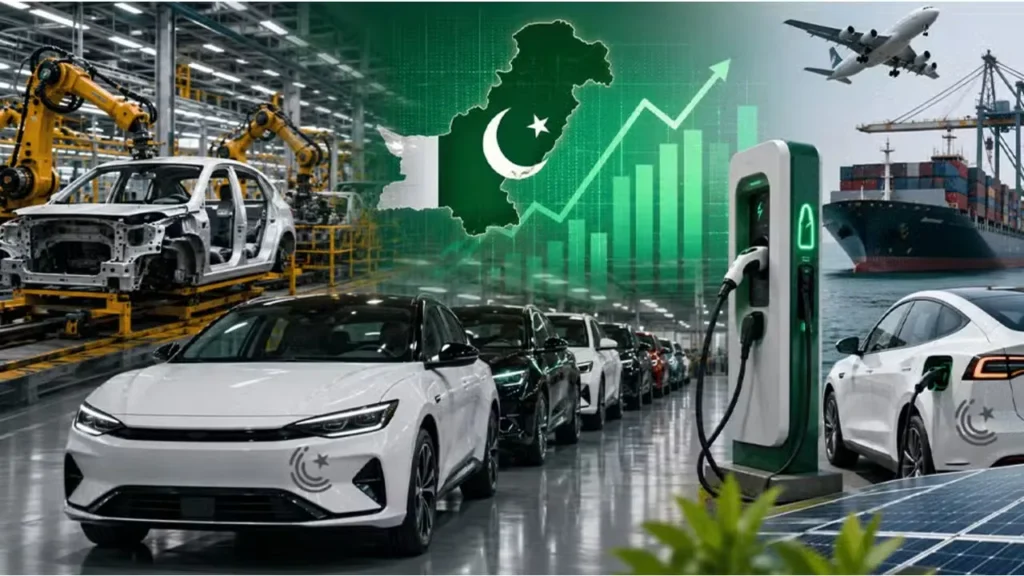
The Pakistan Association of Automotive Parts and Accessories Manufacturers (PAAPAM) has proposed a new tariff structure for Pakistan’s Auto Policy 2026-31, calling for higher duties on imported vehicles and lower or zero tariffs on raw materials to encourage local manufacturing, investment and exports.
In a position paper submitted for consideration during the formulation of the new automotive policy, PAAPAM urged the government to design import tariffs around the industry’s long-term goals of localization, export growth, investment and employment.
The association has also requested a meeting with Prime Minister Shehbaz Sharif before the new auto policy is approved and implemented.
PAAPAM seeks protection for local auto industry
PAAPAM represents more than 300 member companies and around 1,200 businesses across Pakistan’s automotive ecosystem. According to the association, the sector supports approximately 300,000 direct jobs and 1.5 million indirect livelihoods.
Pakistan’s automotive industry includes 13 car assemblers, more than 50 motorcycle and electric-bike assemblers, 10 truck and bus assemblers and three tractor manufacturers.
PAAPAM warned that the National Tariff Policy 2025-30, which proposes reducing import tariffs to a maximum of 15%, could put additional pressure on domestic vehicle and auto parts manufacturers if the specific requirements of the automotive sector are not taken into account.
The association estimates that the industry already faces a 34% structural cost disadvantage because of high energy prices, financing costs, taxation, freight expenses, certification requirements and logistics inefficiencies.
Proposed tariff structure for Auto Policy 2026-31
PAAPAM has proposed the following tariff structure for the new auto policy:
| Category | Proposed Duty |
|---|---|
| Completely Built Units (CBUs) | 50% |
| Localized parts | 40% |
| Completely Knocked Down (CKD) kits | 30% |
| Locally produced raw materials | 5% |
| Imported raw materials | 0% |
The association said the proposed structure would encourage manufacturers to source more components locally while keeping imported raw materials affordable for domestic production.
PAAPAM particularly supported a 40% duty on localized parts, arguing that it would discourage vehicle assemblers from relying heavily on imported components from China, South Korea and Japan.
According to the association, previous tariff structures showed that lower duties could encourage new assemblers to depend on imported parts, with some achieving localization levels of only 0% to 10%.
In contrast, PAAPAM said legacy assemblers increased local content when tariffs on imported components were maintained at around 45%.
Auto industry seeks stronger localization
PAAPAM said Pakistan’s domestic vehicle market remains relatively weak, with car sales volumes still around 2005 levels despite the presence of 13 car assemblers and more than 40 models.
The association also identified used car imports and inconsistent restrictions on CKD kits as factors affecting the competitiveness of local manufacturers.
It argued that a predictable and sector-specific tariff regime is needed to encourage companies to invest in domestic component manufacturing rather than relying on imported parts.
The proposed Auto Policy 2026-31 would therefore need to balance consumer access to vehicles with the government’s objectives of increasing local manufacturing, employment and industrial investment.
PAAPAM targets $1 billion in auto parts exports
The association also sees automotive parts exports as a major opportunity for Pakistan.
PAAPAM said the local auto parts industry could potentially target $1 billion in exports if the government provides policy support that reflects the longer development and production cycles associated with engineering products and components.
It proposed low-cost financing facilities for component exporters and called for changes to exporter classification requirements.
Under its proposal, the export threshold for obtaining exporter status should be reduced from 80% to 25%, followed by gradually increasing export targets over a period of five to 10 years.
Association seeks longer export realization period
PAAPAM has also proposed extending the export realization period under State Bank of Pakistan foreign exchange regulations from 180 days to 365 days.
The association said automotive parts manufacturers often require longer periods because product development, research and development, manufacturing and contract completion cycles can take considerably more time than those of conventional export businesses.
The proposed changes are aimed at giving Pakistan’s auto parts manufacturers greater flexibility to develop export markets while encouraging investment in engineering capabilities and locally manufactured components.
PAAPAM’s proposals will now form part of discussions surrounding the Auto Policy 2026-31, with the association seeking government support for a tariff framework that it says can strengthen Pakistan’s automotive manufacturing base while creating opportunities for higher localization and exports.
