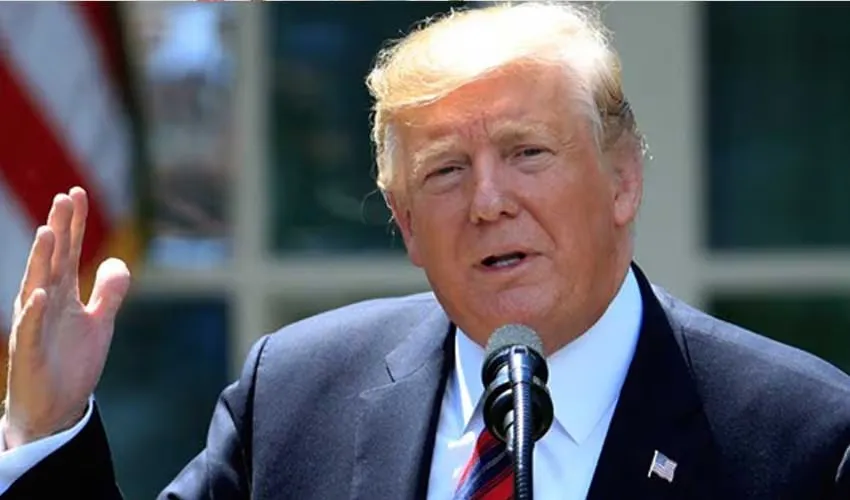
US President Donald Trump has publicly welcomed the newly signed Makkah Joint Defense Agreement between Pakistan, Saudi Arabia, and Türkiye, calling it a significant step toward regional security and self-reliance.
Trump said the pact reflects growing unity in the Middle East and congratulated the leadership of all three countries on reaching the agreement. In a post on Truth Social, he said he was pleased to see the three nations had signed the deal, describing it as and praising what he called the leadership shown by the three countries.
Trump said the agreement shows the Middle East is coming together and that countries in the region will now be better positioned to defend themselves.
His remarks amount to a public endorsement of the defense arrangement, which was signed against a backdrop of heightened tension between the United States and Iran in the wider region.
PM Shehbaz Sharif Responds
Prime Minister Shehbaz Sharif welcomed Trump’s statement in a post on X, saying he was “deeply grateful to President Trump for his statement in support of the Makkah Joint Defense Agreement.”
He said Pakistan, Saudi Arabia, and Türkiye would continue playing a constructive role in strengthening defense and security both within their own countries and across the wider region.
Sharif also credited Trump’s leadership with helping avert a nuclear crisis in South Asia, saying decisive US leadership played a role in saving lives and adding that lasting peace remains essential to a prosperous future for the region’s nations.
What the Agreement Actually Says
The agreement was signed in Makkah on August 7 by Saudi Crown Prince Mohammed bin Salman, Turkish President Recep Tayyip Erdogan, and Pakistani Prime Minister Shehbaz Sharif.
Under the joint statement issued at the signing, an armed attack against any one of the three countries will be treated as an attack against all three.
The pact brings together three regional powers with distinct military profiles: Saudi Arabia as a major Gulf economic and political power, Pakistan as the only Islamic country possessing nuclear weapons, and Türkiye as a NATO member with a large military and a growing domestic defense industry.
Also read: Trump Says Iran Not Charging Ships in Strait of Hormuz
Pakistan and Saudi Officials Say Pact Is Defensive Only
Pakistani officials have repeatedly stressed that the agreement isn’t aimed at any specific country. Foreign Minister Ishaq Dar described the pact as strictly defensive and said it remains open to other regional countries willing to uphold its principles and resolve disputes peacefully.
Saudi officials have echoed that framing. Saudi Deputy Minister for Public Diplomacy Rayed Krimly said the agreement doesn’t represent an effort to build a military axis or a sectarian bloc and that it isn’t tied to nuclear ambitions or an arms race — rather, he said, it’s aimed at developing sustainable, self-reliant defense capabilities among the signatories.
Turkish President Erdogan said the pact was built around the concept of collective deterrence, adding that Ankara will continue pursuing dialogue and diplomacy in line with international law.
Pakistan and Saudi Arabia have maintained close military ties for decades, including a separate bilateral mutual defense agreement signed in September 2025. Pakistan and Türkiye have also deepened their military and defense-industrial cooperation in recent years.
Egypt Weighing Whether to Join
Egypt has emerged as a possible future member of the pact, though it has not yet formally joined.
Egyptian Foreign Minister Badr Abdelatty said Cairo is studying the possibility of joining the security arrangement, noting Egypt’s close bilateral ties with all three current members and saying Egyptian institutions have been kept informed about the agreement since its inception.
Abdelatty said relevant Egyptian state institutions are now conducting a detailed review of the accord, adding that Egypt’s constitutional and legal framework requires careful examination of international defense obligations before Cairo can make any formal commitment.
Trump Also Signals Shift on South Korea Exercises
In separate remarks, Trump indicated a changing US approach toward the Korean Peninsula, announcing plans to scale back joint military exercises with South Korea and saying Washington’s earlier full participation in those drills wasn’t the right approach. He added that his relationship with North Korean leader Kim Jong Un remains positive.
