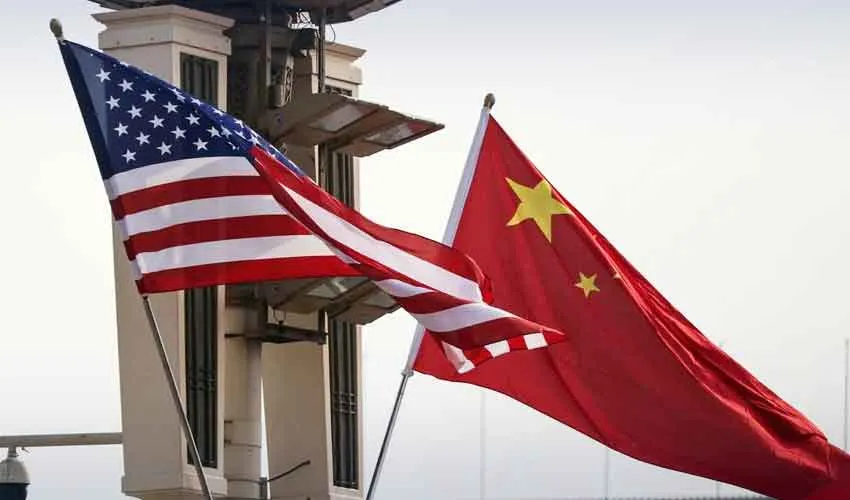
A military conflict between the United States and China over Taiwan could rapidly escalate into a nuclear crisis, according to a new assessment by the London-based International Institute for Strategic Studies, which warns that both sides lack clear safeguards to prevent catastrophic escalation.
The assessment, released ahead of Asia’s most influential security gathering, says the world is approaching a dangerous turning point marked by renewed nuclear competition, with the Asia-Pacific region emerging as the epicentre. Analysts caution that any large-scale confrontation over Taiwan would likely involve coordinated strikes against command, communications, and intelligence systems, significantly increasing the risk of miscalculation.
The report arrives just days before the annual Shangri-La Dialogue in Singapore, where Taiwan, Iran, and uncertainty over long-term US commitments are expected to dominate discussions among defence ministers, generals, intelligence chiefs, and policymakers from around the world.
According to the IISS assessment, China and the United States would pursue fundamentally different objectives in a Taiwan conflict. Beijing would aim to push US and allied forces away from the region, while Washington would focus on strengthening Taiwan’s ability to resist and endure. Despite those differing goals, both militaries would likely conduct sweeping operations across air, sea, cyber, and space domains, creating multiple pathways for escalation.
The report notes there is little public evidence that Washington and Beijing share a mutual understanding of crisis “guard rails” or rules of engagement that would prevent either side from targeting critical command, control, communications, computers, intelligence, surveillance, and reconnaissance systems. Without such limits, the risk of escalation, including the use of nuclear weapons, would loom over any major confrontation.
Also read: China Rejects US Sanctions Over Iran Cooperation
Concerns about stability have grown following a recent summit between Chinese President Xi Jinping and US President Donald Trump in Beijing. While the meeting was intended to ease tensions, it reportedly raised anxiety in Taiwan over whether Washington’s commitment to defending the self-governed island remains unchanged.
China has never ruled out the use of force to assert control over Taiwan, which it considers part of its territory, though it says it prefers peaceful reunification. Taiwan’s government firmly rejects Beijing’s sovereignty claims and has accused China of intensifying pressure by expanding military activity around the island.
Speaking at a briefing, IISS senior fellow Daniel Salisbury said the absence of nuclear-focused dialogue between Washington and Beijing remains one of the most troubling gaps in the relationship. He noted that during the Cold War, the United States and the Soviet Union maintained continuous discussions on arms control and risk reduction, even during periods of deep hostility.
By contrast, Salisbury said, there is little foundation for similar engagement with China, partly because much of Beijing’s nuclear arsenal remains concealed and because trust between the two sides is severely strained. That lack of communication, he warned, makes managing crises far more difficult.
Also read: China rehearses ‘sealing off’ island in third day of Taiwan drills
While the nuclear stockpiles of the United States and Russia still exceed China’s by a wide margin, analysts say China is expanding and modernising its arsenal at a faster pace than any other nuclear-armed state.
A recent Pentagon report estimates China could field up to 1,000 nuclear warheads by 2030. By comparison, the Federation of American Scientists estimates the US has around 3,700 active warheads, while Russia maintains roughly 4,400.
The IISS report concludes that without renewed efforts to establish crisis-management mechanisms and arms control dialogue, the prospect of nuclear escalation will remain a persistent and growing risk in any future US-China conflict. As tensions continue to rise across the Taiwan Strait, the assessment serves as a stark reminder that strategic missteps in the Asia-Pacific could have consequences far beyond the region.
