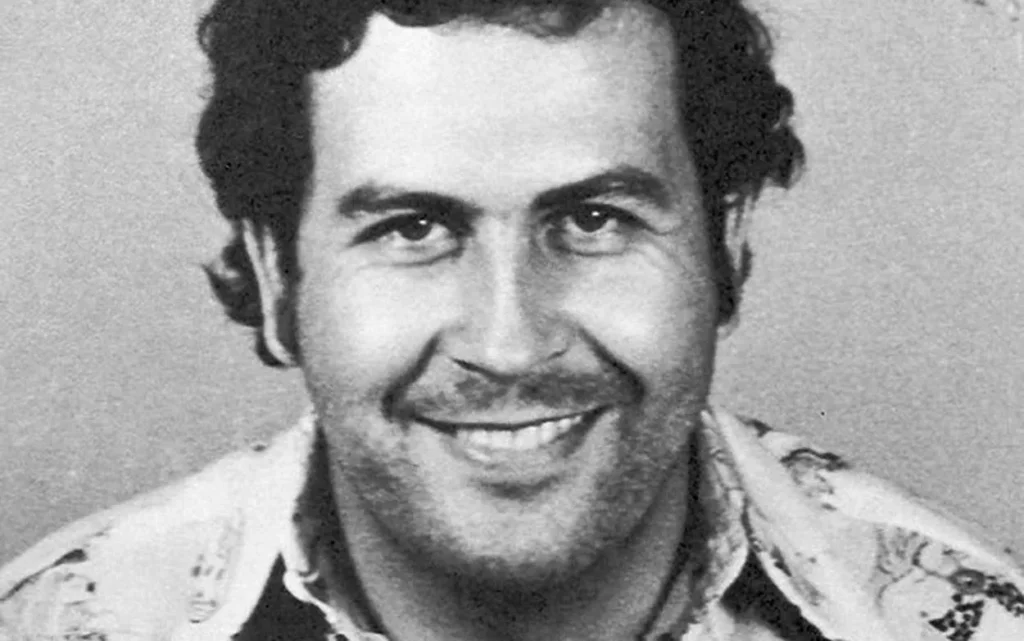
Pablo Escobar, one of the most notorious criminals in modern history, rose from poverty in Colombia to become the world’s most powerful drug trafficker. As the leader of the Medellín Cartel, Escobar controlled the global cocaine trade at its peak, amassing a fortune estimated at $30 billion and earning the infamous title “King of Cocaine”.
While he was once admired by some for funding housing projects and social programs, Escobar’s reign ultimately plunged Colombia into an era of violence, terrorism, and political instability that claimed thousands of lives.
Early Life and Criminal Beginnings
Pablo Emilio Escobar Gaviria was born on December 1, 1949, in Rionegro, Antioquia, and raised in the nearby town of Envigado. Coming from a poor family, Escobar developed ambitions early, reportedly dreaming of becoming Colombia’s president.
His criminal career began with small-time offenses such as selling fake diplomas, stealing cars, and smuggling contraband cigarettes. These early ventures laid the groundwork for his future dominance in organized crime.
Formation of the Medellín Cartel
In the early 1970s, Colombia’s strategic location between coca-producing countries Peru and Bolivia made it the epicenter of the global cocaine trade. Escobar capitalized on this advantage by forming the Medellín Cartel, transforming cocaine trafficking into a massive international operation.
After the death of drug trafficker Fabio Restrepo in 1975—widely believed to be ordered by Escobar—he took control of the organization and rapidly expanded it. The cartel soon controlled over 80 percent of cocaine smuggled into the United States, generating hundreds of millions of dollars weekly.
Wealth, Power, and “Plata o Plomo”
Escobar’s empire relied on his ruthless philosophy of “plata o plomo”—silver or lead—forcing officials to choose between bribes or death. Judges, police officers, journalists, and politicians were routinely targeted.
At the height of his power in the 1980s:
Escobar was listed by Forbes among the world’s richest individuals
He smuggled up to 15 tons of cocaine daily
He built the lavish Hacienda Nápoles, complete with a private zoo, airstrip, and luxury facilities
Despite his brutality, Escobar developed a Robin Hood image by funding schools, roads, and housing projects in Medellín’s poorest neighbourhoods.
Political Ambitions and Terror Campaign
Escobar entered politics in 1982, becoming an alternate member of Colombia’s Congress. However, investigations exposed the criminal origins of his wealth, forcing him to resign. Shortly afterward, Justice Minister Rodrigo Lara Bonilla was assassinated.
As pressure mounted for his extradition to the United States, Escobar launched a nationwide terror campaign. His violence included:
Assassination of presidential candidates
Bombing of Avianca Flight 203, killing 107 people
Car bomb attacks in Bogotá
Murder of over 1,000 police officers
Public sentiment turned decisively against him.
The Luxury Prison and Escape
In 1991, Escobar negotiated a controversial surrender to Colombian authorities, avoiding extradition in exchange for imprisonment in a self-built luxury prison known as La Catedral. The facility featured a nightclub, casino, football field, and spa.
In 1992, when authorities attempted to transfer him to a standard prison, Escobar escaped—triggering a massive manhunt involving Colombian forces and U.S. agencies.
Death of Pablo Escobar
On December 2, 1993, Colombian security forces tracked Escobar to a middle-class neighborhood in Medellín. During a rooftop gunfight, Escobar and his bodyguard were killed.
His death marked the collapse of the Medellín Cartel and a turning point in Colombia’s war against drug trafficking.
Family, Legacy, and Cultural Impact
Escobar married Maria Victoria Henao in 1976 and had two children, Juan Pablo (now Sebastián Marroquín) and Manuela. His son later became a motivational speaker and author, openly condemning his father’s actions.
Escobar’s life continues to influence global pop culture through books, films, and TV series, including Narcos, Loving Pablo, and El Patrón del Mal.
Despite the devastation he caused, more than 25,000 people attended his funeral, highlighting the deep contradictions of his legacy.
