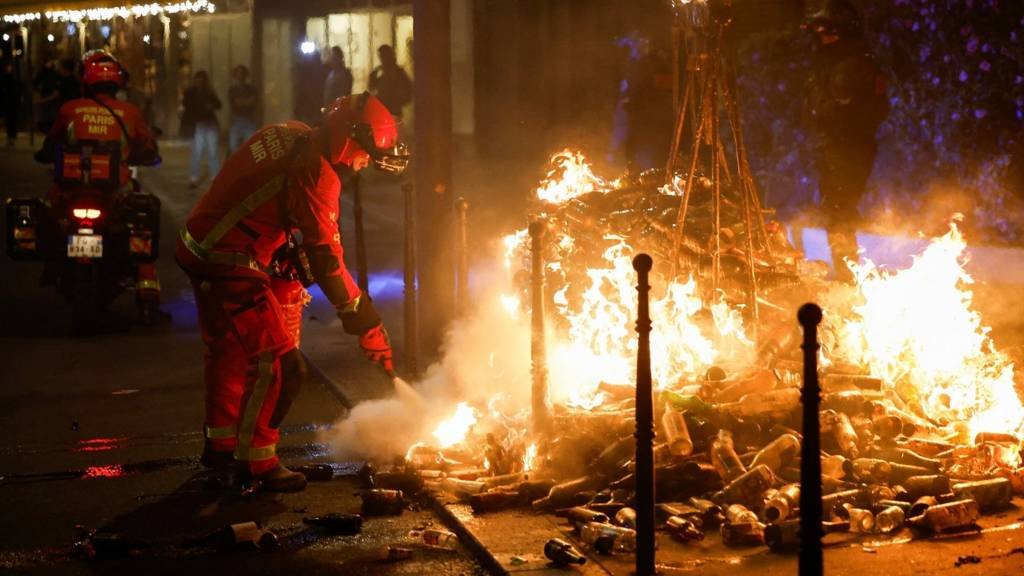
What’s happening in France? A 17-year-old kid was shot by police in Paris on Tuesday, sparking a ban on rallies in some cities, travel warnings, and reigniting a discussion about over-policing in marginalized groups.
People were seen setting fire to vehicles and jumping onto buildings with damaged windows, as riot police forces clashed aggressively with demonstrators.
The disturbance prompted French President Emmanuel Macron to call an emergency meeting with ministers as he seeks to heal tensions and unite the country in his second term.
Here’s what we know.
What ignited the protests?
During a traffic stop in the Paris district of Nanterre earlier this week, a police officer shot and killed the youngster, Nahel, who was of Algerian descent.

A passerby caught video of the incident, which showed two officers standing on the driver’s side of the car, one of whom shot his gun at the driver despite the fact that there appeared to be no immediate threat.
According to Nanterre prosecutor Pascal Prache, the officer stated that he shot his weapon because he was afraid the child might run someone over with his automobile.
According to Prache, the cop used his firearm in an unauthorized manner. He is currently being held in pre-trial detention as part of a formal investigation for voluntary homicide.
What’s happening in France?
Protesters have been waving posters that read “the police kill,” and hundreds of government buildings have been vandalized as a result of Nahel’s killing, which has sparked outrage in the country about racial injustice.
Following several nights of violence across France and its overseas territories, French officials have launched a crackdown. More than 40,000 police officers have been sent across the country to patrol cities, about 1,000 people have been arrested, and more than 200 police officers have been injured.
Must read: France shooting: Who was Nahel M, shot by police in Nanterre?
5,000 security personnel were deployed in Paris alone. Officers have been given authority to quell disturbances, make arrests, and “restore republican order,” according to French Interior Minister Gerard Darmanin.
Overseas French territories have also witnessed violent protests. A man was killed by a “stray bullet” in Cayenne, capital of French Guiana, by a “stray bullet” during riots on Thursday.
What does this mean for Macron?
After weeks of protests over unpopular pension reforms earlier this year, Macron gave himself 100 days to heal the country and reset his leadership. However, the broad protests are now likely to derail plans for a reset. The fact that French President Emmanuel Macron attended an Elton John performance on Wednesday, as cars burnt and buildings were vandalized across the country, did not go unnoticed.
The French government is attempting to avoid a repeat of 2005, when the deaths of two adolescent boys hiding from police triggered a state of emergency, resulting in three weeks of riots.
Macron did cut short his attendance at a European Council summit in Brussels that had been due to last through Friday. He announced a ban on all “large-scale events” in France, including “celebratory events and numerous gatherings,” and implored parents to keep their children at home, saying a third of the almost 900 people detained overnight were young.
Macron has also called for social media platforms to help quell the demonstrations, asking TikTok and Snapchat to withdraw the “most sensitive content” and to identify users who employ “social networks to call for disorder or to exacerbate violence.”
What led to the unrest?
Activists believe Nahel’s race had a role in his death, exposing deep-seated issues in France about police prejudice against minority communities.
Secularism, also known as “lacité” in French, is a crucial pillar of French culture, as it tries to provide equality for all by eradicating markers of difference, such as race.
However, many people of color in France believe they are more likely than White people to be victims of police brutality. According to a 2017 survey by the Rights Defenders, an independent human rights watchdog in France, young men considered to be Black or Arab were 20 times more likely than their peers to be stopped by police.
French police have long faced allegations of cruelty. In a statement earlier this year, the Council of Europe condemned the “excessive use of force by state agents” amid rallies against Macron’s unpopular pension reforms.
Amnesty International, for example, has accused French police of ethnic profiling and has called for profound, systemic reform to address the discrimination.
In its first comments since the assassination, the UN urged France to address “deep issues of racism and discrimination in law enforcement.”
In a statement on Friday, a spokesperson for the UN High Commissioner for Human Rights urged French authorities to “ensure the use of force by police to address violent elements in demonstrations always respects the principles of legality, necessity, proportionality, non-discrimination, precaution, and accountability.”
The French Ministry of Foreign Affairs later rebuffed the UN’s comments, saying: “France, and its police forces, fight with determination against racism and all forms of discrimination. There can be no doubt about this commitment.
“The use of force by the national police and gendarmerie is governed by the principles of absolute necessity and proportionality, strictly framed and controlled,” the ministry added.
