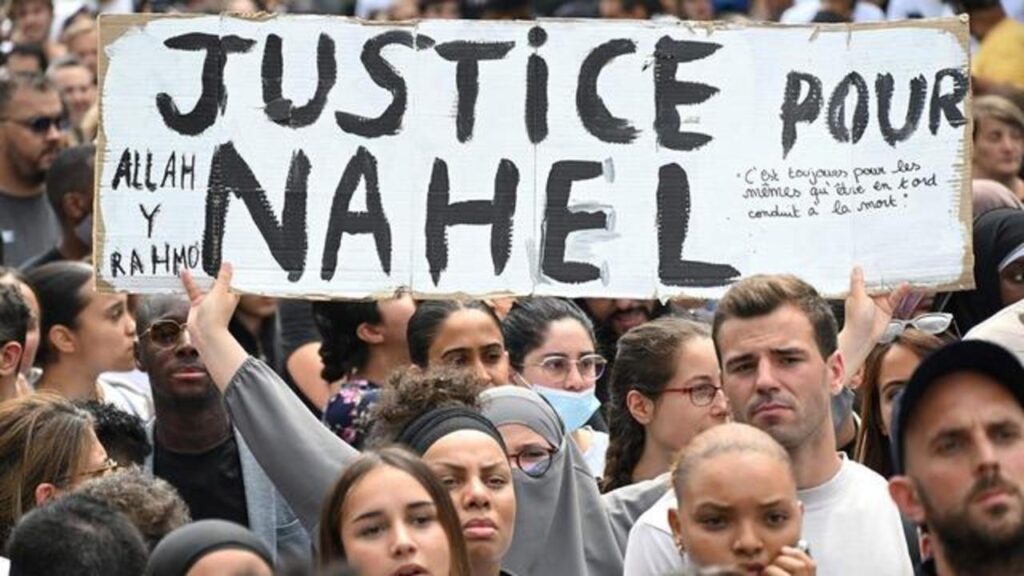
Who was Nahel M? The death of Nahel M, 17, has prompted riots across France, including in the town of Nanterre, west of Paris, where he grew up.
He was an only child raised by his mother, worked as a takeaway delivery driver, and played rugby league.
His schooling was described as chaotic. He was studying electrical engineering at a college in Suresnes, not far from where he lived.
Those who knew him said he was well-liked in Nanterre, where he lived with his mother Mounia, and appeared to have never met his father.
His college attendance record was dismal. He had no criminal record, but he was known to the police.
He had given his mother a big kiss before she went to work, with the words “I love you, Mum”.
“What am I going to do now?” asked his mother. “I devoted everything to him,” she said. “I’ve only got one, I haven’t got 10 [children]. He was my life, my best friend.”
His grandmother spoke of him as a “kind, good boy”.
“A refusal to stop doesn’t give you a licence to kill,” said Socialist Party leader Olivier Faure. “All the children of the Republic have a right to justice.”
Who was Nahel M
Nahel had spent the previous three years as a member of the Pirates of Nanterre rugby team. He had participated in an integration project for troubled youths operated by an organization called Ovale Citoyen.
The program’s goal was to place people from disadvantaged communities in apprenticeships, and Nahel was learning to be an electrician.
Jeff Puech, president of Ovale Citoyen, was one of the elders in the community who knew him best. He had just seen him a few days before and described him as a “kid who used rugby to get by.”
“He was someone who had the will to fit in socially and professionally, not some kid who dealt in drugs or got fun out of juvenile crime,” Mr. Puech told Le Parisien.
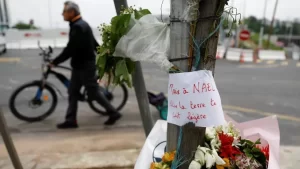
He applauded the teen’s “exemplary attitude,” which was a far cry from the negative portrayal of him on social media.
He met Nahel when he resided with his mother in the Nanterre area of Vieux-Pont before they moved to the Pablo Picasso home.
His family’s Algerian ancestry has not gone ignored. “May Allah grant him mercy,” a banner hung above the Paris ring road at Parc des Princes stadium read.
“Police violence happens every day, especially if you’re Arab or black,” said one young man in another French city calling for justice for Nahel.
“We have a law and judicial system that protects police officers and it creates a culture of impunity in France,” he told the BBC.
Must read: France pension law changed despite protests
Since 2021, Nahel had been the target of up to five police checks for refus d’obtempérer, or refusals to cooperate.
He was reportedly detained just last weekend for such a refusal and was scheduled to appear in juvenile court in September. He was recently involved in a lot of difficulties involving autos.
Many in France are reminded of the events of 2005, when two youths, Zyed Benna and Bouna Traoré, were electrocuted as they escaped police after a football game and ran into an electricity substation in the Paris district of Clichy-sous-Bois.
“It could have been me, it could have been my little brother,” a Clichy teenager called Mohammed told the French website Mediapart.
