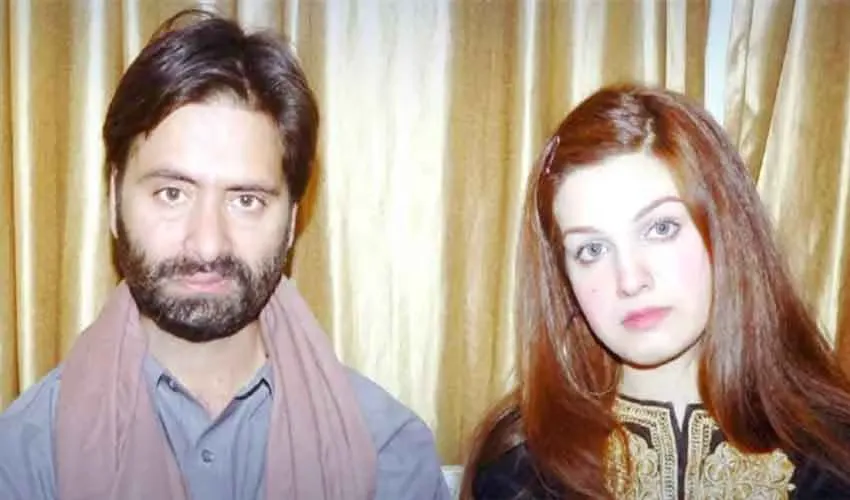
Kashmiri separatist leader Yasin Malik has told an Indian court that he will no longer contest his cases and is prepared to accept any punishment, including the death penalty, while continuing to deny the allegations against him.
Malik submitted a 25-page affidavit before a Srinagar court, saying his decision was a protest against what he described as political persecution and a judicial process he no longer believes can deliver justice.
Statements made by Malik on August 24 were formally taken on record as part of the evidence in the proceedings.
In his affidavit, Malik said accepting a court sentence should not be interpreted as an admission of guilt. He maintained that he had presented his position and conscience before the court and would leave the final outcome to Allah.
Yasin Malik denies role in Sarla Bhat murder
Malik categorically denied involvement in the 1990 murder of Kashmiri medical student Sarla Bhat, saying he had been implicated in the case as part of what he described as a government conspiracy.
He questioned the basis of the allegations, referring to an alleged Jammu and Kashmir Liberation Front (JKLF) note reportedly found with Bhat’s body. Malik questioned why the document was later missing from the official record.
He also argued that he had suffered serious injuries 11 days before the murder and claimed his physical condition made it impossible for him to plan or direct the killing.
Malik described the case as an attempt to implicate him decades after the incident, alleging that the proceedings were politically motivated.
Malik questions use of Pakistan links against him
The Kashmiri leader also referred to his past interactions involving India-Pakistan relations.
According to Malik, Indian agencies had encouraged him to strengthen contacts with Pakistan and later used those interactions as evidence against him.
He also referred to the government of former Indian prime minister Atal Bihari Vajpayee, claiming that officials including Ajit Doval, Brajesh Mishra and RK Mishra had encouraged him to play a constructive role in improving India-Pakistan relations.
Malik argued that positions and activities once encouraged in the context of bilateral engagement were subsequently cited against him.
Allegations of political use during Indian elections
Malik further alleged that Indian authorities used his name, photograph and legal proceedings to advance a political narrative during the 2019 and 2024 elections.
He claimed that his cases were presented as part of an anti-Pakistan political narrative and said his decision to stop contesting further proceedings should therefore be viewed as an act of protest rather than an admission of guilt.
Malik said he no longer expected justice from Indian courts and indicated that he would accept even a death sentence if imposed.
Years of imprisonment and family separation
The affidavit also highlighted the personal impact of Malik’s prolonged imprisonment.
He referred to years of separation from his mother, wife Mushaal Mullick and daughter, describing the emotional consequences of his imprisonment and isolation.
In a personal message to Mushaal, Malik acknowledged her support and courage during his imprisonment and said he wanted to free her from what he described as a life overshadowed by his prolonged incarceration and the possibility of execution.
He also addressed his daughter, asking her to remain close to her grandmother and help her cope with the emotional impact of the situation.
Experts call for international attention
Political commentators supporting Malik described his prosecution as an attempt to suppress a prominent Kashmiri political voice.
They argued that prolonged imprisonment had not eliminated support for the broader Kashmiri demand for political rights and called for greater international attention to the issue.
The experts also urged the United Nations to address the situation of political prisoners.
Malik’s affidavit is now part of the court record. While he has chosen not to continue actively contesting the proceedings, he has maintained that the decision does not amount to an acceptance of the allegations against him.
Instead, Malik has presented his withdrawal from the legal fight as a political protest and said he is leaving the final decision to the court and to Allah.
