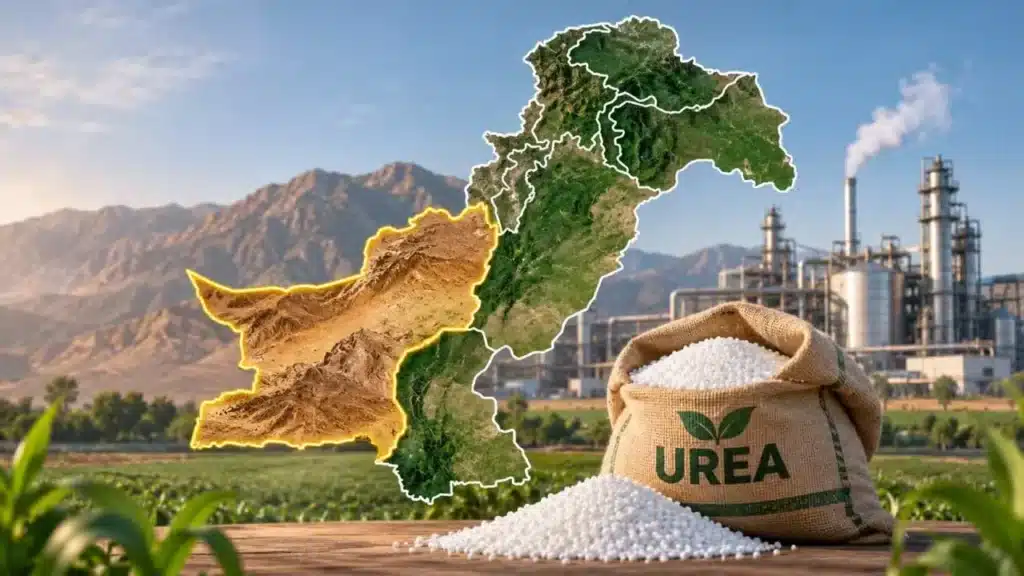
Balochistan has approved a Rs. 250 billion ($895 million) urea fertilizer manufacturing complex in Sui, Dera Bugti, as Pakistan seeks to expand domestic fertilizer production and reduce its dependence on imported supplies.
The proposed plant will have an annual production capacity of 580,800 tonnes, with commercial operations scheduled to begin in April 2031.
The Balochistan Public-Private Partnership (PPP) Board approved the project during its 10th meeting on November 17, 2026, chaired by Chief Minister Mir Sarfraz Bugti. Faraz Syed, Chief Executive Officer of the Balochistan PPP Authority, announced the decision, describing the development as the largest public-private partnership project in the province’s history.
The $895 million investment also ranks among Pakistan’s largest proposed industrial transactions under the PPP framework. The project will be developed on a 496-acre site and use locally available natural gas from the Zin block to manufacture urea for the domestic agricultural market.
According to the Balochistan PPP Authority’s official announcement, the proposed facility will receive 100 million cubic feet per day of indigenous low-BTU gas at a delivered price of $2 per million British thermal units (MMBtu).
The gas will come from the Zin block, operated by Oil and Gas Development Company Limited (OGDCL). The block has estimated recoverable reserves of 912 billion standard cubic feet (Bscf), while the proposed supply is expected to remain at a plateau level until 2043.
The availability of domestic gas is central to the project’s proposed economics because natural gas serves as the primary feedstock for conventional urea manufacturing. Using local resources could also create additional industrial value from Balochistan’s energy reserves while supporting fertilizer production within Pakistan.
The proposed plant is expected to add nearly 581,000 tonnes of annual urea production capacity to the country’s fertilizer industry. Urea is widely used by farmers to supply nitrogen to crops, making its availability important for agricultural productivity and seasonal farming requirements.
Expanding domestic manufacturing could help Pakistan reduce its exposure to international fertilizer prices, import costs and disruptions in global supply chains.
However, the actual impact on fertilizer imports will depend on the project’s completion, production efficiency, gas availability and future agricultural demand.
The Balochistan PPP Authority has estimated the project’s net present value at $301 million, with an equity internal rate of return of 25.1% and a projected payback period of nine years.
These figures represent the project’s estimated financial returns, while actual performance will depend on construction expenses, financing arrangements, operating costs and future fertilizer market conditions.
The project is also attracting attention from potential foreign investors. According to Topline Research, the investment opportunity has been presented to Saudi investors, who are exploring possible participation in the proposed complex.
Potential Saudi investors could enter the project alongside a Pakistani partner, which may include an existing fertilizer manufacturer or an established local business group. However, discussions remain at an early stage, and no investment agreement or formal partnership has been confirmed.
The provincial government has acknowledged the contributions of the Planning and Development Department, Finance Department, Energy Department, Balochistan Energy Company Limited and Balochistan Board of Investment and Trade in advancing the proposal.
If implemented as planned, the Sui complex could expand Pakistan’s fertilizer manufacturing capacity, provide an industrial market for indigenous natural gas and bring additional investment into Balochistan. Commercial production is currently targeted for April 2031.
