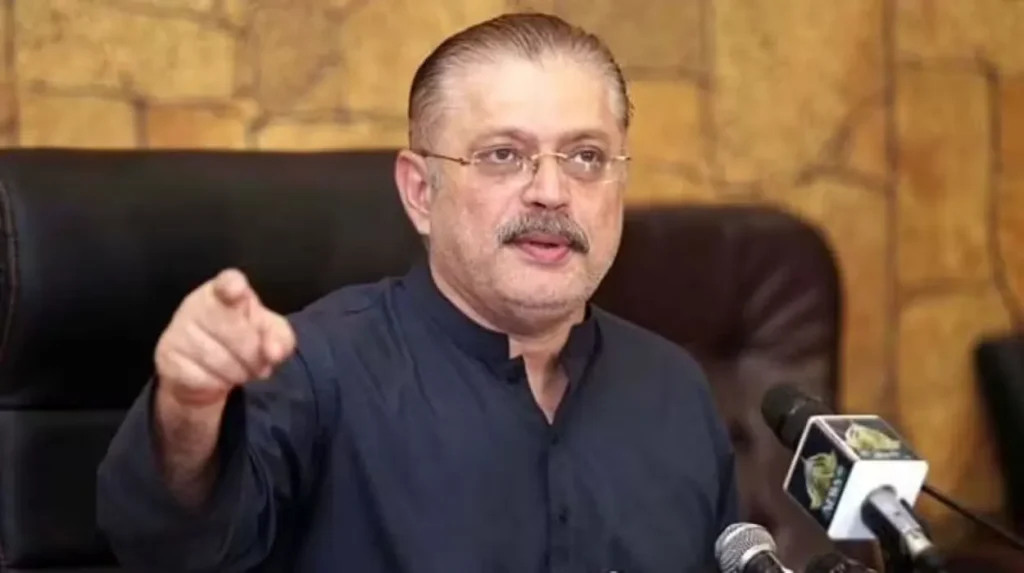
Sindh Senior Minister Sharjeel Inam Memon has rejected calls for holding a referendum on the creation of new provinces, maintaining that such an exercise cannot legally change provincial boundaries without following the constitutional procedure.
Speaking at a press conference in Karachi on Monday, Memon said the Constitution of Pakistan clearly defines the legal requirements for creating a new province by dividing an existing one.
He explained that any proposal to establish a separate province from Sindh would require approval from the Sindh Assembly through a two-thirds majority, as prescribed under the Constitution.
The provincial minister argued that political parties could organise referendums whenever they wanted, but the results would not have constitutional or legal authority to alter provincial boundaries.
Memon also pointed out that the Sindh Assembly had already expressed its position on proposals to create a new province from the existing territory of Sindh. He stressed that constitutional requirements must be respected instead of relying on political campaigns or public announcements.
Responding to recent statements by federal ministers about the creation of new provinces, Memon said everyone had the right to express their political opinions. However, he suggested that the matter would become clearer if the federal government formally introduced legislation in the National Assembly.
He also accused certain political groups of attempting to create ethnic and linguistic divisions in the province, warning that the Sindh government would oppose any efforts to spread hatred among different communities.
The minister’s remarks come amid renewed political debate over the possibility of creating additional administrative provinces in Pakistan, particularly proposals involving the division of existing provinces.
Under Article 239(4) of the Constitution, a constitutional amendment affecting the limits of a province cannot be presented to the president for assent unless it has been approved by the provincial assembly concerned through a two-thirds majority of its total membership.
Memon also addressed political activities planned in Karachi later this month, saying parties would need prior government permission to organise public rallies and gatherings.
He maintained that the provincial government supported peaceful political activities but would not allow organisers to disregard established rules or create situations that could disrupt public order.
Moving to the provincial government’s development initiatives, Memon provided an update on Sindh’s large-scale rehabilitation programme for families affected by devastating floods.
He said the provincial government had launched a housing reconstruction initiative worth more than $2 billion, describing it as one of the largest projects of its kind globally.
According to the minister, more than one million houses had already been completed, while construction work on another 700,000 homes was underway.
He also claimed that the programme had received recognition in the Guinness Book of World Records.
Memon said 42,565 Village Reconstruction Committees had been established to supervise housing development and rehabilitation activities. Women account for approximately 42 percent of the representation in these committees.
He further stated that flood protection and rehabilitation measures had provided protection to 2.51 million people, including 1.17 million women.
Providing details about infrastructure improvements, the minister said reconstruction work on 205 kilometres of protective embankments had been completed as part of the government’s flood resilience programme.
He added that 157,000 hectares of agricultural land across 12 districts had been restored for cultivation, helping affected communities resume farming activities and rebuild their livelihoods.
The protective embankment surrounding Manchhar Lake had also been reconstructed over a length of 30 kilometres to strengthen flood protection in the surrounding areas.
Memon also discussed progress on the modernisation of Sindh’s irrigation infrastructure, particularly the province’s major barrages.
He said all 44 gates of Sukkur Barrage had been replaced, while work on Guddu Barrage was continuing. So far, 54 of its total 65 gates had been replaced.
The provincial government aims to modernise and automate all barrages in Sindh, including Sukkur and Guddu, by 2027.
Another major development highlighted by the minister was the lining of 4,137 kilometres of canal distributaries across the province.
According to Memon, the work has helped save approximately 4,137 cusecs of water by reducing losses within the irrigation system.
The latest remarks highlight the Sindh government’s position on the politically sensitive question of creating new provinces, alongside its claims of progress in flood rehabilitation, housing reconstruction and irrigation infrastructure.
While Memon has firmly rejected the idea of using a referendum to redraw provincial boundaries, the debate is likely to continue as political parties discuss administrative reforms and the future structure of Pakistan’s provinces.
