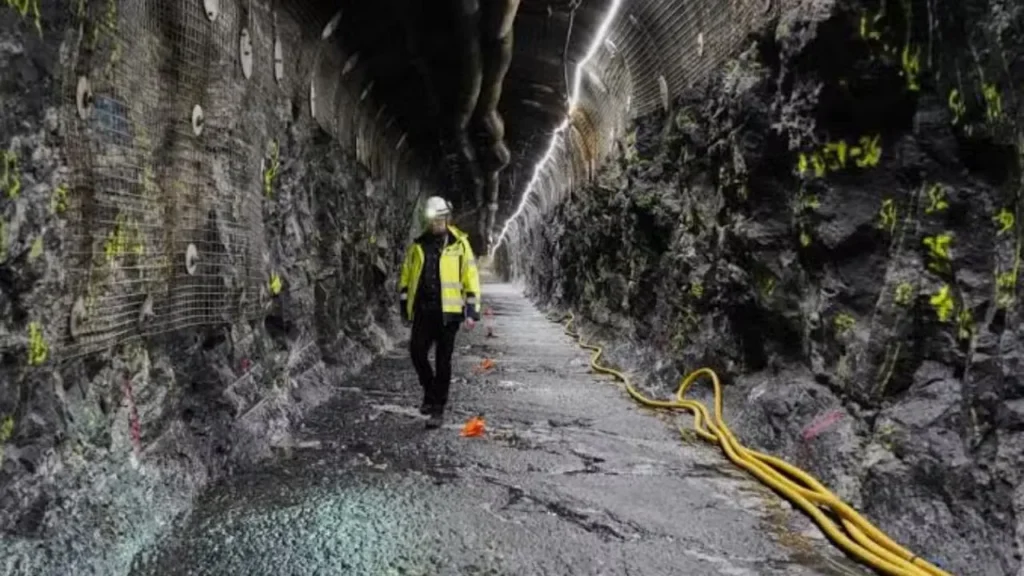
Finland has granted an operating licence for the world’s first permanent geological repository for spent nuclear fuel, marking a major milestone in the long-term management of radioactive waste.
The facility, known as Onkalo, is located in Eurajoki in southwestern Finland. Developed by nuclear waste management company Posiva, it is designed to isolate spent nuclear fuel deep underground, using engineered barriers and stable bedrock to contain radioactive material over thousands of years.
“This is a great and historic day for both Posiva and Finland,” Posiva Chief Executive Ilkka Poikolainen said in a statement.
Although the licence has been granted, final disposal operations will not begin immediately. Posiva must complete commissioning tests and inspections, while Finland’s Radiation and Nuclear Safety Authority (STUK) must verify that the facility meets the required safety standards.
How the Onkalo Nuclear Waste Repository Works
The Onkalo facility extends hundreds of metres below the surface into ancient bedrock. Its geological setting is intended to provide a stable environment for the long-term isolation of radioactive waste.
Under the disposal system, spent nuclear fuel will be sealed in specially designed copper canisters before being placed in holes drilled into underground tunnels. Bentonite clay will surround the canisters, providing an additional barrier against water movement, while the tunnels will eventually be backfilled and sealed.
The system combines natural geological protection with engineered containment measures to reduce the risk of radioactive material reaching the surrounding environment.
Spent nuclear fuel remains hazardous for extended periods after being removed from a reactor. Its radioactivity decreases over time, but safe disposal requires a facility designed to remain effective over geological timescales.
When Will Final Disposal Begin?
Posiva has not announced a confirmed date for the start of final disposal. The facility must first complete its commissioning phase, including technical tests and inspections.
STUK will assess the results and verify compliance with Finland’s nuclear safety requirements before disposal operations can proceed.
The operating licence is therefore an important regulatory milestone, but it does not mean that spent nuclear fuel is already being placed in the repository.
Capacity to Store Finland’s Spent Nuclear Fuel
Onkalo is designed to accommodate approximately 6,500 tonnes of uranium in spent nuclear fuel from Finland’s five nuclear reactors.
The project has taken decades of research, planning and construction to reach the licensing stage. Its development reflects Finland’s effort to establish a long-term solution for radioactive waste rather than relying indefinitely on temporary storage facilities.
According to Posiva, the disposal system is designed to isolate spent fuel for periods extending tens of thousands of years.
The company estimates that after about 100,000 years, the radioactivity of the material will have declined to roughly the level of the uranium ore from which the fuel was produced.
Other Countries Pursuing Underground Nuclear Waste Disposal
Many countries continue to store spent nuclear fuel in interim facilities while developing permanent disposal solutions. Finland’s progress is significant because deep geological repositories are technically complex and require extensive safety assessments, regulatory oversight and long-term planning.
Sweden and France are also developing geological disposal facilities, although their projects are at different stages.
Onkalo’s eventual operation will provide an important real-world case for evaluating how spent nuclear fuel can be isolated from people and the environment over extended periods.
The project’s estimated cost is approximately $1.16 billion. Its long-term performance will depend on the effectiveness of its containment system, continued regulatory oversight and compliance with safety requirements.
For official information about the project and its regulatory framework, readers can consult Posiva and Finland’s government website.
