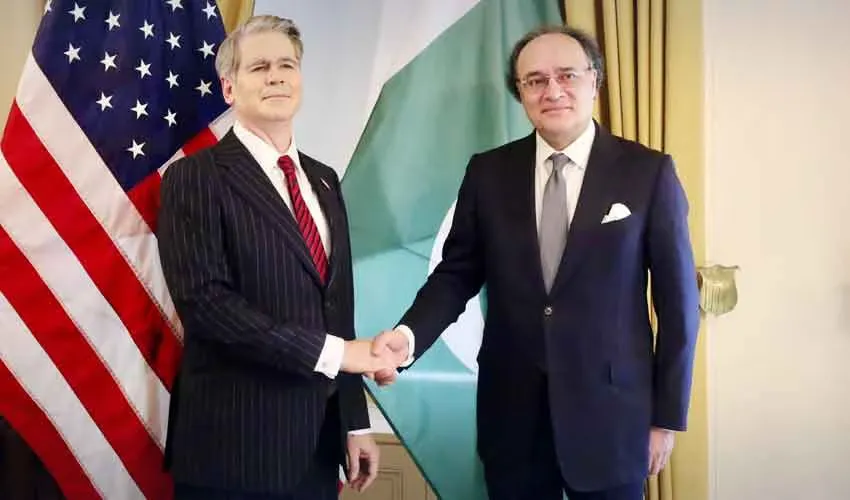
Pakistan has reportedly requested a $10 billion Exchange Stabilization Support Facility from the United States, seeking financial backing to strengthen its foreign exchange reserves, stabilize the rupee, and reduce dependence on multilateral lenders.
According to a source familiar with the matter, Islamabad submitted the request to US Treasury Secretary Scott Bessent as part of broader efforts to improve the country’s financial resilience amid ongoing economic challenges.
Pakistan Proposes Five-Year Financial Facility
Under the proposal, Pakistan is seeking a bilateral exchange stabilization facility worth $10 billion with a maturity period of up to five years.
If approved, the facility would provide additional dollar liquidity to Pakistan, help strengthen the country’s foreign exchange reserves, reduce pressure on the Pakistani rupee, and improve confidence in the economy.
The reported request follows Pakistan’s recent diplomatic engagement in facilitating talks related to the Iran conflict, which officials believe has strengthened Islamabad’s strategic relationship with Washington.
Finance Minister Raises Economic Concerns in Washington
During a meeting in Washington on Tuesday, Finance Minister Muhammad Aurangzeb met with US Treasury Secretary Scott Bessent and discussed Pakistan’s economic vulnerability to regional geopolitical developments.
According to Pakistan’s Finance Ministry, Aurangzeb sought greater US support for Pakistan’s return to international capital markets through stronger foreign exchange reserves, improved sovereign credit ratings, and enhanced market access.
The ministry said both sides reaffirmed their commitment to expanding bilateral economic cooperation, encouraging US investment, and advancing strategic projects.
Neither the ministry’s statement nor US officials publicly confirmed the reported request for the stabilization facility.
The US Treasury Department declined to comment, while Pakistan’s Finance Ministry did not immediately respond to media requests seeking clarification.
Pakistan Continues IMF-Backed Economic Reforms
Pakistan remains under a $7 billion International Monetary Fund (IMF) Extended Fund Facility, which requires the government to implement fiscal reforms, broaden the tax base, reduce public spending, and strengthen monetary discipline.
The country narrowly avoided sovereign default in 2023 after securing a $3 billion IMF Stand-By Arrangement, followed by the larger Extended Fund Facility and an additional $1.3 billion climate resilience loan.
Despite improvements in macroeconomic indicators, Pakistan continues to rely heavily on IMF disbursements, bilateral deposits, and financial support from countries including China, Saudi Arabia, and the United Arab Emirates.
Why the Facility Matters
Exchange stabilization facilities are relatively rare financial arrangements administered by the US Treasury’s Exchange Stabilization Fund.
Unlike permanent US Federal Reserve swap lines with major central banks, these facilities are designed to provide temporary liquidity support, helping countries stabilize foreign exchange reserves and maintain confidence in their currencies during periods of financial stress.
Financial analysts say such a facility would serve both as an important liquidity backstop and a strong signal of US confidence in Pakistan’s economic reform efforts.
Foreign Exchange Pressures Continue
Pakistan’s external position remains vulnerable despite ongoing reforms.
Earlier this year, the country repaid approximately $3.5 billion to the United Arab Emirates, equivalent to nearly one-fifth of its foreign exchange reserves, while receiving fresh financial support from Saudi Arabia to help maintain reserve levels.
The State Bank of Pakistan has projected that reserves could rise to around $20 billion by the end of 2026 if external financing and economic reforms continue as planned.
However, international ratings agency Fitch Ratings has warned that higher global energy prices, geopolitical uncertainty, and potential supply disruptions could place renewed pressure on Pakistan’s external accounts despite progress under the IMF program.
Expanding Economic Cooperation With the United States
The reported request comes as Pakistan seeks to deepen economic engagement with the United States beyond traditional financial assistance.
Recent cooperation has included discussions on cryptocurrency regulation, mining investment, and infrastructure development. Pakistan has also signed a stablecoin agreement for cross-border payments with an affiliate of World Liberty Financial, while pursuing redevelopment plans for the Roosevelt Hotel in New York and encouraging US investment in the Reko Diq copper and gold mining project.
If approved, the proposed exchange stabilization facility could provide Pakistan with additional financial flexibility, strengthen investor confidence, and support the country’s ongoing efforts to stabilize its economy while continuing reforms under the IMF program.
