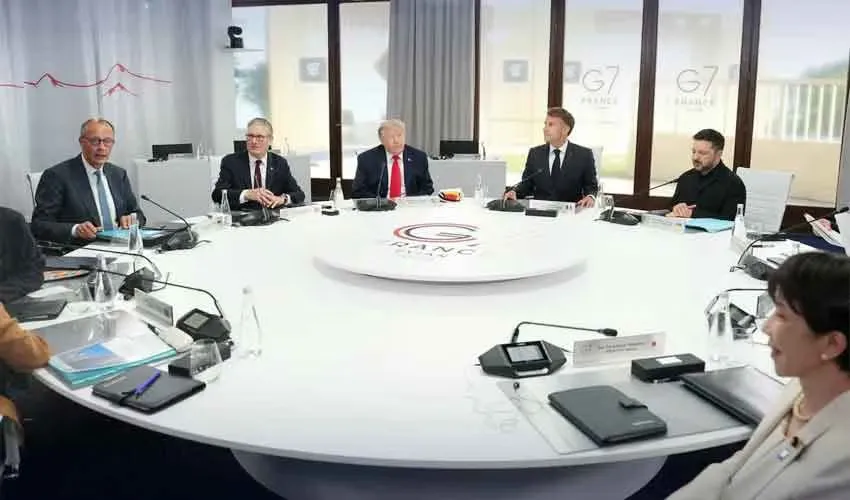
France is pressing fellow Group of Seven nations to endorse a joint statement on critical minerals, as Western economies seek to curb their dependence on China-dominated supply chains and protect investors from potential retaliation and market dumping, diplomats said.
The issue is expected to feature prominently on Wednesday, the final day of the June 15–17 G7 summit hosted by France in Evian-les-Bains. Securing access to strategic minerals has been a core priority of France’s G7 presidency, alongside broader discussions on global trade imbalances.
China sent shockwaves through global markets last year when export restrictions on rare-earth permanent magnets disrupted manufacturing across the energy, defence, and technology sectors. The episode underscored how deeply Western supply chains rely on materials largely controlled by Beijing.
“We are negotiating texts that are significant on critical minerals and, as a consequence, on economic sovereignty,” a French presidency official said ahead of the summit.
First Steps Toward Resilient Supply Chains
Diplomats familiar with the talks said the draft statement could include measures such as price-support mechanisms, market standards, subsidies, guaranteed purchases, and incentives to attract private investment into mining, processing, and recycling projects outside China.
However, officials cautioned that any commitments announced at the summit would likely mark initial steps rather than binding obligations, given the scale of investment required to build alternative supply chains.
China has spent decades establishing its dominance across rare earths and battery metals, making any rapid rebalancing difficult.
China’s Tightening Grip Raises Alarm
The proposed G7 action follows a series of export curbs imposed by Beijing in recent years. In 2025, China tightened restrictions on niche materials, adding to earlier limits affecting access to tungsten, antimony, and other strategic metals, particularly for U.S. companies.
Western governments are racing to secure offtake agreements from mines in Africa, Australia, and the Americas, while also expanding processing and recycling capacity. Industry experts warn it could take years before these efforts significantly reduce China’s market share.
The United States floated the idea of a critical minerals trading bloc in early 2026, but divisions remain over how such a framework would function, especially in light of Washington’s “America First” industrial policies.
Global Economic Imbalances in Focus
Beyond minerals, G7 leaders are also debating how to address global trade distortions and what France describes as “predatory competition,” largely attributed to China.
French officials have summarised the imbalance starkly: China produces too much, the United States consumes too much, and Europe invests too little.
European policymakers are increasingly concerned about what analysts call a “second China shock,” as Beijing moves from low-cost manufacturing into higher-value industries, contributing to record trade surpluses.
France’s President Emmanuel Macron sought to engage Beijing diplomatically ahead of the summit, hoping to ease tensions. China, however, has rejected EU allegations of unfair subsidies and warned of strong countermeasures against proposed “Buy European” rules and tighter technology sovereignty regulations.
EU Trade Defences Under Review
European Union leaders are set to continue the debate at a separate summit in Brussels on Thursday, where tougher and more systematic use of trade defence tools against surging Chinese imports will be discussed.
The EU recorded its largest-ever trade deficit with China, exceeding €360 billion last year.
“This is, of course, not sustainable,” said Ursula von der Leyen. “In Europe, our strategy is very clear: de-risk, not decouple.”
AI Also on the Agenda
G7 leaders will also turn their attention to artificial intelligence during a working lunch on Wednesday. Discussions are expected to cover the liability of AI systems, autonomous agents, and how algorithms present factual and misleading information.
Among those expected to attend are Sam Altman, head of OpenAI, and Dario Amodei, chief executive of Anthropic.
