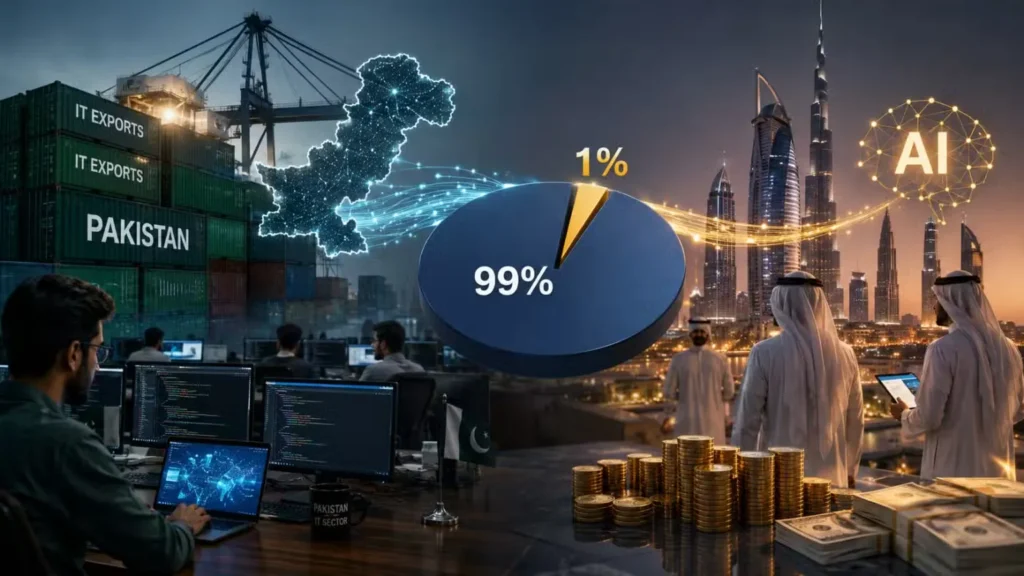
ISLAMABAD: Pakistan’s information technology exports continue to grow at a strong pace, but the country remains largely absent from the high-value global artificial intelligence consulting industry, according to a new private-sector analysis.
A report by Densight Labs says Gulf countries collectively spend more than $12 billion each year on AI consulting and implementation services. Pakistan, however, captures less than one percent of this market, despite having a large and expanding technology workforce.
According to the report, over 70 percent of Pakistan’s technology export earnings come from low- and mid-value activities such as outsourcing, conventional software development, and freelance services. In contrast, high-end AI consulting, data strategy, and enterprise AI implementation account for only a marginal share of total exports.
Industry experts argue that the shortfall is not due to a lack of technical talent. Instead, they point to the absence of internationally recognised certifications, weak institutional credibility, and the lack of government-backed standards that global clients require before awarding large AI contracts.
“The talent exists, but the trust frameworks do not,” the report notes, highlighting that international firms prefer vendors certified under globally recognised standards.
To address this gap, the proposal recommends the creation of a Pakistan AI Certification Standard (PACS). The framework would be aligned with international benchmarks set by organisations such as IEEE and ISO, enabling Pakistani firms to compete more effectively in global tenders.
According to projections cited in the report, implementing PACS could help Pakistan generate an additional $500 million in AI consulting exports by FY2028, provided it is supported by government endorsement and industry-wide adoption.
The report warns that without a strategic shift towards higher-value AI and data consulting services, Pakistan’s IT sector risks continuing to grow only in volume rather than value. This would limit export earnings despite rising global demand for advanced AI solutions.
Analysts say the findings carry important implications for policymakers as Pakistan seeks to move beyond traditional outsourcing and position itself as a competitive player in the global artificial intelligence economy.
The report calls for coordinated action involving regulators, export bodies, universities, and private firms to ensure Pakistan does not miss out on the next phase of growth in the global technology services market.
