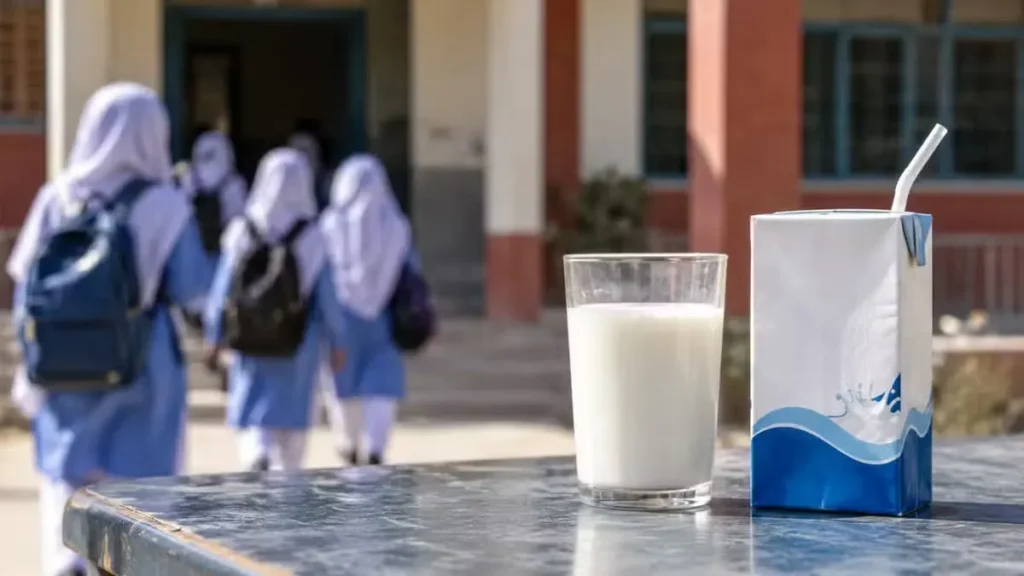
Eleven members of a family, including women and children, were hospitalized after falling ill following the consumption of milk reportedly distributed under the Punjab government’s Chief Minister’s Milk Program, according to Dawn.
The incident occurred in Khichiwala, where the family alleged that the milk had been brought home by a student from Government Girls Primary School (GGPS) 186/7-R.
According to a police report cited in the coverage, the family members became ill after consuming the milk and were taken to hospital in a semi-conscious condition.
However, the cause of their illness has not been independently established, and the allegation that the milk was contaminated remains unconfirmed.
The incident has raised concerns about food-safety monitoring under the school nutrition initiative, although education officials have said an initial inquiry found no problem with the milk’s quality.
Family Calls for Investigation Into Milk Quality
Abdul Sattar, one of the affected family members, said in a video circulating on social media that his daughter had brought the milk home from school. He claimed that several members of the family became ill after drinking tea prepared with the milk.
Sattar urged the authorities to determine whether the milk was contaminated or otherwise unsafe and to take action if any wrongdoing was established.
Also read: Pakistan Economic Survey 2025-26 Shows Broad-Based Growth in Livestock Sector
The family also alleged that officials from the education and health departments had not contacted them to arrange testing of the milk in their possession.
Laboratory testing of any remaining milk, together with medical assessments of the affected family members, could help establish whether the product was linked to the reported illness. Investigators would also need to examine the cartons’ handling, storage and distribution history.
Education Officials Report No Illness Among Students
A report issued by the Fort Abbas district education officer on October 21 stated that 132 of the school’s 155 enrolled students had consumed the milk without any reported illness.
The report also stated that 119,915 students across the district consume milk under the programme daily and that no food-poisoning cases had been reported through the scheme so far.
Chief Executive Officer (Education) Dr Attaur Rehman said an inquiry had found no issue with the milk’s quality. He added that the cartons held by the family carried an expiry date of January 12, 2027.
The absence of reported illness among students does not, by itself, establish what caused the family’s symptoms. Similarly, an unexpired date does not independently confirm that a product was safe when consumed. Storage conditions, packaging integrity and laboratory results may all be relevant to determining its condition.
School Nutrition Programme Faces Food-Safety Questions
The Punjab government’s CM School Meal Program aims to improve children’s nutrition, learning and school attendance by providing milk and other food items to eligible students in selected districts.
The programme’s background and objectives are also outlined by the Punjab Education Sector Reform Programme, which describes the School Meal Programme as an initiative of the provincial School Education Department.
While the programme is intended to support children’s health, the Khichiwala incident requires a separate investigation to establish whether the milk was responsible for the reported illness.
Food-safety monitoring is particularly important in programmes that distribute food to children on a large scale. Appropriate checks should cover product quality, transportation, storage and the handling of complaints about suspected foodborne illness.
The Punjab Food Authority provides information about the provincial food-safety regulator and its work on food standards and enforcement. Its involvement, where appropriate, could help determine whether the milk meets applicable safety requirements.
Testing Needed to Establish the Cause
The key unanswered question is whether the milk was linked to the family’s illness. Investigators would need to review the available product samples, medical findings and distribution records before reaching a conclusion.
If testing identifies a safety problem, the authorities would then need to determine whether it involved a particular batch, improper storage, contamination or another issue.
Until such evidence is available, the incident should be described as a reported illness following milk consumption rather than a confirmed case of milk contamination.
A transparent investigation would help address the family’s concerns and maintain public confidence in Punjab’s school nutrition programme.
