
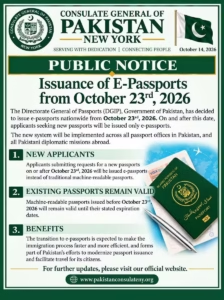
Pakistan has revised the start date for its nationwide e-passport rollout to October 23, 2026, with the Directorate General of Immigration and Passports (DGIP) planning to shift new passport applications to the electronic format.
The transition was initially scheduled for October 15. Public notices issued by Pakistani diplomatic missions abroad have announced the revised timetable, including a notice from the Consulate General of Pakistan in New York dated October 14.
For passport holders, the key point is that existing machine-readable passports will remain valid until their expiry dates. People with valid passports do not need to replace them simply because the government is introducing e-passports.
E-Passport Schedule Revised for Pakistan and Overseas Missions
Under the announced policy, passport offices across Pakistan are expected to issue e-passports for new applications from October 23.
Pakistan’s overseas missions have also begun communicating their transition arrangements. The Embassy of Pakistan in Doha, for example, has announced that it will start issuing e-passports on October 25 and continue issuing machine-readable passports until October 22.
The difference between the dates makes it important for overseas applicants to check the latest instructions from their respective embassy or consulate. The Doha schedule should not automatically be treated as the implementation date for every Pakistani mission abroad.
Applicants should consult the Directorate General of Immigration and Passports or their relevant diplomatic mission for the latest requirements, processing arrangements and applicable fees.
Do Existing Pakistani Passports Need to Be Replaced?
No immediate replacement is required under the policy described in the published notices. Machine-readable passports issued before the transition will remain valid until their stated expiry dates.
Travellers should continue to check the entry and passport-validity requirements of their destination countries, since some destinations require a passport to remain valid for a specified period beyond the intended stay.
People applying for a new passport after the transition date should confirm the application procedure and fee category with DGIP before submitting their documents.
What Changes With an E-Passport?
An electronic passport, commonly called an e-passport, contains a chip that stores the holder’s identity and biometric information. Border authorities can use this information as part of identity-verification and passport-authentication procedures.
The technology is designed to strengthen document security and support more efficient checks at international borders. However, an e-passport does not automatically guarantee visa-free entry, faster clearance at every airport or eligibility for automated gates. Those benefits depend on the rules and systems used by individual countries.
For Pakistan, the transition represents a change in the document issued to new applicants. Existing passport holders can continue using their valid machine-readable passports until expiry, while people applying for new documents should follow the latest instructions issued by the relevant passport office or diplomatic mission.
What Applicants Should Check Before Applying
Before submitting an application, applicants should verify the rollout date applicable to their location, the required documents, the current fee and the expected processing time.
This is particularly important for Pakistanis living abroad, as diplomatic missions may publish separate implementation schedules. Official DGIP and embassy notices should take precedence over older reports or social media posts.
The revised date establishes the announced timetable for the transition, but applicants should rely on the latest official guidance for location-specific details.
