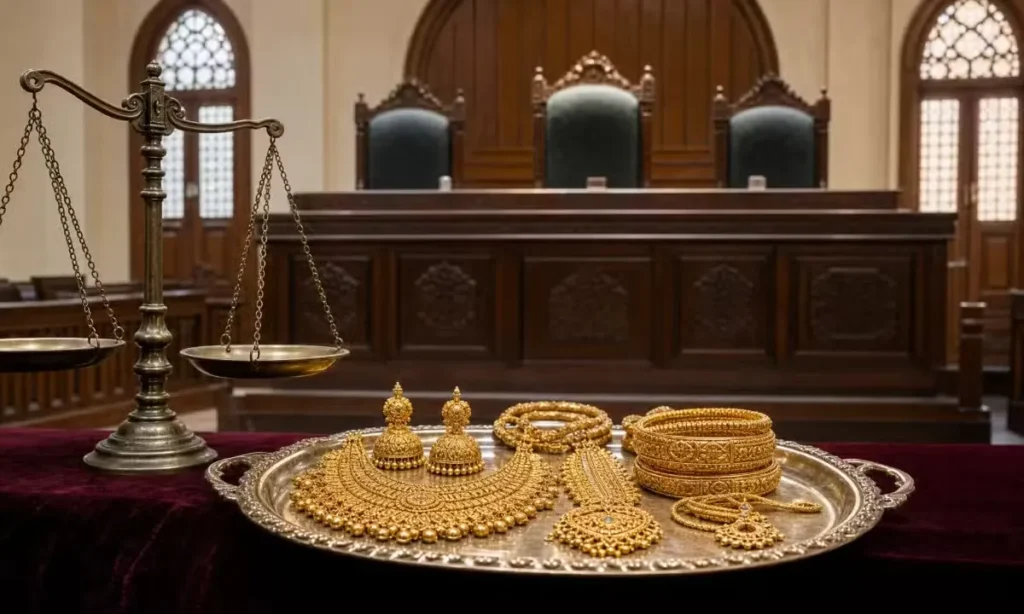
The Lahore High Court (LHC) has ruled that a husband cannot reclaim gold ornaments listed as dower in a Nikahnama as consideration for Khula if the ornaments were not actually paid for from his own resources.
Justice Raheel Kamran issued the ruling while deciding four connected petitions arising from a matrimonial dispute between Dr Rukhsana Kausar and Shahid Nazeer.
The petitions challenged findings of a Muzaffargarh sessions court concerning gold ornaments, maintenance, dowry articles and ownership of the couple’s matrimonial house.
LHC Clarifies Rules on Gold and Khula
The couple’s marriage was dissolved through Khula in 2012. The family court had initially held that the wife was required to return the dower received as Badl-i-Khula, while other disputes relating to maintenance, dowry articles, gold ornaments and delivery expenses remained pending.
In 2018, the family court partly decreed the case. It awarded maintenance, ordered the recovery of dowry articles and directed the wife to return 11 tolas of gold, or its monetary value, to the husband.
The appellate court upheld the findings in 2020, making only one modification by reducing the annual increase in the minor child’s maintenance from 15 percent to 10 percent.
Husband’s Financial Capacity Questioned
Justice Kamran upheld the lower courts’ findings regarding maintenance, noting that the husband had failed to provide his complete salary record.
Instead, he produced only a certificate showing his basic salary. The court held that the circumstances justified drawing an adverse inference regarding his actual earning capacity.
The judge also referred to testimony from the husband’s brother that Shahid Nazeer owned a Honda Civic.
Justice Kamran observed that a financially capable parent cannot understate his resources in an attempt to reduce his responsibility toward his child.
Matrimonial House Could Not Be Reclaimed
The LHC also upheld the finding concerning the ownership of the matrimonial house.
According to the judgment, the wife’s father, who was working abroad at the time, financed the entire purchase through documented banking transactions.
Bank officials corroborated the transactions, and their evidence remained largely unchallenged during cross-examination.
The court noted that although the house had been included in the dower, the husband had never actually paid for it.
Therefore, Justice Kamran held that the husband could not seek its return as Badl-i-Khula.
The court also upheld the wife’s subsequent transfer of the property to her father and the decree granting him possession.
LHC Rejects Husband’s Claim for 11 Tolas of Gold
The court separately examined the husband’s claim for 11 tolas of gold.
Justice Kamran held that the lower courts had placed too much emphasis on the absence of documentary evidence while failing to properly consider the surrounding circumstances.
Given the husband’s established financial circumstances, the judge found it more likely that the gold had also been financed by the wife’s father.
The court consequently ruled that the husband could not demand the return of the ornaments as Badl-i-Khula because the gold had not been dower paid from his own resources.
Wife’s Claim for Dowry Gold Also Rejected
The court, however, upheld the findings against the wife concerning 22 tolas of dowry gold.
Justice Kamran noted that she had not claimed that the jewelry had been forcibly taken from her.
Her inconsistent statements regarding when she left the matrimonial home, coupled with her refusal to produce a video from her sister’s wedding showing her wearing jewelry after leaving her husband’s home, also contributed to the adverse inference against her.
The LHC further upheld the dismissal of her claim for Rs63,000 in maternity and delivery expenses.
What the LHC Ruling Means
The judgment highlights an important distinction in matrimonial disputes: simply listing an asset as dower in a Nikahnama does not necessarily establish that the husband personally paid for it.
In this case, the court examined the evidence surrounding the actual source of funds before deciding whether the husband could recover the gold or property as Badl-i-Khula.
The ruling also reinforces that courts can consider a party’s financial circumstances, documentary evidence and surrounding facts when determining maintenance and ownership disputes.
