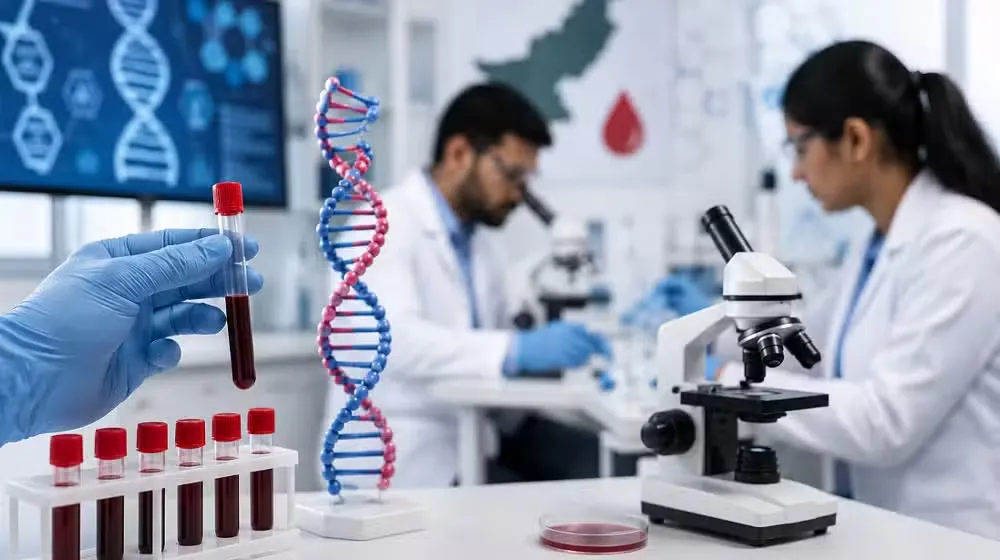
Researchers at the University of Health Sciences (UHS) are making notable progress in developing a next-generation gene-editing therapy for beta-thalassemia, a serious inherited blood disorder affecting thousands of families across Pakistan.
The study is being led under the supervision of Dr. Mahmood Saba at the Department of Human Genetics and Molecular Biology. Scientists at UHS are focusing on an advanced technique known as multiplex prime editing, a highly precise form of gene editing designed to modify DNA sequences with improved accuracy and reduced risk of unintended changes.
Breakthrough Focus on Fetal Hemoglobin Activation
A key aspect of the research involves targeting the gamma-globin gene, which is responsible for the production of fetal hemoglobin.
Researchers believe that reactivating fetal hemoglobin in patients with beta-thalassemia could help compensate for defective adult hemoglobin production.
This biological mechanism may significantly reduce the severity of symptoms, offering a potential alternative pathway to manage the disease beyond conventional treatments.
The university highlighted that this work represents an important early-stage development in gene-based therapies for blood disorders, potentially paving the way for reduced dependence on lifelong blood transfusions.
Understanding Beta-Thalassemia Burden in Pakistan
Beta-thalassemia is a genetic blood disorder caused by mutations in the beta-globin gene, leading to chronic anemia and long-term health complications. Patients often require frequent blood transfusions, iron chelation therapy, and continuous medical monitoring.
Also read: Punjab makes genetic testing mandatory for student admissions under new law
According to data shared by UHS, approximately 100,000 individuals in Pakistan live with beta-thalassemia major, while between 5,000 and 9,000 children are born with the condition each year, placing a significant burden on the healthcare system.
Toward Future Gene-Based Treatments
While the research is still in its developmental stage, experts view multiplex prime editing as a promising tool in the future of precision medicine and genetic disorder treatment. If successful, it could mark a shift from symptom management to targeted genetic correction for inherited blood diseases.
UHS officials emphasized that continued research and clinical validation will be required before the technique can move toward human application, but the early findings offer strong scientific potential for future therapeutic breakthroughs.
About Tamoor Ahmed

Tamoor Ahmad has been covering politics since 2022.
