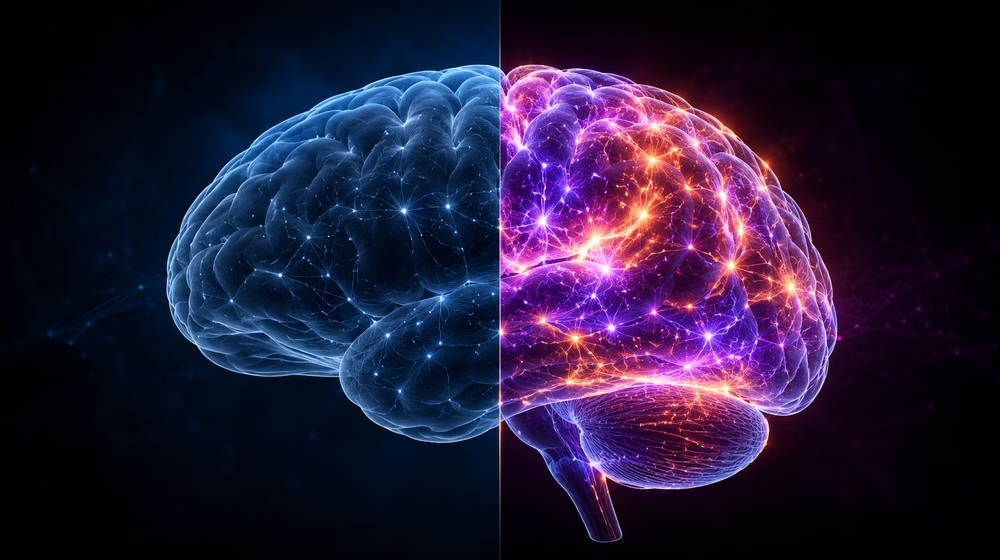
A new study from Rutgers Health has found that the human brain integrates fast and slow information processing through its white matter communication networks, offering new insight into how cognition and behavior are shaped.
Published in Nature Communications, the research examined how the brain manages information streams that operate across different timescales. Scientists said this coordination is essential for thinking, decision-making, and adapting to changing environments.
The study suggests that the organisation of neural timescales across the cortex plays a key role in how efficiently the brain shifts between large-scale activity patterns linked to behavior.
Brain timing patterns differ between individuals
Researchers also found clear differences between individuals. According to Professor Linden Parkes, people whose brain connectivity is better aligned with how regions process fast and slow information tend to show stronger cognitive performance.
The team analysed data from 960 participants, using advanced brain imaging techniques. They created detailed brain connection maps known as connectomes and applied mathematical models to track how information moves across neural pathways.
And the findings went beyond human data. Similar patterns were also observed in mice, suggesting that these mechanisms may exist across multiple species.
What are intrinsic neural timescales
Scientists refer to these patterns as intrinsic neural timescales (INTs). These describe how different brain regions are tuned to process information over varying periods of time, from rapid reactions to slower integration.
So, rather than working in isolation, brain regions appear to coordinate through timing-based communication supported by white matter networks.
Professor Parkes, who is also part of the Rutgers Brain Health Institute, said the study directly links local processing in brain regions with how information is shared across the brain to support behavior.
Next step: mental health research
Researchers are now extending this work to study neuropsychiatric conditions such as schizophrenia, bipolar disorder, and depression.
But they say more research is needed to understand how disruptions in brain connectivity may affect the brain’s ability to process information over time and influence mental health outcomes.
About Tamoor Ahmed

Tamoor Ahmad has been covering politics since 2022.
